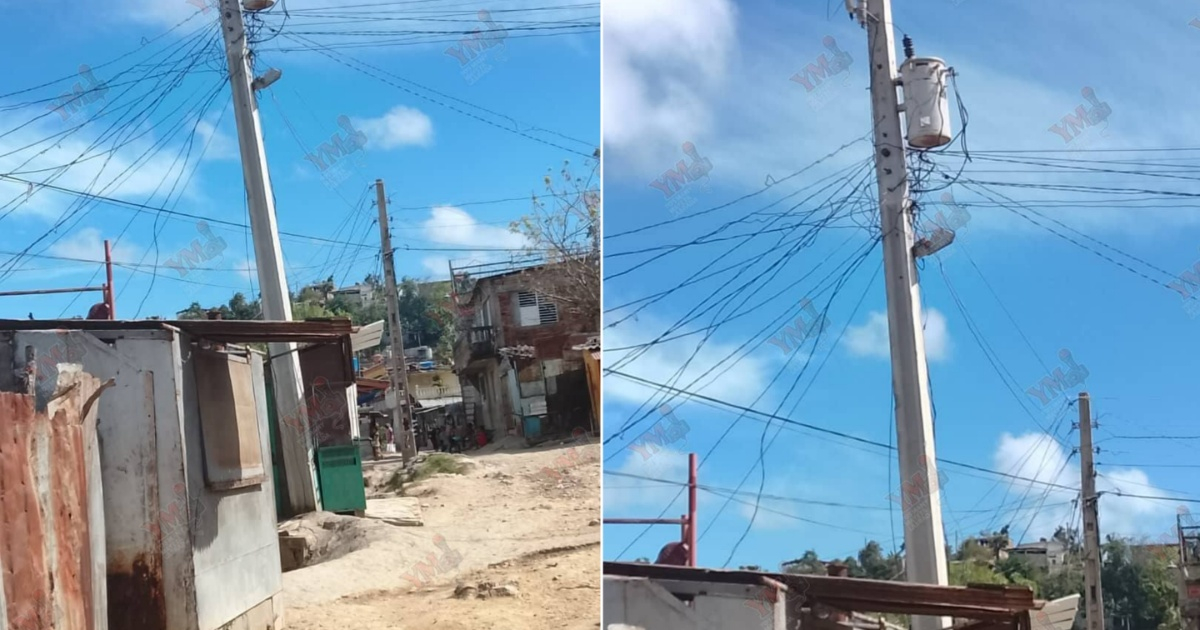
In La Posita, part of the Altamira neighborhood in Santiago de Cuba, locals are reporting more than three days without electricity. This prolonged outage is occurring amidst unbearable heat, and the Electric Company has yet to provide an effective resolution.
"I am at my wit's end. My baby, just four months old, cries constantly because of the heat. It's impossible to sleep or live like this. My food has spoiled, and no one is offering a solution," a distressed mother from the area shared with journalist Yosmany Mayeta Labrada.
According to the independent journalist, residents have repeatedly reached out to the electric company, only to receive the unhelpful response that "the report has been sent to dispatch," leaving them waiting indefinitely for the issue to be resolved.
The situation highlights the ongoing neglect endured by many neighborhoods in Santiago, where power outages have escalated from being a mere inconvenience to a humanitarian crisis, particularly affecting families with young children, the elderly, and other vulnerable groups, Mayeta Labrada noted.
"The community demands immediate action, as enduring over 72 hours without electricity in such conditions is an intolerable punishment," he concluded.
Authorities in Santiago de Cuba describe an electrical crisis characterized by breakdowns and maintenance issues, with power rotations through four blocks and limited service times ranging from 3 to 6 hours depending on available capacity. They also warn of reduced photovoltaic support if weather conditions worsen.
These warnings come after a previous day marked by 24-hour disruptions nationwide and a forecast of significant deficits during peak hours.
According to the National Electric System's (SEN) Information Note on Saturday, January 31, 2026, the previous day's peak shortfall due to generation capacity deficit reached 1916 MW at 6:20 PM.
On the morning of the 31st, the available capacity at 6:00 AM was 1160 MW against a demand of 1995 MW, with 830 MW affected. By noon, an impact of 1150 MW was anticipated.
The report identifies major incidents affecting several thermoelectric units: Unit 5 at the Mariel Power Plant, Unit 5 at Nuevitas, Unit 2 at the Felton Power Plant, and Units 3 and 6 at the Antonio Maceo Power Plant.
Maintenance work is ongoing at Unit 3 of the Santa Cruz Power Plant, Unit 4 of the Carlos Manuel de Céspedes Power Plant (Cienfuegos), and the Antonio Guiteras Power Plant.
Thermal generation limitations account for 366 MW being out of service. Additionally, the morning of the 31st saw the Ernesto Guevara de la Serna Power Plant's Unit 2 offline due to a turbine regulation system failure.
The forecast for peak demand is a maximum of 3040 MW with an available capacity of 1160 MW, resulting in a projected deficit of 1880 MW; if these conditions persist, a 1910 MW impact is anticipated during peak hours.
Understanding the Power Crisis in Santiago de Cuba
What is causing the power outages in Santiago de Cuba?
The outages are primarily due to breakdowns and necessary maintenance in several thermoelectric units, coupled with insufficient generation capacity to meet demand, especially during peak hours.
How are residents coping with the prolonged lack of electricity?
Residents, particularly families with young children and the elderly, are struggling with the intense heat and lack of refrigeration, leading to food spoilage and significant discomfort.
What measures are being taken to resolve the power crisis?
Authorities are conducting maintenance and repairs on various power units. However, the resolution remains slow, with limited service hours and a rotating schedule to manage the available capacity.