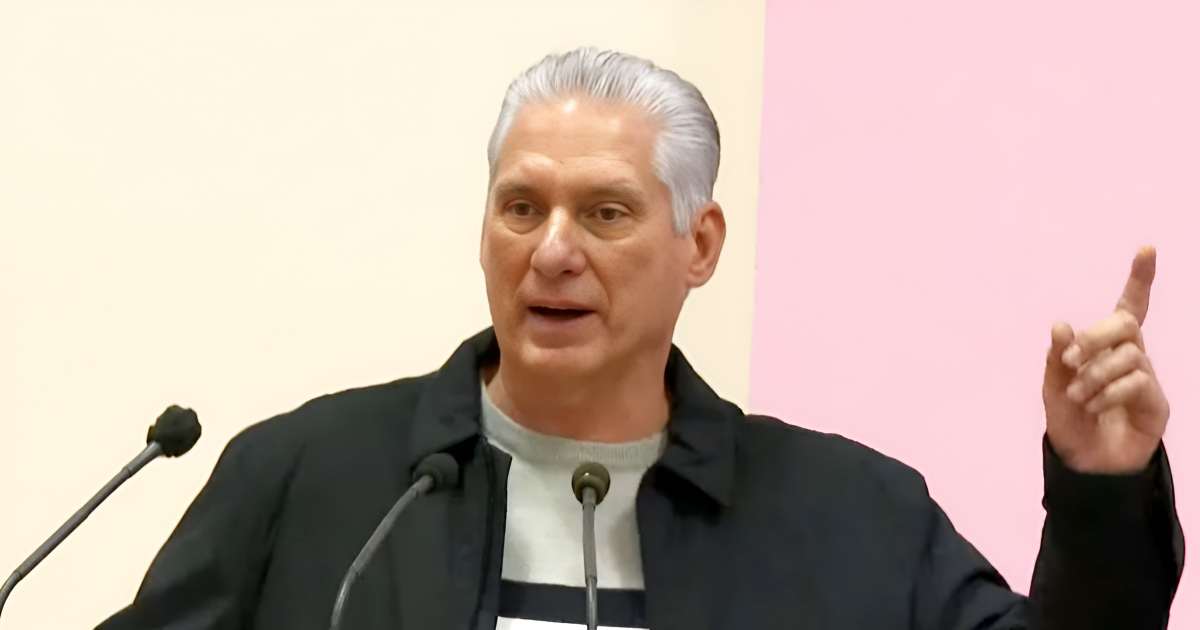
During a recent session of the Communist Party (PCC) in Havana, Miguel Díaz-Canel once again invoked a frequently repeated and often criticized official narrative: the idea that "in 65 years, Cuba has achieved social outcomes that the United States has not." This statement, made amidst official acknowledgment of the country's urban, healthcare, and energy crisis, not only highlighted the leader's disconnect from reality but also the regime's attempt to portray the national collapse as a supposed moral high ground over Washington.
Díaz-Canel used this comparison as a rhetorical shield against the visible decline of the socialist system. While transportation, housing, healthcare, and the economy show signs of irreversible breakdown, the first secretary of the PCC resorted to the old argument of "social achievements" to uphold the narrative of resistance against the "empire."
Mentioning the United States was no accident; whenever the internal crisis reaches levels that cannot be concealed, the state-controlled media responds with an ideological pivot aimed at re-establishing the external confrontation narrative. In this instance, the reference to Cuba's "alternative model" served to deflect attention from the shortages, blackouts, inflation, or mass exodus. The so-called "social results" presented by the leader—lacking figures, evidence, and context—aim to sustain the idea of a heroic Cuba, blocked but morally superior.
However, the stark contrast with reality is overwhelming: hospitals without supplies, crumbling schools, entire neighborhoods without water or electricity, and a population surviving on lines, bartering, and remittances. The comparison with the United States functions more as a strategic distraction than a political argument, aimed at both the Party's base and international public opinion.
As institutions crumble, the official discourse insists on measuring internal failure with an external yardstick, as if the daily deterioration of the island could be relativized by evoking the flaws of another country. In truth, Díaz-Canel's assertion confirms the exhaustion of rhetoric that no longer even convinces its followers.
When those in power resort to impossible comparisons, what they attempt to hide is not an ideological difference but a void of results. And that void—economic, political, and moral—defines Cuba in 2026 more than any foreign adversary.
The Myth of Socialist Achievements vs. Reality
Díaz-Canel's speech, which aims to place Cuba above the United States in "social results," crumbles against the most basic international data. According to the United Nations Development Program (UNDP), the Human Development Index (HDI) ranks the United States at 20th (0.927) and Cuba at 97th (0.764).
While the island nears the U.S. in life expectancy, it falls behind in years of schooling and educational attainment. In terms of gender equality, the contrast is also telling: Cuba boasts a high female representation in Parliament—over 55%—but the Gender Inequality Index (GII) places it below the United States, with greater gaps in opportunities and real participation.
The disparity becomes glaring when examining indicators of freedom and civil rights. According to Freedom House, the United States is a "Free" country, scoring 83/100 points, whereas Cuba barely reaches 12/100, classified as "Not Free." In the Press Freedom Index by Reporters Without Borders (RSF), the island ranks among the 15 worst countries in the world (165/180), compared to the U.S.'s 57/180.
The regime's insistence on these comparisons seeks not to inform but to fabricate an illusion of moral superiority that justifies the current economic and social collapse. In a country where hospitals lack antibiotics, blackouts paralyze daily life, and emigration reaches record numbers, the rhetoric of "social conquests" acts as an ideological sedative for an exhausted population.
Since the days of dictator Fidel Castro, the narrative of the so-called "revolution" has been upheld by the belief that "suffering in the name of justice" grants political legitimacy. Today, Díaz-Canel attempts to reignite that narrative in the face of a situation that no longer admits excuses: structural poverty, the collapse of public services, and the total loss of trust in institutions.
The recourse to comparison with the United States serves two functions: keeping the "external enemy" narrative alive and diverting attention from internal failure. In a context of total crisis—economic, energy, healthcare, and moral—the regime appeals to the nostalgia of a mythologized past that no longer withstands scrutiny.
The gap between real data and propaganda not only reveals systematic manipulation but also signifies political weakness: when a government needs to compare itself to its historical adversary to justify its survival, it is because it has lost the ability to produce its own results.
Key Questions on Cuba's Social Achievements
How does Cuba's Human Development Index compare to that of the United States?
Cuba ranks 97th with a score of 0.764 on the Human Development Index, while the United States ranks 20th with a score of 0.927.
What are the discrepancies between Cuba and the U.S. in terms of freedom and civil rights?
According to Freedom House, the United States is classified as "Free" with a score of 83/100, while Cuba is "Not Free," scoring only 12/100. In press freedom, Cuba ranks among the 15 worst globally.
Why does the Cuban government compare its social achievements to those of the United States?
The comparison serves as a strategic distraction to uphold an illusion of moral superiority and justify the nation's current economic and social predicament.