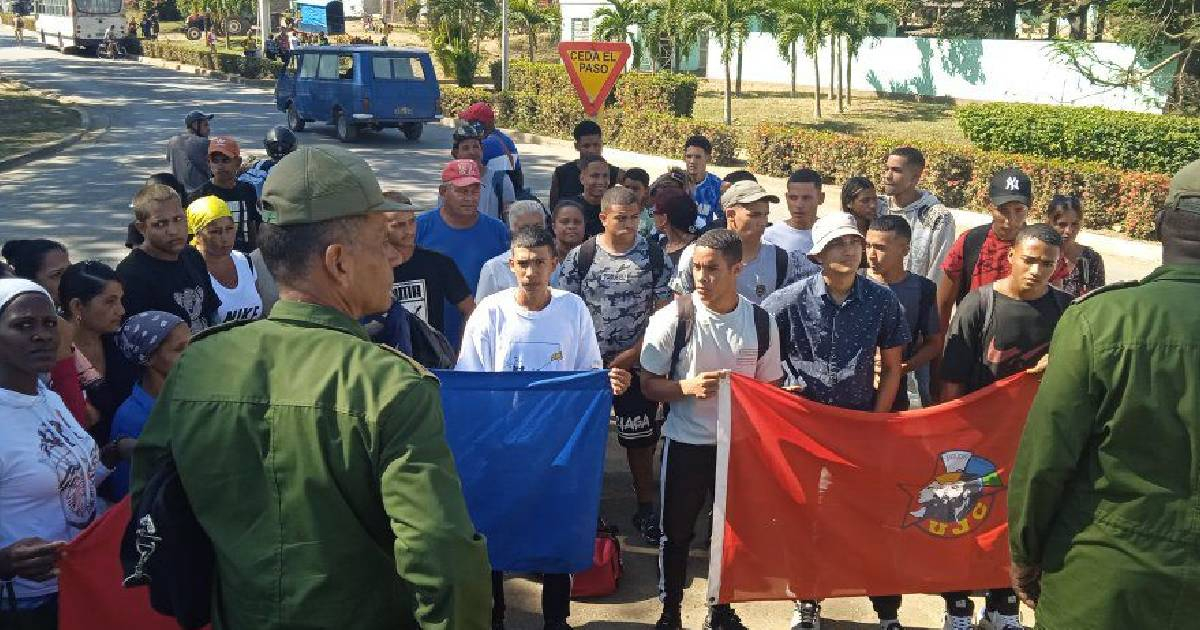
Families from eastern Cuba are voicing their frustration over the abrupt transfer of young recruits to Havana without prior notice or subsequent communication. This institutional silence has further heightened their anxiety and skepticism towards the Compulsory Military Service (CMS).
In various eastern regions, particularly in the Santiago municipality of Segundo Frente, relatives of young individuals enrolled in the Compulsory Military Service report being unaware of their whereabouts and the conditions under which they were moved to the capital recently. Independent journalist Yosmany Mayeta highlighted this issue on his Facebook profile.
According to testimonies shared on social media and relayed by Mayeta, the recruits were taken from their communities without clear explanations, without prior preparation, and in some instances, without basic clothing or personal items.
Days following the transfer, families claim they have not received any official information regarding their destinations or current status.
“Every time we ask, we get a different answer. No one provides a concrete response,” wrote one user who claims to have no news of her son for four days.
Other family members recount being told their loved ones were headed to nearby destinations, only to later discover they had been sent to the capital, describing this as deceitful and disrespectful.
Many comments agree that the military authorities have consistently maintained silence. Mothers and partners note the absence of a clear communication channel or any entity taking responsibility in front of the families after the recruits' departure.
Social media reactions indicate that the discontent extends beyond just a single transfer, linking it to a deep-seated distrust towards the CMS.
Several comments highlight the prolonged absence of basic information, the contradictory stories given to families, and the treatment they describe as haphazard and dismissive.
For some users, the issue is not just the current silence but the normalization of opacity, where inquiries about a child are perceived as acts of "hostility" or "provocation."
Other comments situate recruitment within a broader framework of social inequality. They point out that the burden of obligatory service repeatedly falls on the most vulnerable sectors, while the children of officials and leaders are often exempt or have access to other opportunities.
The memory of past experiences, from everyday mistreatment to the participation of young people from the east in foreign military missions, serves as the backdrop for a deeper critique: the perception that the compulsory army acts as a mechanism of social punishment, delaying life plans and exposing youths to precarious conditions without real benefits or institutional protection.
Meanwhile, official pages and profiles on social media, along with journalist Idalberto Aguilar Macías, have shared images depicting the recruits' departures from Segundo Frente as organized and patriotic events, accompanied by slogans and banners from the Party and the UJC.
The stark contrast between this triumphant narrative and the reality described by families has intensified the outrage.
In addition, Mayeta mentioned the circulation of a document addressed to the Eastern General Staff and the Ministry of the Armed Forces questioning the current recruitment model.
The document criticizes the treatment of young people as mere numbers to meet quotas, without considering their family context or social vulnerability, and denounces abuses against those lacking resources or influence to protest.
The text warns that a recruitment process driven by pressure, improvisation, and silence erodes the moral legitimacy of military institutions and inflicts deep harm on affected families.
In the absence of official responses, families are demanding immediate information and transparency regarding the situation of the transferred youths.
For many, their concern remains undiminished and is summed up in a single question that, so far, remains unanswered.
Key Concerns About Youth Recruitment in Cuba
Why are families in Santiago de Cuba concerned about the transfer of young recruits?
Families are worried due to the lack of transparency and communication about the whereabouts and conditions of their young relatives who were suddenly transferred to Havana without prior notice.
What criticisms have been raised against the current recruitment process?
Critics argue that the recruitment process is opaque, treating young people as numbers to fulfill quotas without considering their family or social situations, leading to a loss of trust in military institutions.
How has the issue been portrayed in official media?
Official media have depicted the recruits' departures as patriotic and organized events, which contrasts sharply with the accounts of families who describe a lack of communication and respect.