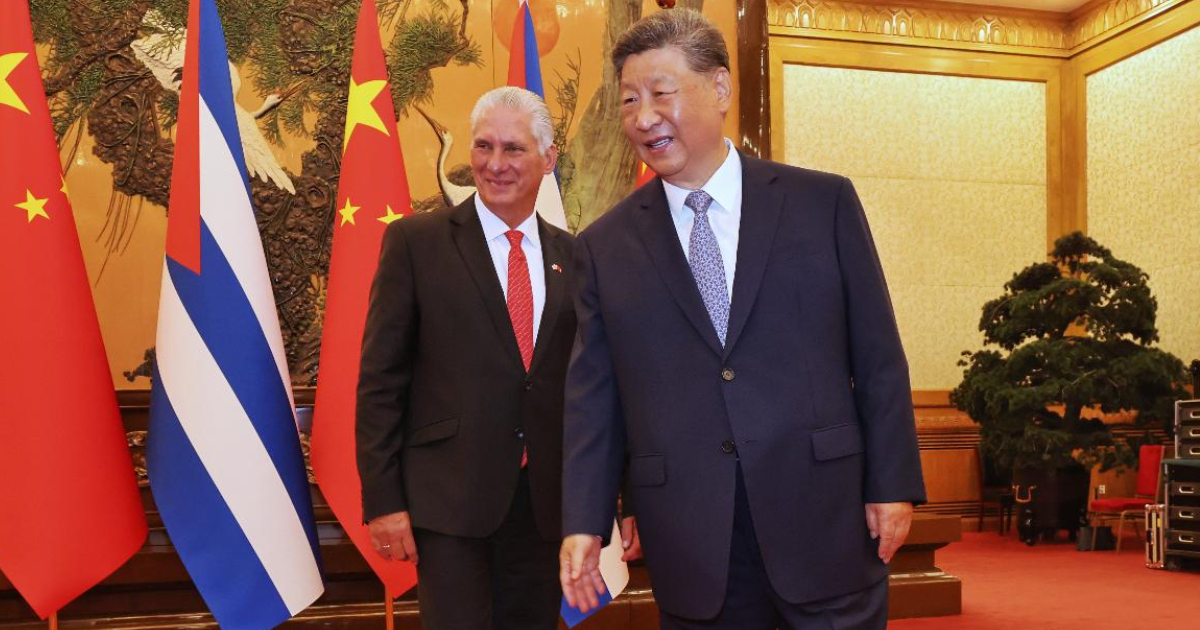
In a strong defense of Havana, China criticized the recent measures announced by U.S. President Donald Trump aimed at countries supplying oil to Cuba. On Friday, China's Ministry of Foreign Affairs spokesperson, Guo Jiakun, labeled the actions as "inhumane" for their intent to heighten economic pressure on the island.
According to Russia Today, Guo stated that Beijing "strongly supports Cuba in defending its national sovereignty and security," directly responding to Trump's decree signed on January 29.
Trump previously declared a "national emergency," claiming that the Cuban situation posed an "unusual and extraordinary threat" to U.S. security and foreign policy. Following this, Washington established a framework for imposing an additional "ad valorem" tariff on imports from any nation that directly or indirectly supplies oil to Cuba.
Guo emphasized China's firm opposition to any attempts to deprive the Cuban people of their right to survival and development. He reiterated Beijing's longstanding opposition to the "blockade," unilateral sanctions, and all forms of coercion against Havana, a stance China has maintained in international forums for years.
U.S. Strategy to Isolate Cuba
The executive order by Trump aims to cut off one of the Cuban regime's primary economic lifelines: the external oil supply. The U.S. seeks to prevent Cuba from obtaining crude oil and financial resources, particularly from allies like Venezuela, whose energy support has significantly dwindled following Maduro's capture on January 3.
Currently, Cuba is in a state of severe fragility, marked by prolonged blackouts, halted production, and an almost complete reliance on imported oil. In this scenario, the U.S. intends to block the last survival route for Cuba's energy system following the loss of Caracas' backing.
This move aligns with a broader strategy disclosed by The Wall Street Journal, which asserts that the White House is actively working to instigate a regime change in Cuba by 2026, leveraging what U.S. officials describe as a "historic window of opportunity." President Trump himself has been candid about the situation: "Cuba seems on the brink of collapse. I don't know how they will sustain themselves," he commented recently.
China's Continued Support for Cuba
Prior to Trump's announcement, the Chinese government had already reaffirmed its political support for Havana and urged the United States to lift the sanctions and embargo. Guo Jiakun declared that China would continue providing support and assistance to Cuba "within its capabilities," expressing confidence that the Cuban people would overcome their challenges under the leadership of the Communist Party and the island's government.
Beijing accused Washington of "violating international law" and depriving the Cuban people of their right to survival and development, further undermining regional peace and stability. On January 20, Chinese President Xi Jinping approved a new round of aid to the island, including $80 million in emergency financial assistance and a donation of 60,000 tons of rice.
China's stance is in line with Russia, another ally of the Cuban regime, which has offered loans, food, and technology in exchange for geopolitical influence in the Caribbean. Moscow has labeled reports of a potential U.S. plan to impose a total naval blockade on Cuba as "alarming" and assured that the U.S. cannot replicate the Venezuelan scenario on the island.
Russia's permanent representative to the UN, Vasili Nebenzia, stated that the U.S. would not succeed in Cuba as it did in Venezuela, where it launched a military assault and captured Nicolás Maduro. "In Cuba, that won't work. I think, despite the rhetoric the Americans have been using lately regarding Cuba, for now, it's just rhetoric. Because in Cuba, it won't be easy if they want to repeat something similar to what happened in Venezuela," the high-ranking diplomat noted, as reported by Russia Today.
Impact of U.S. Tariffs on Cuba
What are the recent actions taken by the U.S. against Cuba?
The U.S. implemented additional tariffs on imports from countries that supply oil to Cuba, part of a broader strategy to cut off Cuba's external oil supply and financial resources.
How has China responded to the U.S. measures against Cuba?
China has strongly opposed the U.S. measures, labeling them as "inhumane" and reiterating its support for Cuba in defending its national sovereignty and security.
What type of aid has China provided to Cuba recently?
China has approved $80 million in emergency financial assistance and a donation of 60,000 tons of rice to Cuba.