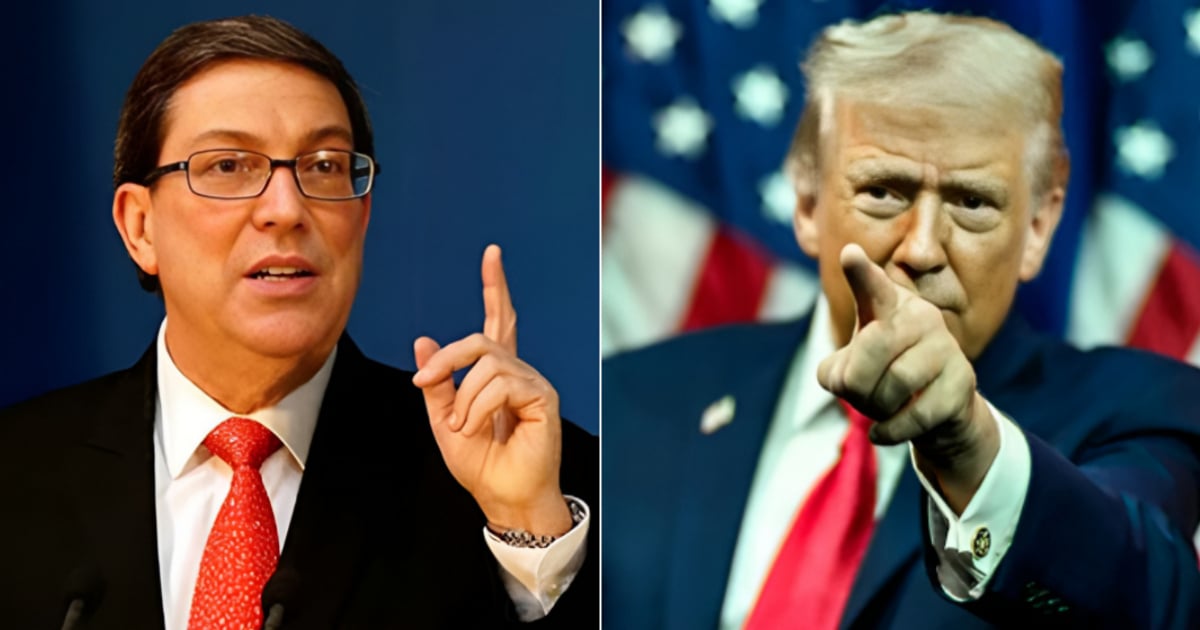
The Cuban regime's Foreign Minister, Bruno Rodríguez Parrilla, announced on Friday an "international emergency" following an executive order issued Thursday by U.S. President Donald Trump. This order aims to halt oil supplies to the island by imposing tariff sanctions on third countries.
Rodríguez described Trump's administration as an "unusual and extraordinary threat" stemming "entirely or substantially from the anti-Cuban neofascist right," in a statement shared on social media platform X and on the Ministry of Foreign Affairs' website.
The statement, attributed to "the people of Cuba, with the solidarity of the international community," asserts that the situation with the U.S. government jeopardizes national security, the foreign policy of all nations, international peace, and humanity's survival in the face of nuclear and climate threats.
Thus, it "declares an international emergency concerning this threat."
Rodríguez previously warned that the White House's narrative portrays Cuba as a "destabilizing actor" in the region, while asserting that it is the U.S. that fosters instability by relying on "a long list of lies" to present Cuba as a menace.
He also accused Washington of diplomatic pressure to isolate Cuba, using "blackmail and coercion" against other nations, threatening them with tariffs in violation of free trade norms.
Trump's order declares a "national emergency" over the "unusual and extraordinary threat" posed by Cuban policies to U.S. security and foreign policy, accusing Havana of collaborating with "malicious actors" like Russia, China, Iran, Hamas, and Hezbollah.
Cuba is accused of hosting adversaries, facilitating Russian and Chinese intelligence, providing refuge to terrorists, destabilizing the region through migration and violence, and systematically violating human rights.
The directive empowers the Secretaries of Commerce and State to impose tariffs on countries that sell or supply oil to Cuba, as part of a strategy to trigger the regime's collapse, according to sources cited in the document.
Trump has recently stated that "Cuba appears to be on the verge of collapse" due to its energy crisis, marked by daily blackouts and fuel shortages.
Cuban-American Congressman Carlos Giménez responded to Rodríguez on X: "Bruno, you still have time to return to your birthplace in Mexico. President Trump doesn't play games. He keeps his word. Your time is running out. This is until the end." As of this article's publication, Cuban President Miguel Díaz-Canel has not publicly reacted to the announcement.
This offensive is set within a "historic window of opportunity" following the collapse of Venezuelan support and the capture of Nicolás Maduro. "The United States has zero tolerance for the depredations of the Cuban communist regime," the executive order warns.
Key Questions About U.S.-Cuba Relations
What is the main reason behind Trump's executive order against Cuba?
Trump's executive order is primarily aimed at blocking oil supplies to Cuba by imposing tariff sanctions on countries that sell or supply oil to the island, which is part of a broader strategy to pressure the Cuban regime.
How has the Cuban government responded to the U.S. sanctions?
The Cuban government, represented by Foreign Minister Bruno Rodríguez, has declared an "international emergency" and criticized the Trump administration as a threat, accusing it of destabilizing the region and isolating Cuba through coercive measures.
What are the alleged threats posed by Cuba according to the U.S.?
The U.S. alleges that Cuba collaborates with malicious actors like Russia, China, Iran, Hamas, and Hezbollah, provides refuge to terrorists, destabilizes the region through migration and violence, and systematically violates human rights.