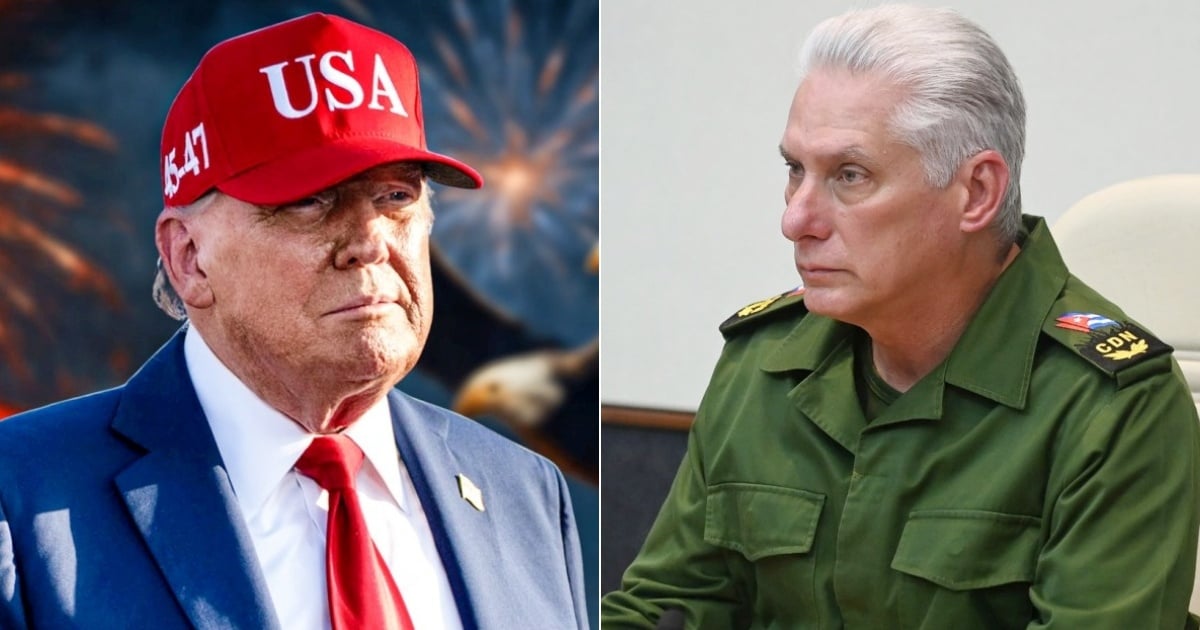
Miguel Díaz-Canel has spoken out this Friday regarding a recent executive order signed by Donald Trump, aiming to halt oil deliveries to Cuba through tariffs on countries that send fuel to the island.
The Cuban leader accused the United States of acting with "a deceitful pretext lacking in justification," and attempting to "suffocate the Cuban economy by imposing tariffs on nations that trade oil with Cuba independently."
"Did the Secretary of State and his acolytes not claim the blockade didn't exist? Where are those who bore us with their fabricated tales of it being a mere 'bilateral trade embargo'?" Díaz-Canel questioned, confronting those who deny the existence of "the blockade."
Staying true to his rhetoric, he concluded by stating that this new escalation reveals "the fascist, criminal, and genocidal nature of a clique that has hijacked the interests of the American people for purely personal motives."
Bruno Rodríguez's Earlier Criticism
The Cuban president's response came hours after Foreign Minister Bruno Rodríguez condemned what he called a "brutal act of aggression" by Washington.
Rodríguez was the first to raise the official voice, warning that the United States seeks to "impose a total blockade on fuel supplies" and subject the country to "extreme living conditions."
He accused the White House of using "coercion" to pressure other countries to align with its isolationist policy against Cuba, with threats of "arbitrary and abusive tariffs."
The MINREX statement claims that the measure is based on "a long list of lies aimed at portraying Cuba as a non-existent threat."
Rodríguez also insisted that "the only threat to regional peace, security, and stability" is the U.S. government itself.
Trump's Executive Order
The executive order signed by Trump labels Cuba as an "unusual and extraordinary threat" to U.S. security, empowering the Secretaries of Commerce and State to sanction countries maintaining energy exchanges with the island.
The document accuses the Havana regime of facilitating intelligence operations by Russia and China, harboring groups like Hamas and Hezbollah, and contributing to regional destabilization through "migration and violence."
According to sources cited by The Wall Street Journal, this strategy is part of an offensive aimed at accelerating regime change in Cuba, with the belief that "the island is on the brink of collapse" and immediate action is necessary.
Global Tensions Over Oil Supplies
The measure also has a global dimension. Governments like those in Mexico, Russia, or Algeria that have recently sent oil to the island could be directly affected by these sanctions.
The executive order is grounded in a mix of legal frameworks - including the National Emergencies Act, the International Emergency Economic Powers Act, and the U.S. Code - granting it broad reach.
Meanwhile, reports indicate that foreign embassies and companies are discreetly reviewing their evacuation plans in response to a potential energy collapse in Cuba.
The standoff between Washington and Havana has reached a peak of geopolitical tension.
Díaz-Canel's stance reinforces the Cuban government's narrative of victimization in the face of external aggression. However, Trump's measure seems to extend beyond mere symbolic pressure.
This is a calculated attempt to suffocate the Cuban regime at its most vulnerable point: access to energy sources, while aiming to sever the last links of international cooperation that sustain the island's power structure.
Understanding U.S.-Cuba Oil Supply Sanctions
What is the purpose of the U.S. executive order against Cuba?
The executive order aims to halt oil supplies to Cuba by sanctioning countries that send fuel to the island, labeling Cuba as a security threat to the U.S.
How has Cuba's government responded to the U.S. sanctions?
The Cuban government, through Díaz-Canel and Foreign Minister Bruno Rodríguez, has condemned the sanctions as unjust and aggressive, accusing the U.S. of trying to destabilize Cuba's economy.
What is the global impact of these sanctions?
Countries that have supplied oil to Cuba, such as Mexico, Russia, and Algeria, could face direct effects due to the imposed sanctions, potentially disrupting international relations.