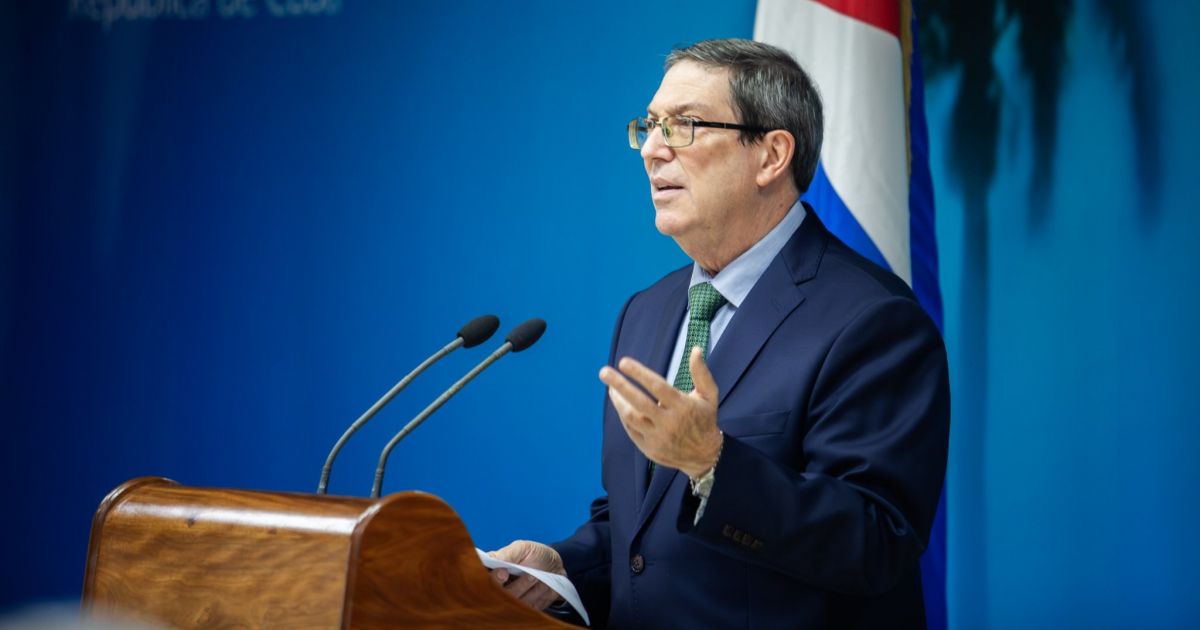
The Cuban government has labeled the executive order signed by President Donald Trump on Thursday as a "brutal act of aggression." This directive introduces a mechanism to obstruct the island's oil supply by imposing tariff sanctions on third-party countries.
Foreign Minister Bruno Rodríguez criticized Washington's move, claiming it aims to subject Cuba to "extreme living conditions." He attributed the measure to a political maneuver rooted in "lies" and international "blackmail."
“We strongly condemn the new escalation of #USA against #Cuba. It now seeks to enforce a total blockade on our country's fuel supplies,” the diplomat expressed at the outset of his complaint on X.
Rodríguez warned that the narrative pushed by the White House tries to cast Cuba as a destabilizing force in the region, whereas, in his view, it is Washington that causes instability.
“To justify this, they rely on a long list of lies that aim to portray Cuba as a threat that it isn't,” states the communication, also shared by the Ministry of Foreign Affairs (MINREX) on their website.
“There is mounting evidence each day that the only threat to peace, security, and regional stability, and the sole malign influence, is the U.S. government against the nations and peoples of Our America," the document adds.
The foreign minister also accused the United States of exerting diplomatic pressure to further isolate Cuba.
“The U.S. resorts to blackmail and coercion, attempting to get other countries to join its universally condemned blockade policy against Cuba. Those refusing face the threat of arbitrary and abusive tariffs, violating all norms of free trade," adds the regime's formal complaint.
“We denounce to the world this brutal act of aggression against Cuba and its people, who have been subjected to the longest and cruelest economic blockade ever applied against an entire nation, now promised extreme living conditions," Rodríguez concluded.
Carlos Giménez responded. The reaction by Bruno Rodríguez was met with a reply.
Cuban-American congressman, Carlos Giménez, directly addressed the foreign minister on the X network.
“Bruno, there's still time for you to return to your native homeland of Mexico. President Trump's actions are no game. He keeps his word. Your time is short. This goes to the end,” the Republican legislator wrote.
As of the close of this article, Miguel Díaz-Canel has remained silent, not responding to President Trump's announcement.
A Political Offensive Amid "National Emergency"
The Cuban regime's response follows the executive order signed by President Donald Trump, declaring a "national emergency" due to the purported threat Cuba poses to U.S. security and foreign policy.
The directive empowers the U.S. government to impose tariffs on countries that sell or supply oil to Cuba.
According to the document, "the policies and actions of the Cuban Government represent an unusual and extraordinary threat," accusing Havana of collaborating with "malign actors" such as Russia, China, Iran, Hamas, and Hezbollah.
The White House asserts that Cuba "harbors dangerous adversaries," facilitates infrastructure for Russian and Chinese intelligence, and offers refuge to terrorist organizations.
It also claims that the communist regime "destabilizes the region through migration and violence" and systematically violates human rights.
“The United States has zero tolerance for the depredations of the Cuban communist regime,” warns the order, establishing a tariff sanction system to be administered by the Commerce and State Secretaries.
A Measure to Prompt Regime Collapse
This diplomatic and economic offensive is part of a broader strategy driven by Trump, which - as revealed by The Wall Street Journal - seeks to expedite a regime change in Cuba as soon as possible.
U.S. officials have reportedly identified a "historic window of opportunity" following the collapse of Venezuelan support and the capture of Nicolás Maduro.
Trump himself has been explicit in his assessments: "Cuba seems like it's about to fall. I don't know how they can sustain themselves," he remarked recently, referring to the energy crisis impacting the island, characterized by daily blackouts, halted production, and acute fuel shortages.
A Scenario of Maximum Tension
This new measure adds to others previously adopted by Trump since his first term, such as adding Cuba to the list of state sponsors of terrorism, implementing travel restrictions, or canceling bilateral agreements.
In June 2025, the White House had already tightened its policy toward the island through a national security memorandum.
Internal conditions in Cuba, with a struggling economy, a semi-paralyzed productive apparatus, and growing social unrest, now worsen with the real possibility of running out of fuel supplies.
The EFE agency reported in recent hours that several embassies and international companies are discreetly updating their evacuation protocols, fearing a total collapse scenario.
A Measure with Global Reach
The executive order not only impacts Havana but also serves as a warning to governments like Mexico, Russia, or Algeria, which have maintained energy exchanges with Cuba in recent years.
The U.S. Secretary of Commerce must identify the countries involved in these supplies, while the Secretary of State will decide on the imposition of sanctions.
The legal document relies on the International Emergency Economic Powers Act, the National Emergencies Act, and Title 3 of the United States Code.
It includes provisions to amend the decree based on reprisals or changes in context, as well as the obligation to report to Congress on actions arising from the declared emergency.
Implications of U.S. Sanctions on Cuba's Oil Supply
What is the United States' main objective with the new sanctions on Cuba?
The primary goal of the new sanctions is to prevent Cuba from receiving oil supplies by imposing tariffs on countries that provide such resources. This is part of a broader strategy to induce a regime change in Cuba.
How has the Cuban government responded to the U.S. sanctions?
The Cuban government has condemned the sanctions, labeling them a "brutal act of aggression" intended to impose extreme living conditions on the Cuban people. They have accused the U.S. of relying on lies and coercion to isolate Cuba further.
What impact do these sanctions have on other countries?
The sanctions serve as a warning to countries like Mexico, Russia, and Algeria that have been involved in supplying oil to Cuba. These nations may face tariffs and other penalties if they continue their energy exchanges with the island.