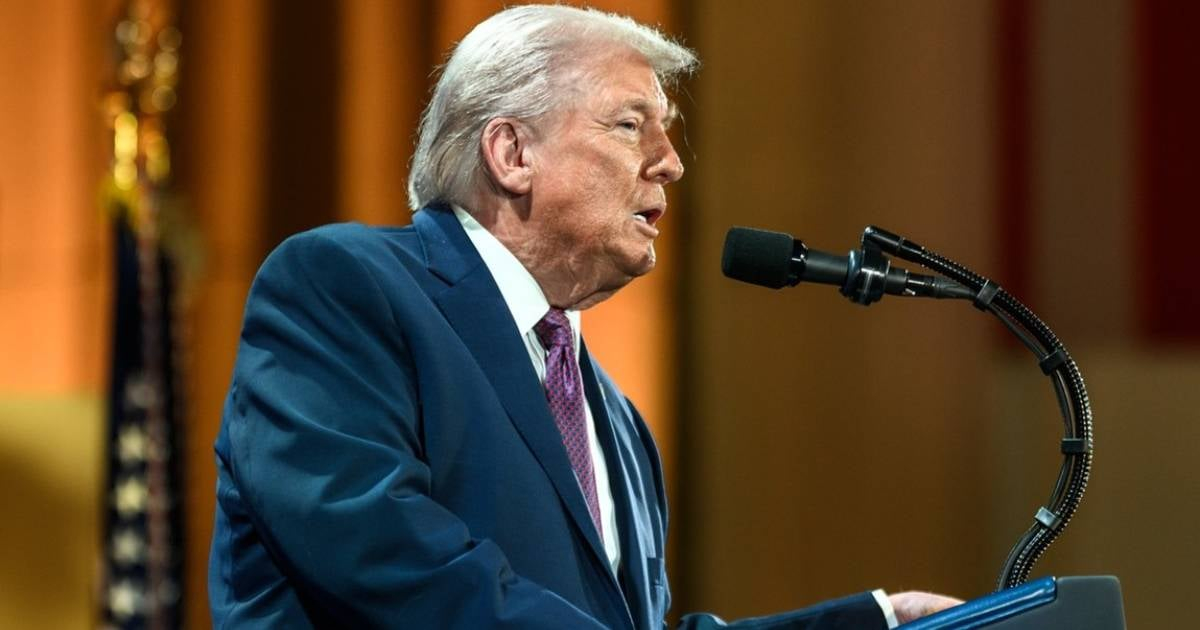
On Thursday, U.S. President Donald Trump issued an executive order declaring a national emergency, citing the Cuban government's policies and actions as an "unusual and extraordinary threat" to the national security and foreign policy of the United States.
The order, effective from January 30, 2026, was announced from the White House. It claims that the Cuban regime is "aligned with several hostile nations, transnational terrorist groups, and malign actors opposed to the United States, including Russia, China, Iran, Hamas, and Hezbollah."
According to the order, Cuba "hosts dangerous adversaries" and enables the establishment of "military and intelligence capabilities that pose a direct threat" to U.S. national security.
The document highlights that Cuba "maintains the largest Russian intelligence base outside of Russia" and is "deepening defense and intelligence cooperation with the People's Republic of China."
Furthermore, it accuses Havana of providing a safe haven for groups like Hezbollah and Hamas, allowing them to create "economic, cultural, and security links" within the region.
The executive order also alleges that the Cuban "communist regime" supports terrorism, destabilizes the region through migration and violence, and violates human rights by suppressing freedom of speech, religion, and press.
"The United States has zero tolerance for the depredations of the Cuban communist regime," the order states. "We will act to protect U.S. foreign policy, national security, and interests while remaining committed to the Cuban people's aspirations for a free and democratic society."
The decree outlines a tariff system allowing Washington to impose additional duties on imports from countries supplying oil to Cuba, either directly or indirectly.
The Secretary of Commerce is tasked with determining whether a country engages in such transactions, while the Secretary of State, in consultation with other agencies, will decide on the application and extent of the additional tariffs.
The order empowers both secretaries to issue rules, regulations, or guidelines necessary for implementing the measures, and allows the president to amend the decree in response to changing circumstances or retaliatory actions by other governments.
The State Department is also instructed to regularly monitor and report to Congress on the declared emergency and related actions, in accordance with existing U.S. law.
Signed by Trump and officially released by the White House, the executive order is grounded in the provisions of the International Emergency Economic Powers Act, the National Emergencies Act, and Title 3 of the United States Code.
An accompanying White House statement emphasized that the measure is part of President Trump's efforts to "safeguard U.S. security and foreign policy against the malign actions of the Cuban regime."
The document reaffirms the administration's view of the Cuban government as an ally of hostile countries and groups such as Russia, China, Iran, Hamas, and Hezbollah, and accuses it of sheltering terrorist organizations and destabilizing the region.
The White House also noted that this action aligns with the "Putting America First" policy and continues the measures Trump implemented from his first term to tighten policies toward Cuba.
In June 2025, the president signed a national security memorandum and imposed travel restrictions on Cuban citizens due to the country's role as a terrorism sponsor and its lack of cooperation in migration and judicial matters.
The escalating geopolitical tension in the Caribbean and the rapid deterioration of internal conditions in Cuba have raised alarms: numerous embassies and international companies are reportedly discreetly updating their evacuation protocols in case of a major emergency scenario on the island, according to the EFE agency.
Impact of U.S. National Emergency Declaration on Cuba
Why did President Trump declare a national emergency regarding Cuba?
President Trump declared a national emergency due to the Cuban government's alignment with hostile nations and groups, posing an "unusual and extraordinary threat" to U.S. national security and foreign policy.
How does the executive order affect trade with countries supplying oil to Cuba?
The order establishes a tariff system enabling the U.S. to impose additional duties on imports from countries that supply oil to Cuba, directly or indirectly.
What actions has the U.S. taken against Cuba under this emergency declaration?
The U.S. plans to implement tariffs and monitor compliance with the order, while also empowering government officials to adjust policies in response to changing conditions or retaliations from other countries.