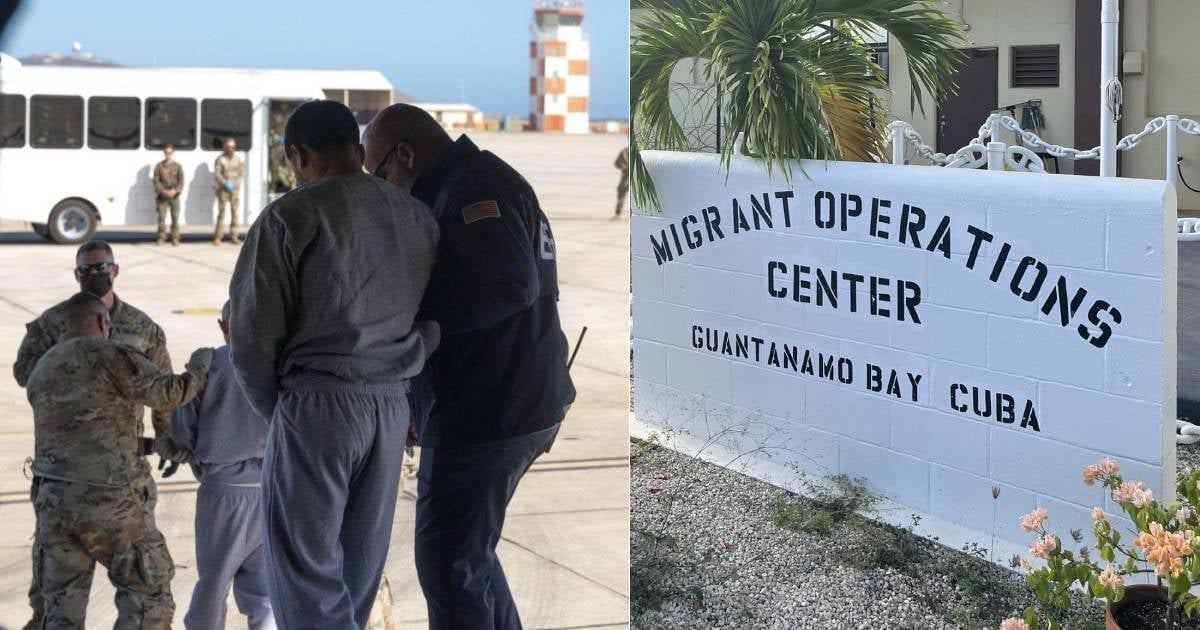
A group of Cuban nationals detained by the U.S. Immigration and Customs Enforcement (ICE) agreed to deportation with the expectation of returning to Havana, reuniting with their families, and closing a chapter filled with immigration uncertainty. Contrary to their belief, the plane landed at the Guantánamo Bay Naval Base.
As reported by The New York Times in a piece by journalist Carol Rosenberg, these individuals have been stuck at the U.S. military installation since before Christmas, caught in a limbo that is both absurd and cruel.
Many of them were unaware that Guantánamo was still an option within the U.S. immigration process. They thought that accepting deportation was the fastest way out of detention centers, never imagining they would end up confined in a facility long associated with terrorism detainees.
Approximately 50 men, ranging from their 20s to 50s, were moved from various detention centers across the U.S., primarily from Louisiana. According to the New York outlet, several believed they were en route to Havana until the plane landed on the eastern tip of Cuba, under Washington's control. By then, it was too late.
Being in Guantánamo did not bring them closer to freedom. Instead, due to Cuba's stringent restrictions on flights from the base to the rest of the island, U.S. authorities are forced to return these Cubans to U.S. soil before they can be handed over to Cuban authorities. This bureaucratic cycle has prolonged their detention for weeks.
Initially, some were housed in barracks near the airstrip, assessed as not posing a high risk. However, The New York Times confirmed that due to undisclosed technical issues, all detainees ended up in Camp 6, a prison formerly used for suspected Al Qaeda members.
Since December, CiberCuba has received direct complaints from relatives claiming that their family members were misled, kept incommunicado for days, and treated as criminals, despite most having no criminal records. In some instances, they had sought asylum or held work permits but accepted to return to Cuba after years of waiting without resolution to their cases.
Accounts from family members and media like Telemundo 51 describe shackles, chains, rifles pointed at them as they disembarked, and brief, fear-laden phone calls. Some relatives even went to Cuban airports expecting a flight that never arrived, returning home with the anguish of not knowing their loved ones' whereabouts.
Meanwhile, official silence has been almost complete. The Department of Homeland Security has merely stated that among the detained are individuals with severe criminal records, without providing evidence or details. Families vehemently deny these claims.
The American Civil Liberties Union (ACLU), challenging this policy, argues that many accepted deportation believing it was the end of their confinement, not the beginning of another uncertain period.
The case of the Cubans trapped at Guantánamo highlights the contradictions of a costly and inefficient operation. The Trump administration ordered in January 2025 to prepare the base to hold up to 30,000 “foreign criminals.” A year later, only about 780 migrants have been processed there, according to The New York Times, without evidence that most had criminal backgrounds. The Pentagon and the Department of Homeland Security have spent millions on a facility that has remained largely unused for extended periods.
For Cuba, the situation is even more precarious. The regime has remained silent while limiting the repatriation of deportees from the U.S. to a single monthly flight. Washington has requested an increase in this number, to no avail. Human rights organizations point out that the island's deep economic crisis, marked by blackouts and shortages, partly explains the refusal to accept more returnees.
Meanwhile, the Cubans detained at Guantánamo have occasionally managed to communicate with family in the U.S., who then inform relatives on the island. In private groups, mothers, wives, and aunts share rumors, pray, and cling to faith for solace.
“God knows where they are and watches over them,” wrote a woman from Cuba in one of those spaces. These words encapsulate the human drama behind an immigration policy that, for many Cubans, turned the anticipated return home into an ordeal without a foreseeable end.
Frequently Asked Questions about Cuban Deportees at Guantánamo
Why were Cubans taken to Guantánamo Bay instead of Havana?
Cubans were taken to Guantánamo due to U.S. immigration procedures, which led to unexpected detainment at the military base rather than deportation directly to Havana.
What are the living conditions like for Cubans at Guantánamo?
Initially, some detainees were housed in barracks. However, due to undisclosed issues, they were moved to Camp 6, a facility previously used for suspected terrorists.
How has the Cuban government responded to the situation?
The Cuban government has remained silent and maintains strict limitations on the repatriation of deportees, allowing only one flight per month from the U.S.