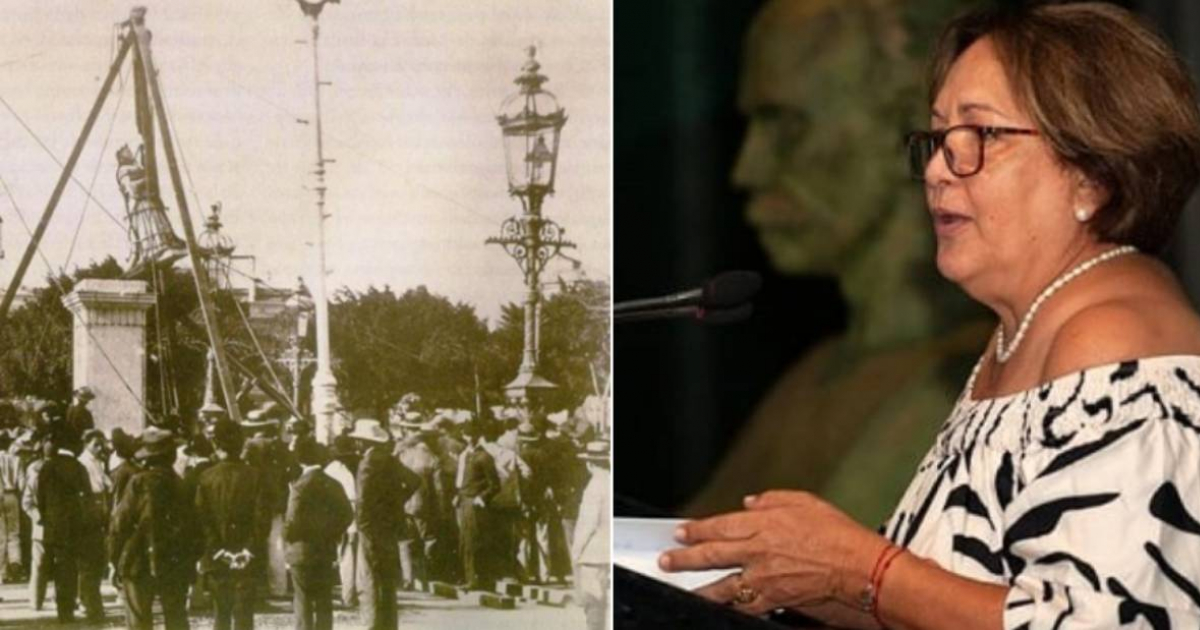
The recent debate sparked by a statement from the pro-government journalist Arleen Rodríguez Derivet, who claimed that “José Martí never experienced electric light,” has reignited interest in a seldom-discussed topic: the true arrival of electricity in Cuba.
According to Cuban engineers and historians, documented evidence is found in the studies Milestones of Electricity and Its Applications in Cuba and the book A Light That Came to Stay by José Altshuler and Miguel González. These resources are available on the website of the Cuban Electric Union and even Ecured.
Electric street lighting in Havana began on March 3, 1889, utilizing arc lamps powered by the Tallapiedra plant, marking the start of regular electric service in the city.
Electricity's Early Footprint Across Cuba
Contrary to Havana's claim, other sources suggest that Cárdenas, in the province of Matanzas, was the first Cuban city with electric street lighting, dating back to September 1889. This was managed by the Cárdenas Electricity Company, established by entrepreneur Antonio Prieto, who began setting up his plant in late 1888.
By 1890, electrical networks were operational in Havana, Matanzas, and Camagüey. By 1893, the city of Pinar del Río also had electric lighting.
The Tallapiedra: A Symbol of Technological Advancement
Cuba was home to one of Latin America's most advanced thermal power plants, the renowned "Tallapiedra," founded by the Spanish American Light and Power Company in 1889.
This facility began generating electricity in 1913 using American technology and Westinghouse single-phase generators. A year later, its iconic neoclassical building, which now stands in near ruins, was inaugurated in Old Havana.
José Martí and the Era of Electric Light
Electricity was not a latecomer to Cuba. In 1858, Havana witnessed a public demonstration of electric lighting at the docks, and by 1886, several private lighting and power companies were already operating in the capital.
The growth of the telegraph, telephone, and later, the cinematograph, accompanied this wave of technological modernization during the colonial period.
José Martí fully experienced this transformation. In the introduction to The Golden Age (1889), he mentioned “electric light” as a symbol of scientific progress, and in his chronicles from New York, he exclaimed: “Beautiful electric light! … the soft air illuminated, like reflections of angel wings.” His own words contradict the notion that he was unaware of this innovation's existence or impact.
Controversy and Apologies
Rodríguez Derivet's error, made during an interview with former Ecuadorian President Rafael Correa and countered with the response “but Arleen, we are in the 21st century,” led to a wave of social media criticism.
The journalist acknowledged her mistake on Tuesday, offering a public apology and explaining that her comment was made “offhand.”
Beyond the media blunder, historical records affirm that Cuba was familiar with electricity from the late 19th century.
In 1889, as Martí wrote about the light transforming the world, Havana was unveiling its first electric street lighting. Yet, over 130 years later, millions of Cubans endure prolonged blackouts, in an irony even the Apostle himself could not have envisioned.
Understanding Cuba's Electrical History
When did electric street lighting first appear in Havana?
Electric street lighting was inaugurated in Havana on March 3, 1889, with arc lamps powered by the Tallapiedra plant.
Who was Antonio Prieto, and what was his contribution to Cuba's electrification?
Antonio Prieto was an entrepreneur who established the Cárdenas Electricity Company, responsible for introducing electric street lighting to Cárdenas in September 1889.
Did José Martí write about electric light?
Yes, José Martí mentioned electric light as a symbol of progress in his writings, including the introduction to The Golden Age in 1889 and his chronicles from New York.