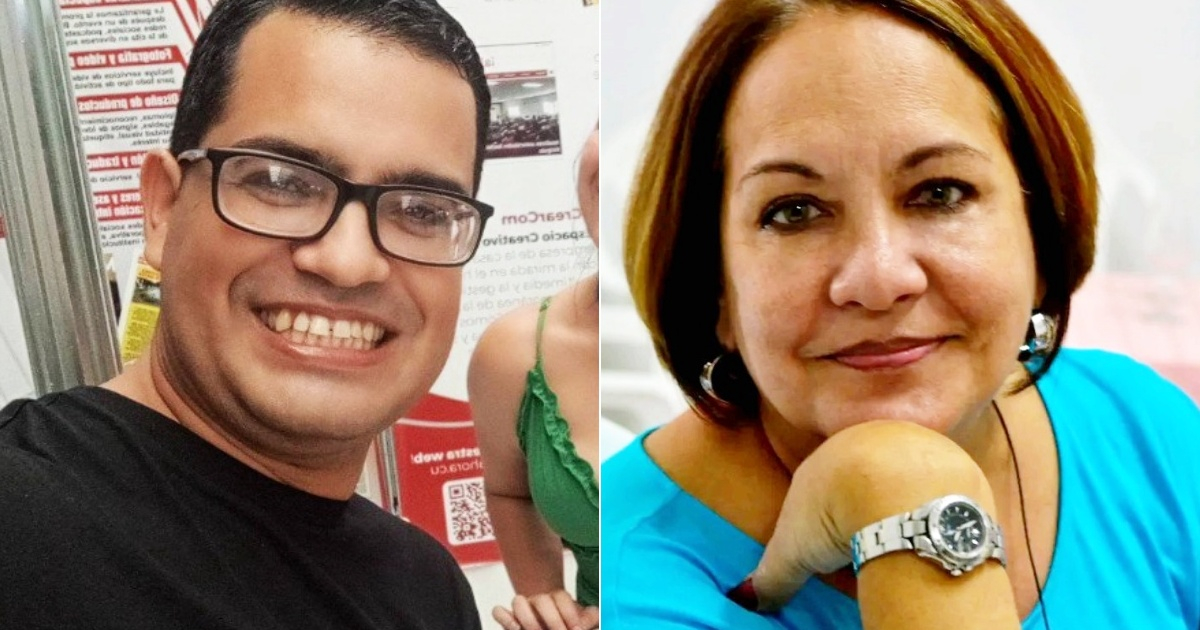
State-affiliated journalist Abdiel Bermúdez has publicly addressed the uproar ignited by a comment made by his colleague, Arleen Rodríguez Derivet, regarding José Martí and Cuba's ongoing electricity issues. The controversy arose after an interview recorded months ago with former Ecuadorian President Rafael Correa went viral.
In a lengthy Facebook post, Bermúdez staunchly defended Rodríguez, whom he acknowledges as a personal friend, while attempting to downplay the impact of the comment that has set social media ablaze.
"To the smug, the 'enlightened,' the perfect ones who never erred... I couldn't care less if they turn on me now. I don't mind if they come at me, biting, attacking, or 'judging'... I've tasted that 'medicine' before," he wrote, opening his statement with defiance.
Rather than justifying Arleen's words, Abdiel concedes it was a mistake, framing it within a challenging context where social media judgments are often harsh and unforgiving:
"My opinion, after watching the interview with Correa: Arleen made a mistake. Perhaps she didn't fully consider how she expressed herself, and in this interconnected world, one must tread carefully, as every word risks reputation assassination or the unintended spread of unconfessed grievances until one errs," he noted.
Drawing from his own experiences, Bermúdez empathized with his colleague's situation: "That's what I think, having made mistakes myself, like everyone; but I won't disparage her for it."
In a tone of homage, he highlighted Rodríguez's professional achievements, emphasizing her sensitivity, her connection to the people, and her dedication to "the Revolution."
"She's always been... a 'remarkable' journalist in pursuit of truth despite misunderstandings, and deeply committed to portraying Cuba with the genuine sensitivity of its people. All of its people," he proclaimed.
Anticipating critiques of supposed privileges, Bermúdez preemptively countered those arguments:
"No one should refute me now by talking about blackouts and alleged privileges. Arleen has never hidden her friendship with the president, even before 2018; nor has she hesitated to speak many truths that pain us as a nation."
With a more passionate than political tone, he concluded with a nod to Martí:
"And yes, she is indeed my friend, and for friends, I will fight wherever necessary, especially if the world seems against us. And I learned that from Martí, so often consulted today: 'If asked what is the most beautiful word, I will say "homeland" - and if asked for another almost as beautiful as "homeland," I will say friendship.'"
He firmly stated that his stance was not dictated by any imposed editorial lines.
"By the way, that talk of 'the order to defend Arleen has been given' doesn't fly with me. No one tells me what I can or cannot post on my Facebook profile. And anyone who comes with disrespectful attacks will be removed," he concluded.
The Roots of the Controversy: Martí and Power Outages
The spark for this communicational crisis was a remark made by Arleen Rodríguez during an interview with Correa, where she attempted to downplay the severity of the blackouts by comparing them to the life of the Cuban independence hero.
"José Martí never knew electric light and was a genius, wrote like the gods; I wish I could write a line like Martí with the lights on," the journalist stated.
Correa responded immediately, discomfort visible, with a call to the present: "But Arleen, we're in the 21st century."
Although the interview was recorded in November, it has now gone viral as blackouts have worsened in several provinces, lasting over 40 hours in some instances.
In this context, the remark has been perceived as mocking the daily hardships and "romanticizing darkness," as numerous internet users have summarized.
Support for Arleen: A Renowned Journalist's Unintentional Misstep
From circles close to the government, support for Arleen was swift.
Journalists, announcers, and regime sympathizers have stood by Arleen as a figure of prestige and commitment.
"I watched the interview when it aired. A small slip doesn't make a summer or a winter. [...] Many criticize her simply because she's on the side of her Homeland and the Revolution," journalist Francisnet Díaz Rondón asserted.
Another commentator defended journalists as professionals exposed to public errors: "Let those who haven't made mistakes raise their hands, but let those who have published it in the first person raise theirs too."
Others referred to Arleen's "human quality."
"She's human, for goodness' sake, and can make mistakes"; "To err is human, and it all depends on how you look at it"; "Her prestige is so great that a few seconds of error don't erase it," were some other opinions shared.
Criticism: "Enough Romanticizing the Abnormal"
Conversely, numerous voices challenged the underlying sentiment of the comment and Bermúdez's defense, not out of malice, but from accumulated frustration and social outrage.
One commentator warned: "Comments like that, aiming to justify the unjustifiable, have nearly driven this country into chaos [...] such things are offensive."
Another user shared a broadly circulated reflection:
"Martí wrote in the dark, yes... but not to get used to the shadow, rather to teach us to seek the light. Confusing sacrifice with consolation is easy when context dims and excuses light up."
Another individual highlighted the structural issue:
"The criticism isn't for the mistake. The criticism comes from complacency, from normalizing the pain caused by these blackouts."
In another widely shared post on social media, announcer Laritza Camacho, without directly naming Arleen but clearly referring to the matter, declared:
"Keep playing games in the house of the spinning top, but don't play with Martí where his people reside. Martí is perhaps the only light we have left. Show respect."
Conclusion: Personal Loyalties vs. Professional Responsibilities
Abdiel Bermúdez's support for Arleen Rodríguez exposes a significant dilemma: how to reconcile personal loyalty with professional responsibility during one of the country's most exhausting crises?
His defense, however genuine, has reignited a visible divide: the gap between those with microphones, lights, and platforms, and those living literally in darkness.
In a nation where electricity has become a symbol of dignity, drawing parallels between Martí and power outages wasn't just a misstep. It was an ethical stumble.
As one user poignantly noted:
"The people can't afford to err, because everyone knows the consequences of making mistakes."
And while power cuts, official justifications, and heroic metaphors persist, millions of Cubans continue waiting - not for a redeeming phrase - but simply for the power to return.
Understanding the Controversy Surrounding José Martí's Comment
What was the controversial comment made by Arleen Rodríguez?
Arleen Rodríguez compared the current situation of power outages in Cuba to the life of José Martí, stating that Martí wrote without electric light and was a genius, suggesting she wished she could write as well as him even with the lights on.
Why did Abdiel Bermúdez defend Arleen Rodríguez?
Abdiel Bermúdez defended Arleen Rodríguez as a personal friend and respected journalist, arguing that while her comment was a mistake, it was made in a challenging context where social media judgments are often harsh.
How has the public reacted to the comment and defense?
The public response has been divided, with some supporting Arleen as a committed journalist and others criticizing the comment as downplaying the severity of the blackouts and romanticizing hardship.