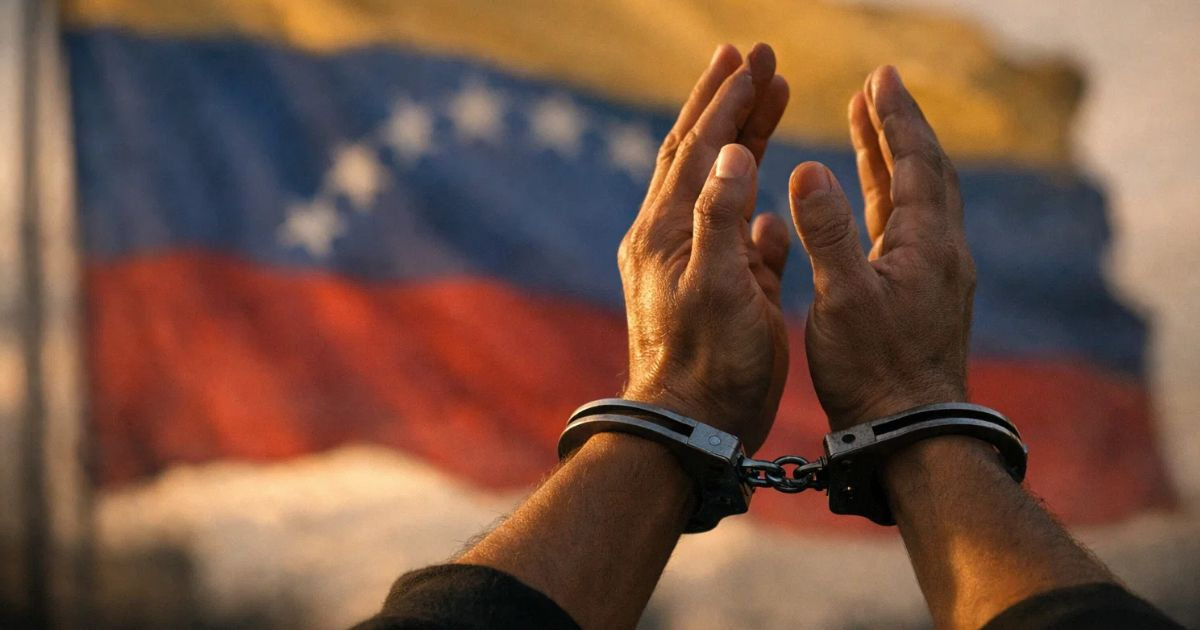
For over 25 years, international law and human rights organizations failed to effectively address the crisis in Venezuela. The populace spent a quarter of a century pleading with the global community to restore their human rights. What was the response? As the song by Alberto Cortez suggests: “The alarm was raised... regulations were issued.” In reality, the world turned a blind eye or settled for issuing documents that simply encouraged “dialogue between parties.” Sadly, the current framework intended to safeguard human rights and uphold international law proved ineffective.
There was no viable solution. No conceivable way forward.
Venezuelans did not lack effort. Between 2000 and 2020, they staged over 100,000 protests—yes, 100,000—demanding their basic rights, such as access to water, electricity, gas, education for their children, healthcare, respect for private property, and free and fair elections.
We've seen this movie before, in black and white. The regime responded as expected: criminalizing protests, making people disappear, returning to political imprisonments, conducting unfair trials—typical of such regimes. Despite their malevolence, the Chavistas exhibited a profound lack of creativity, never adding anything new to the repertoire birthed in the largest of the Antilles.
Much like Cuba during the era of the Varela Project led by Oswaldo Payá, the Venezuelan opposition utilized every legal resource available to them to attempt to reclaim democracy. Unfortunately, with similar outcomes. The decision whether or not to participate in Chavista electoral processes became a constant source of internal division. From the 2003 referendum to recall Hugo Chávez, to participating under arbitrary disqualifications, campaign restrictions, and assaults on their leaders, to engaging in dialogue that was systematically violated by the regime, and finally, proving Nicolás Maduro's electoral fraud in 2024 when the National Electoral Council declared him the winner without presenting results.
Internationally, they reported abuses to bodies like the Inter-American Court of Human Rights, the United Nations, and the International Criminal Court. The regime either ignored or dismissed these reprimands, withdrew from the inter-American system, and threatened to do the same with the ICC, where the Venezuelan case has awaited a decision for a decade. A decade! The same institution quickly acted against Benjamin Netanyahu, pressured by progressive and leftist forces globally.
On January 3, 2026, a turning point exposed the hypocrisy and inability to enforce international laws and regulations proclaimed by international organizations and some NGOs.
Amidst this backdrop, Donald Trump was the sole figure who took action beyond well-intentioned but empty proclamations. He recognized Venezuela as a genuine threat to hemispheric security and to the United States.
The forced migration of nearly eight million individuals, with the tremendous social and economic impact on host countries, and the infiltration of criminal gangs and paramilitary forces among these migrants to create instability in non-allied governments, is a reality. It is a replication of the failed Cuban revolution model, upon which Chavismo always depended and which now survives thanks to subsidies from U.S. adversaries.
After exhausting diplomatic avenues, economic and political pressure, President Trump opted for an intervention promising high efficiency, low cost, and numerous benefits for Venezuela, the hemisphere, and the United States.
This strategy is reminiscent of the Panama intervention in 1989, justified more by issues of narcotrafficking and criminality than an outright declaration of war. However, there are significant differences. In Panama, military forces were dismantled. In Venezuela, the military structure was deliberately kept intact to prevent the total collapse of an already weakened state prior to intervention.
Trump, operating on the premise that the United States leads the region, chose this path to aid in Venezuela’s economic recovery, a critical step toward re-establishing a robust democracy. This model mirrors, but is not identical to, the successful reconstruction of Europe and Japan post-World War II. Consequently, Delcy Rodríguez was temporarily left as acting president, in alignment with Venezuelan legal framework.
Admittedly, circumstances differ. In Venezuela, there was no war, which makes the crisis—a copy of the Cuban failure—even more cruel. The collapse was orchestrated by a political project that dismantled democracy, destroyed infrastructure, attacked the productive apparatus, forced a talent exodus, and decapitalized knowledge. Consider the 2002 dismissal of 20,000 highly skilled PDVSA professionals.
We hope the model adopted at this pivotal moment succeeds, for the sake of Venezuela, Latin America, and the United States. As a lawyer, I wish I could say international organizations responded, listened to all parties, and acted according to the law. Sadly, the truth is otherwise.
Let’s not be naive. Venezuela holds strategic importance. It possesses the world’s largest proven oil reserves, significant gas deposits, the largest gold reserves in Latin America, and abundant iron and bauxite resources.
Additionally, it boasts a substantial supply of rare earth elements, critical minerals increasingly vital for the global economy and advanced technology industries, currently dominated by China.
Beyond economic interests, Venezuela matters as an ally, not as a source of hemispheric disruption. It matters because narcotrafficking threatens millions of American lives. It matters because 30 million people have endured nearly three decades under a tyrannical regime.
Before Chavismo, Venezuela was one of the United States' most steadfast allies. It was a reliable oil supplier during critical times, and its energy development was supported by American investment and expertise.
When international bodies fail to uphold their own human rights charters, something is amiss. If international law cannot hold individuals like Nicolás Maduro accountable—who danced on national television while his people were massacred—something is unquestionably wrong. If the human rights that matter are those of a regime that kept over a thousand political prisoners and a similar number of disappeared individuals, then something is gravely wrong.
Key Questions About Venezuela's Crisis and International Response
Why has the international community been ineffective in addressing Venezuela's human rights crisis?
The international community has often been criticized for issuing statements and encouraging dialogue without taking concrete actions to enforce human rights laws, largely due to political complexities and lack of consensus on intervention strategies.
How did the Venezuelan regime respond to protests and international pressure?
The regime typically criminalized protests, ignored international calls for reform, withdrew from international human rights systems, and maintained a strong stance against any external interference, despite growing domestic and international pressure.
What motivated Donald Trump to intervene in Venezuela?
Donald Trump was motivated by the belief that Venezuela posed a significant threat to regional and U.S. security, driven by issues like mass migration, the infiltration of criminal elements, and the strategic importance of Venezuelan resources.