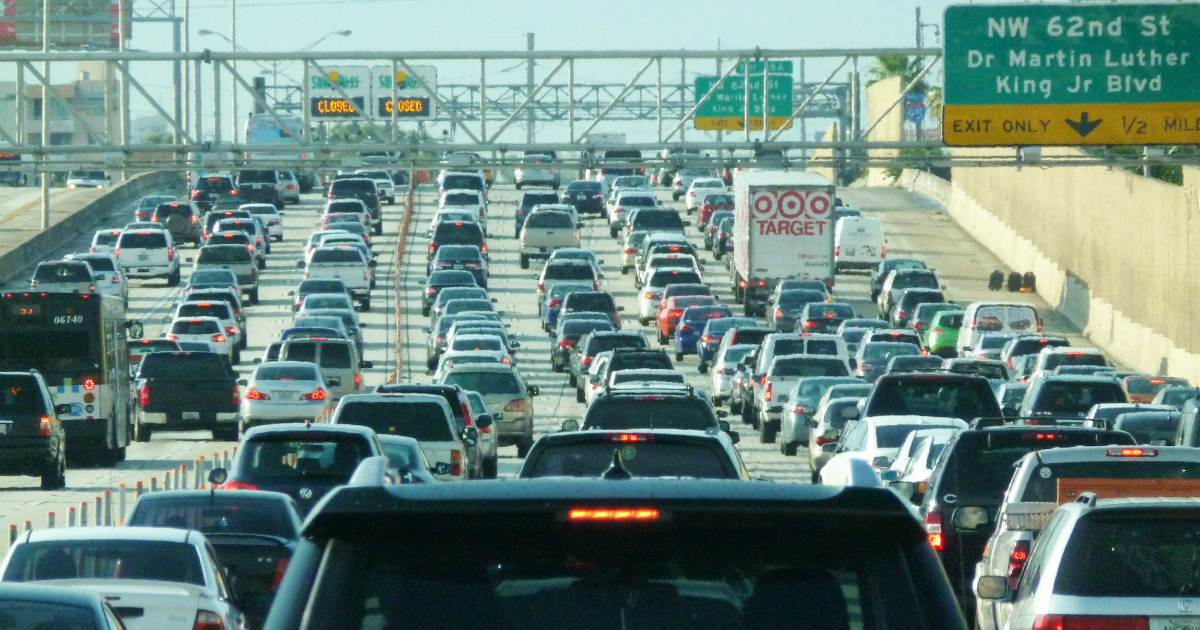
A newly released report by the location technology company TomTom ranks Miami as the second most traffic-congested city in the United States, trailing only behind Los Angeles.
Data collected on urban mobility throughout 2025 indicates alarmingly high traffic levels, which have a direct effect on residents' quality of life, wasted time, and transportation costs.
Understanding Miami's Traffic Congestion
In 2025, an average day in the Miami metropolitan area saw travel times increase by nearly 50% compared to smooth-flowing traffic conditions.
This reflects an increase of nearly 20 percentage points compared to 2019 data.
During peak hours, the following statistics were recorded:
- In the morning, congestion reached 74%, with an average speed of 20.1 mph (32.3 km/h).
- In the afternoon, congestion rose to 89%, with an average speed of 17.7 mph (28.5 km/h).
On the most congested day of the year, traffic surged to 114%, with drivers spending 15 minutes to cover less than 4 miles (6.4 km).
These figures place Miami among the cities with the highest time lost due to traffic congestion in the nation.
Time Spent Driving: Nearly Two Weeks Annually
The U.S. Census Bureau reports that, in 2025, the average resident of the Miami metropolitan area spent approximately 36 minutes commuting to work.
Although the return trip is not tracked by the Census, TomTom's data suggests this journey is 11% slower, increasing the estimated return time to 40 minutes.
This translates to:
- 76 minutes of daily driving (round trip).
- 380 minutes weekly, considering a five-day work week.
- 19,700 minutes annually, which equates to roughly 13.7 days or nearly two full weeks spent inside a car each year.
The Economic and Social Toll of Traffic
Miami stands out for its high transportation costs, being the city with the highest expenses among all major metropolitan areas in the country.
This issue is compounded by a population increasingly forced to live in areas far from the urban core due to rising housing prices.
Urban growth has expanded horizontally, pushing many to reside in places like Homestead, Broward, or even Palm Beach County, where public transport is limited or non-existent.
Structural Causes of Congestion
Cathy Dos Santos, director of Transit Alliance, an organization advocating for better mobility solutions, believes the core issue lies in urban planning. "It's an urban planning issue," she stated.
Miami's low-density, sprawling nature, dominated by single-family homes, creates a structural reliance on cars.
"It's really tough to provide good public transit options in these areas," Dos Santos remarked. "We're essentially forcing everyone to drive."
Moreover, much of the public funding is allocated to highway expansion instead of improving mass transit. This leads to a phenomenon known as induced demand: increasing road capacity encourages more traffic.
"For billions of dollars," Dos Santos noted, "we end up with the same issue after just a couple of years."
Proposed Reforms: Land Use and Parking
Among the most urgent proposals is reforming parking requirements. Current local zoning codes demand 1.5 to 2 parking spaces per housing unit, despite only 53% of households in the Miami metropolitan area owning more than one car, according to the Census.
Transit Alliance estimates these regulations result in half a million unnecessary parking spaces in Miami-Dade alone.
Reducing these requirements could gradually increase residential density and, with it, the viability of public transit.
"This doesn't mean there will automatically be less parking," Dos Santos clarified. "Let's allow the private market to determine the necessary parking."
Active Transport: Walking and Cycling
Pete Costello, TomTom's account manager, suggests expanding beyond roadways: "Miami should look beyond lane expansion" to tackle its traffic crisis.
Both Costello and Dos Santos agree that improving infrastructure for pedestrians and cyclists can offer a quick, effective, and low-cost solution. "We're not talking billions of dollars, but millions," Dos Santos explained.
Walking or cycling is already competitive in time and cost compared to driving for short distances, but the lack of safe infrastructure remains a hurdle.
Protected bike lanes, safe crossings, and pedestrian-friendly streets are still scarce in many parts of the county.
Such investments are easier to operate and maintain and could significantly reduce congestion if implemented strategically.
National Context: Rising Urban Congestion
The 15th Annual TomTom Traffic Index shows a rising trend in urban congestion across the U.S.:
- The country ranked 54th globally with an average congestion level of 19%.
- Despite the low national average, urban congestion increased by 4 percentage points compared to 2024.
Other notable cities include:
- Los Angeles was the most congested U.S. city in 2025, with nearly 60% average congestion.
- New York was the slowest city, with an average loss of 120 hours annually for a 6-mile (9.7 km) journey.
- Honolulu and San Francisco also exhibited high congestion levels.
- Atlanta experienced the highest year-over-year increase.
An important observation is that congestion is no longer confined to traditional peak hours:
- Morning traffic extends beyond 9 a.m.
- Evening traffic starts earlier and lasts longer, from mid-afternoon into the night.
Tuesdays through Thursdays are now the most congested days, reflecting new hybrid work patterns.
Public Policies: Congestion Pricing and Climate Factors
In New York, congestion pricing demonstrated positive outcomes in its first year. It reduced congestion by 4 percentage points in key corridors, improved bridge performance, and saw fewer accidents and injuries within the pricing zone.
Moreover, the report highlights that extreme weather has become an increasing factor.
Currently, it accounts for 15% of non-recurring congestion nationwide. Events such as floods in Texas or California caused prolonged detours and speed reductions lasting months.
Conclusions
The data collected by TomTom indicates that Miami is grappling with a structural urban mobility crisis. The causes are linked to a sprawling urban model, a lack of investment in public transport, and policies that encourage car use.
Proposed solutions include:
- Regulatory reforms on parking.
- Encouraging urban densification near transit nodes.
- Investment in pedestrian and cycling infrastructure.
- Reducing car dependency through more accessible mass transit.
The report confirms that road expansion does not resolve congestion in the long term. The city needs to rethink its priorities to avoid remaining trapped in an unsustainable growth pattern.
Key Questions on Miami's Traffic Crisis
Why is Miami's traffic congestion so severe?
Miami's traffic congestion is severe due to low-density urban planning, reliance on cars, and insufficient investment in public transportation. Policies encouraging car use and expanding highways instead of improving public transit contribute to the congestion.
How can Miami reduce its traffic congestion?
Reducing traffic congestion in Miami can involve reforming parking regulations, promoting urban densification near transit nodes, investing in pedestrian and cycling infrastructure, and making mass transit more accessible.
What role does public policy play in addressing traffic issues?
Public policy plays a crucial role by implementing congestion pricing, reforming zoning and parking regulations, and prioritizing investments in public transit and active transportation infrastructure to address traffic issues.