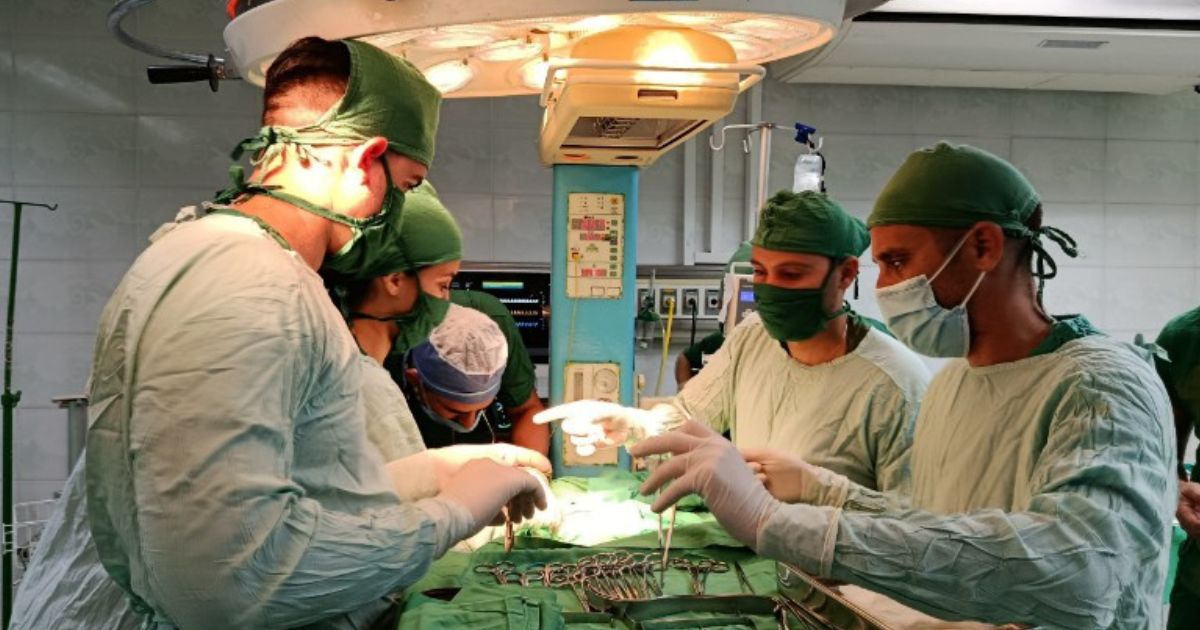
At just five days old, baby Samuel Orlando Milanés García began exhibiting worrying symptoms: persistent vomiting, refusal to eat, and general discomfort that alarmed his mother, Sandra García.
What initially seemed like a minor issue quickly escalated into a grave diagnosis: a congenital duodenal obstruction. This condition prevents food from passing normally from the stomach to the small intestine and requires immediate surgical intervention.
According to the official newspaper Ahora from Holguín, Samuel was transported from the province of Granma to the Regional Center for Neonatal Surgery. Here, a medical team prepared to operate under intense pressure.
This facility, with over 40 years of expertise, handles the most challenging cases of newborns from eastern Cuba. Samuel's condition was critical; an abdominal X-ray revealed the obstruction, setting off a chain of urgent medical actions.
Following medical protocol, the team swiftly suspended oral feeding, stabilized the infant, and scheduled the surgery. Dr. Yanet Hidalgo Marrero, the lead surgeon, emphasized, “We work with extremely fragile structures; a millimeter can make the difference between success and failure.”
The operation, complex and high-stakes, aimed to restore normal food passage. A team of specialists—including surgeons, anesthesiologists, and neonatologists—worked meticulously to stabilize Samuel and correct the malformation without complications.
Sandra recounted her ordeal to the Holguín media outlet, describing it as a nightmare: “It was like a horror movie. We had no idea what was wrong. It could have been an infection or a malformation, and everything was happening too fast,” she recalled, still emotional.
Amidst the uncertainty, Sandra praised the medical staff for their clear communication and support: “They explained everything and were with us every step of the way.” The family's emotional relief amidst the crisis was bolstered by this closeness.
The Octavio de la Concepción y de la Pedraja Pediatric Hospital, where the surgery took place, struggles with a lack of essential medical supplies like catheters, antibiotics, and specialized sutures.
Despite these shortages, the specialists prioritized Samuel's case, ensuring he emerged stable from surgery. Now, Samuel is recovering under medical supervision. His story, shared by Ahora, captures the blend of fear, hope, and resilience experienced by many Cuban families when a child's health hinges on limited resources and the relentless dedication of healthcare workers.
Understanding Duodenal Obstruction in Newborns
What is congenital duodenal obstruction?
Congenital duodenal obstruction is a condition present at birth where a blockage prevents normal passage of food from the stomach to the small intestine, requiring surgical intervention.
How is duodenal obstruction diagnosed in infants?
In infants, duodenal obstruction is often diagnosed through symptoms such as persistent vomiting and refusal to eat, confirmed by imaging tests like an abdominal X-ray.
What challenges do Cuban hospitals face in treating such conditions?
Cuban hospitals often face shortages of medical supplies, including catheters, antibiotics, and specialized sutures, which can complicate treatment for conditions like duodenal obstruction.