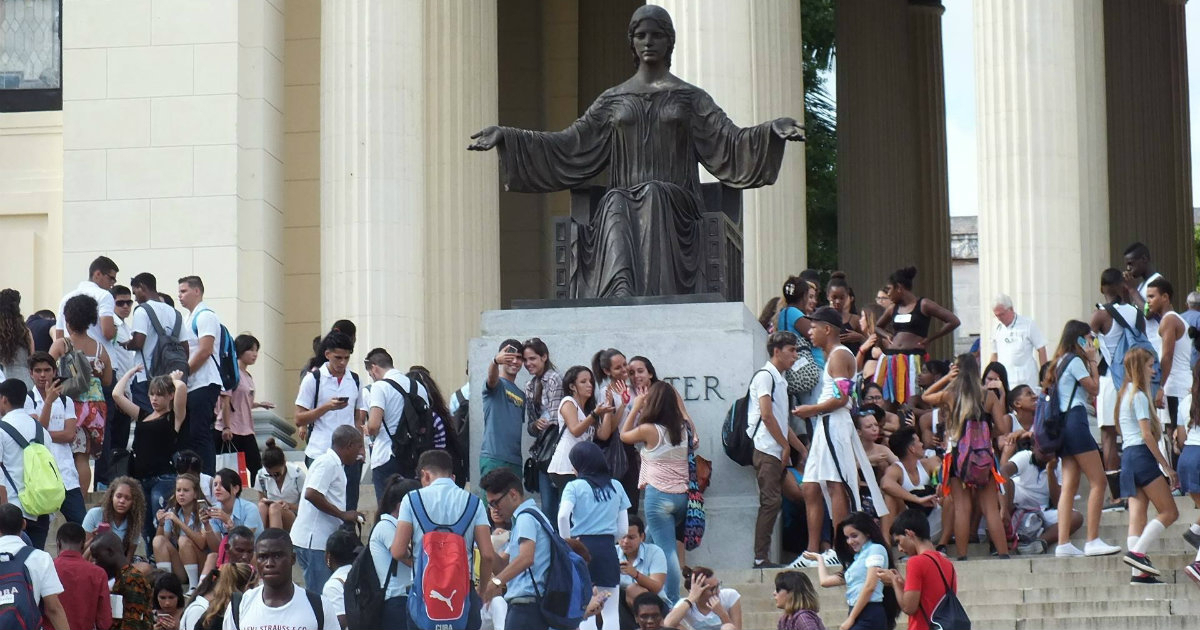
Pursuing higher education in Cuba no longer secures a promising future, nor does it ensure a stable present. Due to the severe economic crisis and inadequate stipends, university students have been turned into forced laborers, compelled to juggle their studies with informal employment to make ends meet. While this situation is commonplace in numerous countries, it was once unimaginable in the Caribbean nation.
The state-run newspaper, Juventud Rebelde, acknowledged in a report that thousands of university students in Cuba are forced to work to sustain themselves because of the insufficient state stipends and the overall economic downfall. The publication features accounts from young people across various provinces who, amidst classes, low-paying jobs, and sleepless nights, strive to complete their education in the face of a crisis that directly impacts their livelihood and career goals.
“We need to earn money to support our families,” revealed one student interviewed, a Computer Engineering major at Universidad de Sancti Spíritus, who opted for an administrative job to cover his expenses. “If we organize ourselves properly, we can certainly manage,” he added, though his statement underscores the normalization of hardship.
According to data from the Ministry of Labor and Social Security cited by Juventud Rebelde, 2,842 students are currently employed part-time in the state sector, with over 2,100 being university students. However, the actual number is likely much higher, as the report acknowledges the presence of young workers in the private sector without formal contracts or labor protection.
Alternative Paths Chosen by Students
One of the most telling stories is that of an Accounting student who abandoned his Engineering studies to take up self-employment in the field of sublimation and printing. “I earn better and have a legal contract, even if it's not related to my degree,” he explained. His experience highlights a growing trend: young people are prioritizing immediate income over their professional calling.
The article also showcases cases of students who balance their studies with jobs in bars, cafeterias, or as construction assistants, all without any legal protection. “I worked for extended periods without a contract, and no one demanded one,” admitted a student from Holguín, as Juventud Rebelde describes this trend as a “serious violation of labor standards.”
Insufficient Stipends and Lack of Support
The publication also admits that state stipends are so low that they are merely symbolic. Since the Reorganization Task, students receive between 200 and 600 Cuban pesos monthly, a sum insufficient to cover even a weekly inter-provincial trip or a meal near the universities. “Eating a pizza can cost 250 pesos,” an interviewed student illustrated.
However, the official report avoids questioning the structural causes of this precariousness. It omits the government's role in the devaluation of academic work and the lack of real incentives for the youth. It also fails to mention that most universities lack cafeterias, adequate dormitories, or basic resources to ensure student life.
The outcome is a generation formed under extreme conditions, pushed into the informal economy, faced with an uncertain professional future, and lacking motivation to remain in the country. A Journalism student in Havana summed up the situation best: “If things were different, I wouldn't have to think about how to study, work, and survive at the same time.”
What Juventud Rebelde frames as “youth responsibility and sacrifice” is, in truth, a reflection of a structural crisis that forces young people to uphold a system that offers them neither guarantees nor a future.
Understanding the Economic Strains on Cuban Students
Why are Cuban university students forced to work?
Cuban university students are forced to work due to the country's severe economic crisis and the inadequacy of state-provided stipends, which are insufficient to cover basic living expenses.
How have students adapted to these challenges?
Students have adapted by taking on informal or part-time jobs, often unrelated to their field of study, to generate income necessary for supporting themselves and, in many cases, their families.