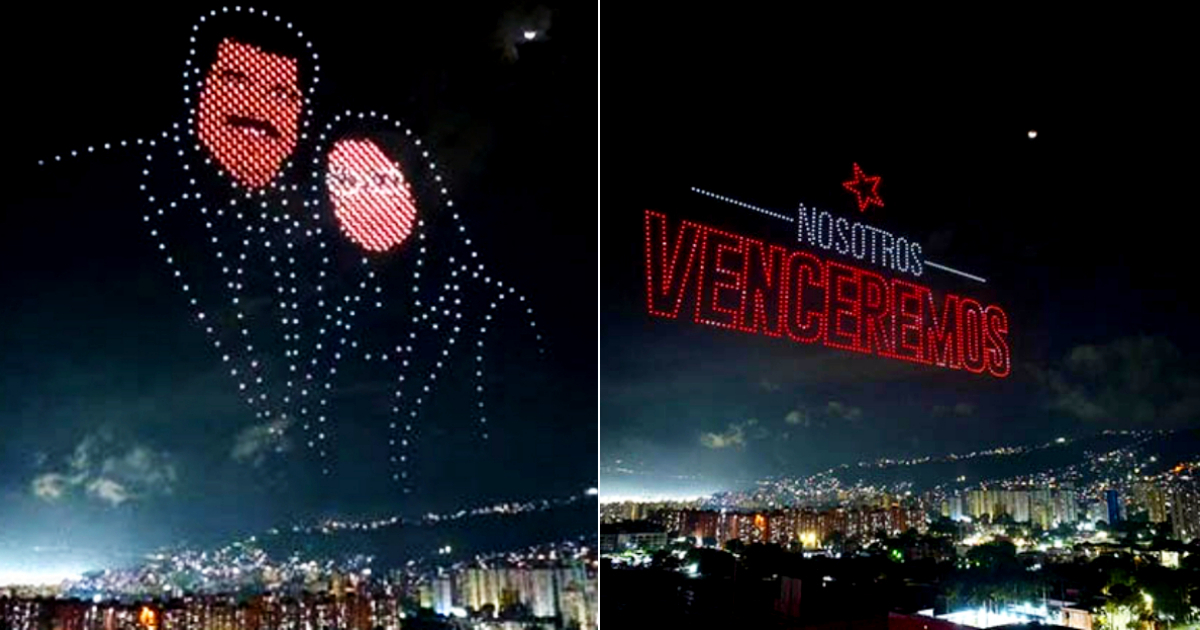
While Cuba is plagued by relentless power outages, Cubadebate published photos that seemed to belong to a different universe: a sky lit up with drones, featuring smiling portraits of Nicolás Maduro and Cilia Flores, alongside the message "We will prevail."
The official narrative touted it as a "spectacular technological display in support of President Nicolás Maduro and the First Lady," with hundreds of drones illuminating "the capital's sky"... but it was in Caracas.
The issue, however, is that the "president" in question is detained in the United States, and the "capital sky" enthusiastically described by the state-run media led to immediate confusion among readers.
Within moments, the post unleashed a wave of sarcasm across social media.
“Those drones have more energy than what was given to Havana last night,” remarked one user, a sentiment that quickly became a recurring theme in the comments. Another joked, “They should send those drones to Cuba, maybe they could at least light up the neighborhood.”
The images depicted thousands of bright points forming figures: a couple many interpreted as Maduro and his wife; a text reading "I am innocent, not guilty"; and another proclaiming "We will prevail."
The display was intended as an act of “Bolivarian” solidarity orchestrated by chavismo leaders—those unidentified flying objects still buzzing over Miraflores—but it instead became a target for widespread ridicule.
“If that happened in Cuba, the miracle isn’t the drones, it’s having power to charge them,” another commentator quipped. “The only light show we see here is when the electricity comes back for five minutes and everyone claps,” someone else added.
Some comments were more direct: “What they spent on that show could repair a power plant” or “Capital sky from where? Because with that much light, it surely isn’t Havana.”
Among the memes that flooded Facebook, one showed drones spelling out “S.O.S.” over a map of Cuba; another, a modified version of the original photo with the text: “We will turn the lights off.”
The Cubadebate article—published just three weeks after the capture of Maduro and his wife by a Delta Force unit in an operation ordered by President Donald Trump—aimed to show support for the “Bolivarian leader,” but backfired.
Cuban sarcasm spared no one: “Maduro gets lit up by drones, we get darkness”; “That’s not artificial intelligence, it’s revolutionary idiocy”; “The only drone flying in Cuba is the one delivering chicken to the store.”
“If they did a show like that here, they’d write S.O.S. in the sky… until the power goes out,” suggested one user. Another concluded, “The Caracas sky full of lights, and Cuba’s full of mosquitoes.”
With over a thousand reactions and hundreds of comments, the post became a session of collective humor. Some compared it to a science fiction movie, others to a political satire. “The spectacle was as real as the MINSAP reports,” one wrote.
There were also political reproaches: “They publish tributes to a narco-dictator while the Cuban people have been without power for 40 hours. That’s the real news, Cubadebate.” Another pointed out: “First lady now, wasn’t she the first combatant? Clearly, even the chavista script is forgotten.”
The context in Venezuela makes the spectacle even more absurd. Following the arrest of Maduro, his wife, and several high-ranking officials, Delcy Rodríguez assumed the role of interim president, backed by the chavista faction attempting to cling to power while the United States directs political transition from Caracas.
The alleged drone shows appear to be an effort to sustain a narrative of resistance that few still believe.
But in Cuba, where flying a drone remains illegal without Ministry of the Interior authorization, Cubadebate’s publication sparked something deeper: a sense of complete disconnection between official media and real life.
“Instead of drones, send us power. Or bread. Or water. Or shame,” wrote one internet user, and the “likes” multiplied. Another summed up the public sentiment: “The government spends on honoring foreign prisoners while Cubans remain imprisoned by blackouts.”
There was even room for sharp political humor: “Delcy Rodríguez spending drones to request freedom for the one she handed over.”
“Let’s see when Cuban drones draw Díaz-Canel... but flying towards New York,” quipped a user, echoing the expectations of many Cubans. “Neither Chávez lives, nor does Maduro return, nor does the power come back,” concluded another.
Amid the energy crisis, the state-run article served as a catharsis. “Cubadebate, read your comments, not one in favor. This seems like black humor sponsored by UNE,” noted a reader.
In the end, the drones meant to pay tribute to the fallen dictator highlighted the ingenuity of the Cuban people, who survive on irony and resilience.
Because in the Cuba of 2026, with the country in darkness and empty refrigerators, people are no longer surprised by anything: not the blackouts, not the tributes to alleged imprisoned narco-terrorists, nor the “capital sky” that Cubadebate portrays resembling a poorly told joke.
As one of the most shared users commented: “While the drones draw imaginary heroes, Cubans continue to light up with sarcasm.”
Questions About Drones and Energy in Cuba
Why did Cubadebate's drone post cause controversy?
The post was controversial because it showcased a drone show in support of Nicolás Maduro amidst ongoing power outages in Cuba, leading to public mockery and highlighting the disconnect between official media and daily life.
What was the Cuban public's reaction to the drone show?
The Cuban public reacted with sarcasm and humor, criticizing the energy used for the show while they faced blackouts, and mocking the state media’s portrayal of solidarity with foreign leaders.
How does the drone situation reflect on Cuba's current state?
The drone situation underscores the stark contrast between state priorities and the everyday struggles of Cubans, particularly as it relates to energy shortages and the lack of basic necessities.