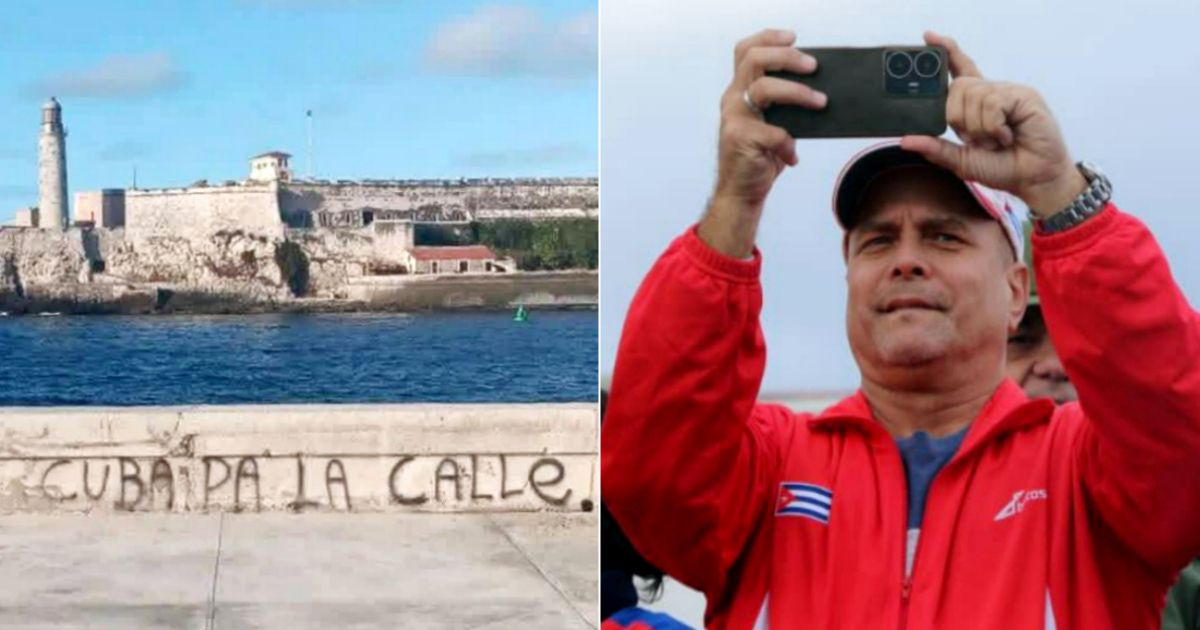
Gerardo Hernández Nordelo, a former spy turned influencer for Cuba's "continuity" campaign, once again found himself ensnared in his own propaganda narrative.
This time, the "general coordinator" of the Committees for the Defense of the Revolution (CDR) took to Facebook to post a comparison of posters, aiming to discredit a graffiti allegedly seen on Havana's Malecón with the statement "Enough is enough. Cuba to the streets."
With a sarcastic tone, Hernández Nordelo remarked, "Some anti-Cuban cybermercenary media think they're the only ones who can invent little posters..."
In an attempt to showcase his "revolutionary creativity," the humorous propagandist shared a doctored image that read "Out ICE! USA to the streets!" displayed on Miami Beach's iconic thermometer.
The alleged graffiti was indeed reported by the independent outlet Click Cuba, documenting the supposed action by activists from the Cuba Primero movement. Social media users also amplified the striking protest image.
Nevertheless, Hernández tried to attribute the message's spread to so-called "mercenary cyber media," inadvertently turning his mockery into an effective promotional campaign for a slogan that openly encourages Cubans to take to the streets.
If real, the graffiti—visible in front of the Castillo del Morro—would be part of a wave of graphic expressions of dissent emerging in various provinces like Camagüey, Santiago de Cuba, and Villa Clara, where messages such as "Homeland and life," "Down with Díaz-Canel," or "Freedom now" have appeared on walls, bridges, and bus stops.
The regime has responded with arrests and patrols, while its spokespersons attempt to downplay the protests as "media operations." Hernández Nordelo's response fits this narrative: nervous irony in the face of a message slipping beyond official control.
In his effort to prove the posters as "fake news," the ex-spy ended up spreading a genuine anti-government message and creating a clumsy forgery that, ironically, echoes the protest language he claims to oppose.
Once again, his enthusiastic propaganda backfired, as instead of debunking the protest, he magnified it on social media, making the call "Cuba to the streets" more visible than ever.
Understanding the Impact of Social Media Propaganda
What was Gerardo Hernández's intention with the Facebook post?
Gerardo Hernández aimed to discredit a protest graffiti message by mocking the idea and presenting a fake image to downplay its significance.
How did Gerardo Hernández's post backfire?
His post inadvertently amplified the anti-government message, making the call for Cubans to protest more visible and widespread.