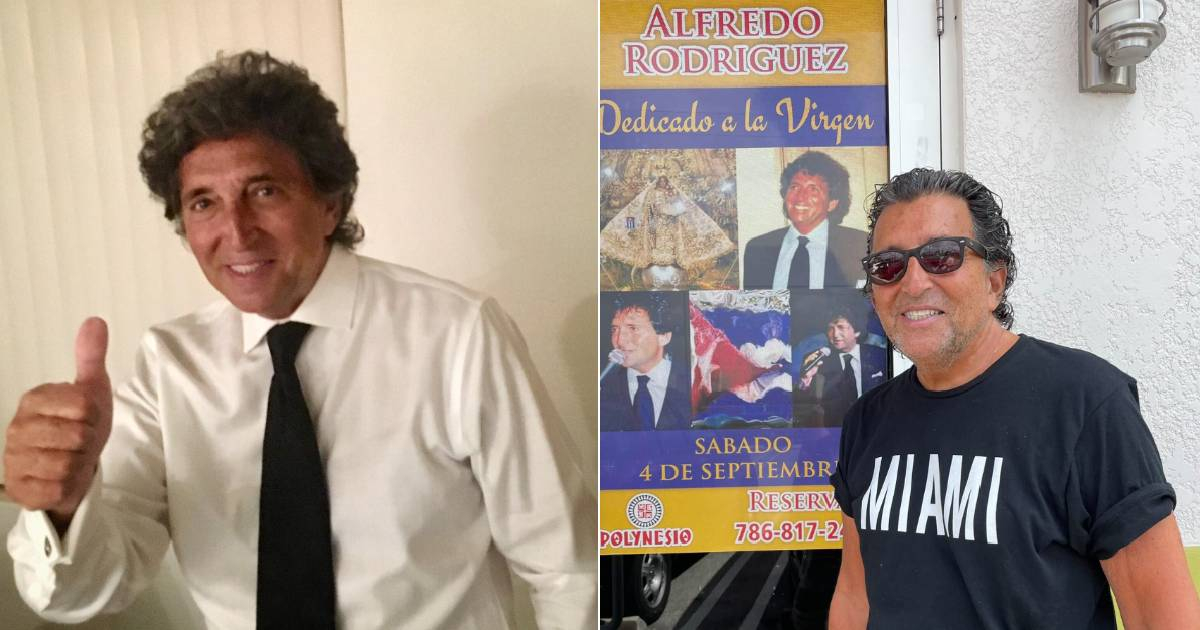
The recent passing of singer Alfredo "Alfredito" Rodríguez (1951-2026) in Miami was acknowledged by the Cuban state media. However, nearly every outlet avoided mentioning the location of his death, a symbolic act of censorship that once again highlighted the contradictions of the state's narrative.
Rodríguez's death on January 23 forced state-run media on the island to report on a figure who is deeply embedded in the cultural memory of the nation. Despite this, from the Cuban Institute of Music's (ICM) statement to outlets like Granma and Cubadebate, they carefully sidestepped the exact location of his death, as if it were an inconvenient or morally inappropriate detail, noted journalist Wilfredo Cancio Isla.
The omission was nearly complete. "Only Juventud Rebelde dared to mention he died in... the United States," the reporter pointed out on his Facebook profile.
Other media outlets provided a sparse and formal announcement of his death, devoid of context, perpetuating a common practice of officialdom: to report without fully reporting, especially when it touches on the sensitive topic of exile and, particularly, Miami.
"At this point, nothing should surprise us about Cuban media and their scribes. This is a minor detail amid the ongoing saga of omissions we're accustomed to. Yet, it's truly laughable that in a country facing a rampant and harrowing crisis on all levels, there's still time for censorship to focus on something as simple as censoring the 'forbidden city,'" he assessed.
Cancio emphasized that the contrast was even more striking because the announcement came shortly after the Cuban government published the Transparency and Access to Public Information Law in the Official Gazette on January 9, presented as a step toward "truthful, comprehensive, and participatory" governance.
"We shouldn't harbor illusions about laws and papers issued by a spurious regime that has been masterful in manipulation strategies and centralized control of public information. But the fact that there is still scrutiny to avoid mentioning where a popular singer dies is an unequivocal sign that our country is in a dire state, and reversing this grotesque spectacle that is a declining Castrism is going to be extremely exhausting," he argued.
The censorship of a basic fact like the location of a popular artist's death reveals, to many observers, the gap between legal discourse and the everyday practice of information control.
Alfredito Rodríguez, one of the most beloved voices in Cuban popular music for decades, passed away far from the island at the age of 74, but his absence could not be ignored.
What was meticulously avoided was naming the place where his life ended, a seemingly minor detail that became a powerful metaphor for the state of official journalism in Cuba.
His family shared the news of his passing on social media, quickly sparking a wave of affectionate and appreciative reactions. His son, the talented pianist Alfredo Rodríguez Jr., wrote an emotional message promising to continue with the tour starting the next day: "I'll keep going 'Palante y Palante,' as you would have wanted, and we'll meet again."
From Miami to Havana, from international stages to the emotional memory of those who witnessed his artistic growth, Alfredito was bid farewell with a shared sentiment: gratitude.
Numerous Cuban artists from various fields have also expressed their sorrow, including Albertico Pujol, Carlos Otero, Mirtha Medina, Rebeca Martínez, Pancho Céspedes, Rojitas, Amaury Gutiérrez, Jorge Ferdecaz, Laritza Bacallao, Yuliet Cruz, Marcos García, and Andy Vázquez, among others.
How Cuban Media Handles Reporting on Exile-Related Topics
Why did Cuban media avoid mentioning Miami in Alfredito Rodríguez's death announcement?
Cuban media often avoids mentioning Miami due to its symbolic representation of exile, which is a sensitive topic for the regime. By omitting the location, they maintain control over the narrative and avoid acknowledging the significance of Miami in exile discourse.
What does the omission of Miami in the death announcement signify about Cuban journalism?
The omission highlights the Cuban media's practice of censorship and manipulation of information. It underscores the gap between the state's legal commitments to transparency and the actual practice of controlling sensitive information.