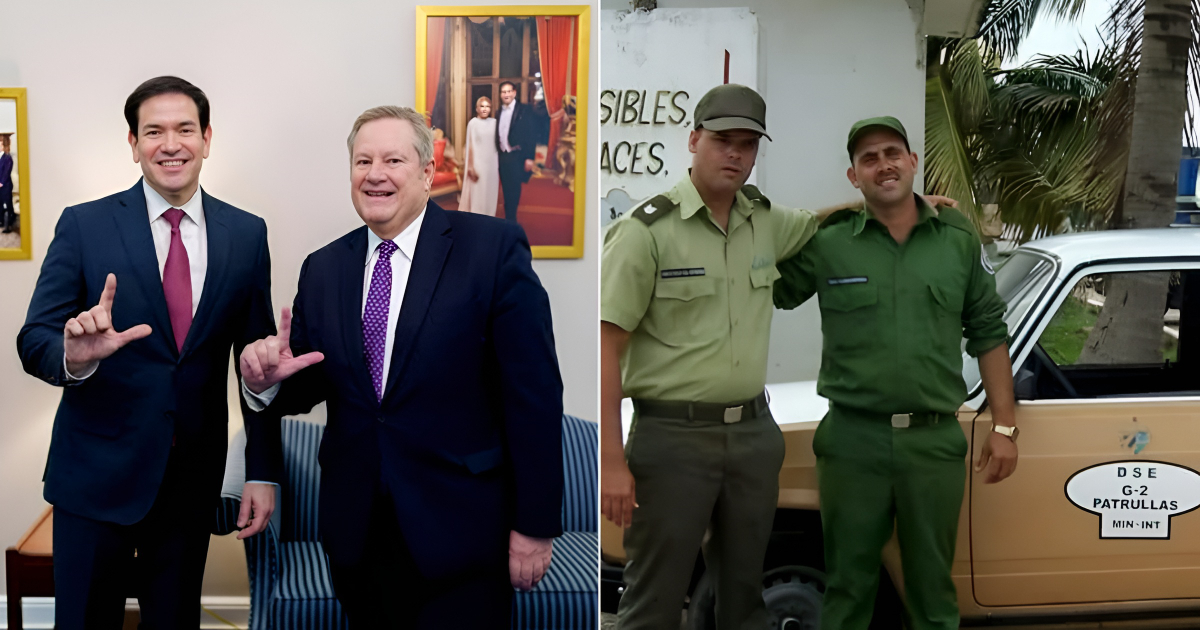
The Cuban regime's State Security has issued a warning that it will "prevent future meetings" between Mike Hammer, the U.S. Chargé d'Affaires in Cuba, and members of civil society. This has sparked a wave of public reactions both inside and outside the island.
Within hours, CiberCuba's report on the incident generated thousands of comments, ranging from indignation and defiance to political humor and hope for an imminent end to the regime.
"If they touch him, it's all over," summarized one reader, a sentiment echoed in various forms: "Let them try, and see what happens," "Mess with the chain, not the monkey," or "That's when things will really get serious."
Others were more direct: "If they lay a hand on him, the aircraft carriers will come," "That's when the Delta Force arrives," "That would be their final sentence."
The overarching message: the Cuban people view the U.S. diplomat as a familiar and untouchable figure, whose potential harm could lead to immediate international repercussions.
Many users interpreted the regime's warning as a sign of fear. "They're panicking; they can't control anything anymore," commented one user. Another remarked ironically, "They're so scared, the fear is showing."
The word "fear" in its various forms was frequently used: "Fear, terror, panic," "they're terrified," "they don't dare."
Hammer as a Symbolic Figure
In contrast, Hammer has been elevated to the status of a moral and political symbol, admired and loved: "That man does more for the Cuban people than all the Party members combined," "We love him from Cuba," "God bless him."
There were also calls for direct action or future justice: "All those repressors will have to pay when the dictatorship falls," "Prepare yourselves, trials will come," "The people's hour is near."
Some users used openly violent language: "Shoot them," "Burn them alive," "Hang them from the Capitol." Although these messages were in the minority, they reflect a pent-up social catharsis and a desire for retribution against the State's oppressive structures.
Voices of Dissent
Among the flood of opinions, a small minority—less than 5%—supported the government's stance. Some argued that the diplomat "violates protocol" or "engages in political interference," calling for his expulsion from the country.
Comments like "Deport him, he's an insolent who conspires with criminals" surfaced. Others claimed that "diplomats everywhere need permits to travel outside the capital," attempting to justify the warning as "standard procedure."
However, these comments were quickly buried by hostile replies: "Cowards, you're suffocating the people"; "You don't represent anyone"; "Don't hide behind a flag to justify repression."
Responses from the Cuban Diaspora
Within the diaspora, reactions ranged from mockery and sarcasm to hopes for intervention. "Do it, so Trump has a reason," one user wrote, directly referencing the U.S. president.
"Arrest him, and you'll see missiles rain down," commented another. Several explicitly mentioned Marco Rubio, the current Secretary of State, as a key figure: "Marco won't let this slide"; "If they touch him, Rubio will order action."
The general tone was one of patriotic defiance: "Down with the murderous dictatorship," "Homeland and Life," "Death to communism."
Some combined humor with warning: "Don't start a war that's not yours"; "Leave the monkey alone"; "Play with the chain, not the Rhino." Others invoked religious imagery: "God will punish you"; "Judgment is coming"; "The future is here."
Expressions of Unity
The dominant sentiment was one of symbolic unity against the threat: "If they touch Hammer, they touch the Cuban people."
Within Cuba, many saw the incident as evidence of the totalitarian regime's isolation and fear of transparency.
"They don't want the truth to be known, that's why they persecute those who listen to the people," said one comment. Another summarized: "The dictatorship fears words, not weapons."
"The State is called Security, but it's only secure for those at the top," wrote a user, referencing the daily repression against ordinary citizens.
There were also messages connecting this case to the country's broader crisis: "Even baseball is censored"; "You can't even watch soccer live anymore"; "The people are suffocated."
Several users denounced the government's double standards, recalling that Cuban diplomats in Washington "freely engage in politics," while the regime tries to "confine" the U.S. representative.
A small, less combative but equally critical group called for caution to avoid a violent scenario. "Don't go crazy; in the end, families suffer," commented one user, evoking Venezuela's example.
Others urged Hammer to "keep doing his job, but carefully": "We need him alive, not a martyr," read one of the most shared messages.
Overall, CiberCuba's publication became an emotional barometer of Cuba's political moment: a nation divided between internal resignation, accumulated fury, and the hope for imminent change.
The digital reaction demonstrated that, beyond ideological nuances, there is a broad consensus: repression no longer intimidates; it is perceived as a sign of weakness, not strength.
As one widely supported comment summarized: "The fear has changed sides. It used to be the people who feared speaking out; now it's the regime that fears being heard."
Understanding the Cuban Regime's Threats
Why did the Cuban regime threaten Mike Hammer?
The Cuban regime threatened Mike Hammer to prevent him from meeting with civil society members, viewing his actions as interference and a challenge to their authority.
How did the Cuban public react to the threat against Hammer?
The Cuban public reacted with outrage, seeing Hammer as a symbol of hope and protection. Many expressed defiance against the regime and viewed the threat as a sign of its fear and weakness.
What implications could the threat have on international relations?
The threat against Hammer could strain Cuba's international relations, particularly with the United States, as it signals a potential escalation in diplomatic tensions and challenges to international norms.