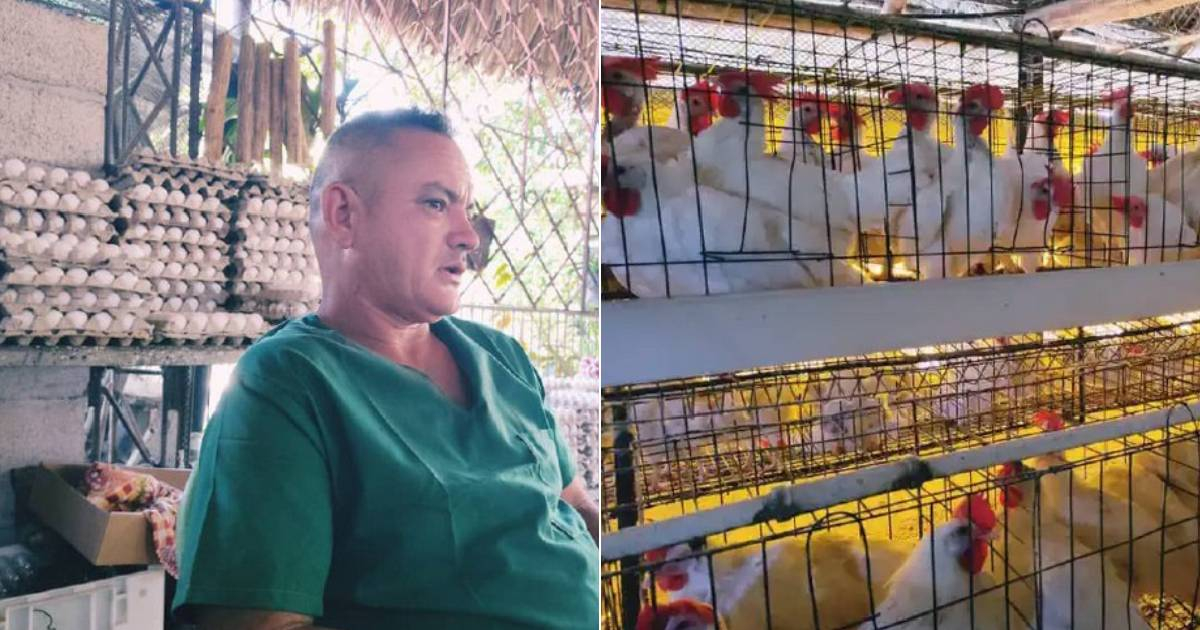
As Cuba grapples with one of its most severe egg shortages in recent history, state media in Villa Clara has highlighted the validation of a mineral supplement that strengthens eggshells, even as millions of households continue to lack reliable access to this essential food item.
Developed by the state-owned company Geominera del Centro in collaboration with the University of Marta Abreu of Las Villas, the Poultry Corrector for Laying Hens has shown "favorable" results in its experimental phase, according to reports from the Cuban News Agency.
Project leaders claim the product enhances eggshell strength, reduces breakage losses, and improves poultry health.
The trial, which began in December 2025 and is nearing completion, is being conducted at the Patio Titi laying farm in Santa Clara. Various supplementation schemes were tested against a control group and an imported supplement.
Specialists noted that the best results were achieved when the domestic supplement was administered in the afternoon, resulting in a laying rate exceeding 75% and better calcium absorption.
Project officials emphasized that 2.5 tons of the supplement have already been produced, highlighting its strategic advantages as a national product purchased with local currency and designed to replace imports.
Technically, they celebrated the production of "ideal" sized eggs, weighing over 48 grams with a firmer shell.
However, the official enthusiasm contrasts sharply with the country's reality. Cuba increasingly relies on egg imports, particularly from the Dominican Republic, where producers have acknowledged shipping about 65 million units monthly to the island, a figure that quadruples previous official estimates.
Additional imports come from the United States and Colombia, despite the regime's insistence on blaming the scarcity on the embargo.
Economists like Pedro Monreal have warned that the decline in national egg production following the 2021 economic "reordering" is more severe than during the Special Period.
In 2024, the Ministry of Agriculture itself admitted that, from producing between four and five million eggs daily, the country barely reached 1,200,000 when it managed to feed the poultry population.
Meanwhile, the State has promoted cooperative production schemes where micro, small, and medium-sized enterprises (MSMEs) and private suppliers receive up to 70% of the eggs, while state poultry retains only 30%, further highlighting the sector's structural fragility.
Yet, eggs remain an almost unattainable commodity for large segments of the population, with informal market prices far exceeding wages and pensions.
In this context, the validation of a supplement that prevents eggshell breakage is presented as a scientific achievement, but it leaves the central question unanswered: what good is a sturdier egg if most Cubans cannot afford to buy it or put it in the pan?
Cuba's Egg Supply Challenges
What is the purpose of the Poultry Corrector for Laying Hens?
The Poultry Corrector for Laying Hens is designed to strengthen eggshells, reduce breakage losses, and improve poultry health.
Why does Cuba rely on egg imports?
Cuba relies on egg imports due to a significant decline in national egg production, exacerbated by economic restructuring and other challenges within the poultry sector.
How does the current egg shortage affect Cuban households?
The egg shortage affects Cuban households by limiting access to a basic food item, with informal market prices surpassing what many can afford on their salaries and pensions.