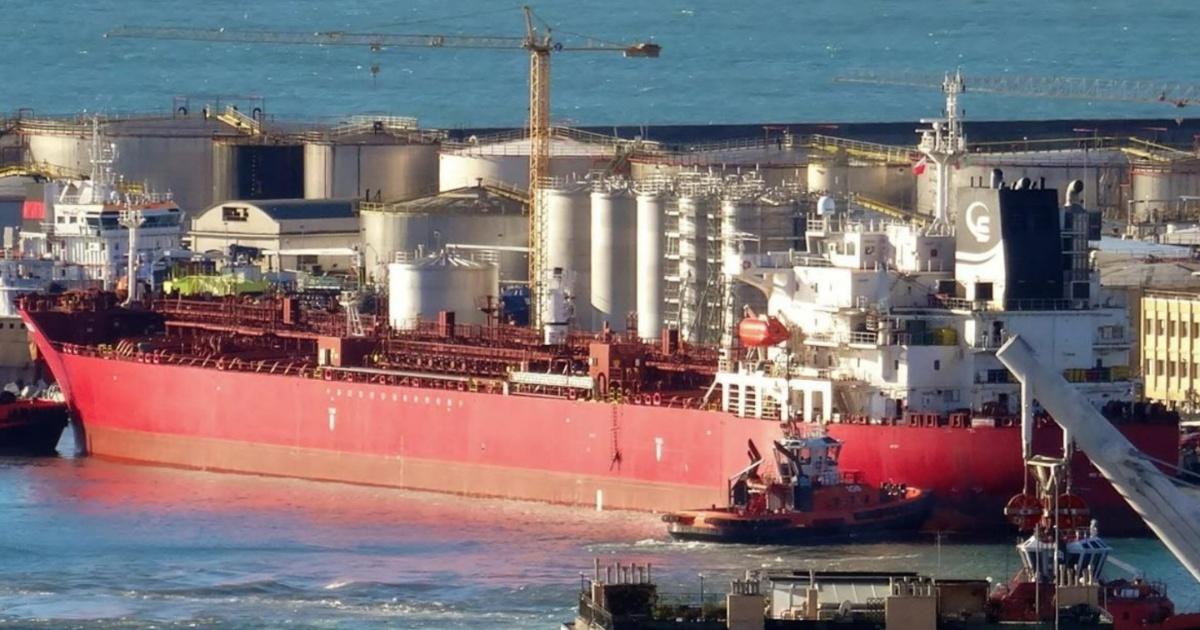
On Saturday, it was revealed that the chemical tanker Mia Grace, which departed on January 19th from Lomé, Togo, with a planned destination of Havana, has changed its course and is now heading towards the port of Río Haina near Santo Domingo. This vessel is expected to arrive on February 2nd.
Satellite tracking platforms have indicated that the ship, flying the Marshall Islands flag, altered its intended destination while crossing the Atlantic. This has sparked uncertainty about whether its cargo of fuel—assumed to be diesel or fuel oil—will eventually reach Cuba or be offloaded elsewhere.
Río Haina is a key commercial port in the Dominican Republic, specializing in handling general cargo, liquids, and chemicals. It is located in proximity to the Dominican Petroleum Refinery (REFIDOMSA), which is responsible for refining and importing petroleum derivatives.
The Mia Grace, a tanker for oil and chemical products, measures 183 meters in length and 32 meters in width, with a deadweight tonnage of 50,000 tons.
Reasons Behind the Change in Course
Reports and experts suggest various possible reasons for this course change, though no official explanation has been confirmed. Cibercuba examines two likely scenarios.
The ship initially departed from the port of Antwerp, Belgium, where GAESA has made occasional purchases in the past, before heading to Togo for its load.
The route diversion coincides with a worsening energy crisis in Cuba, further deteriorating the already precarious daily life of thousands of families, leading to public protests against power outages.
The public anxiously awaits clarity on whether the vessel will deliver its cargo in the Dominican Republic or change its plan once more. The logistical challenges translate into increased uncertainty for a nation urgently in need of fuel.
Spot Purchases and Complex Logistics
Specialists propose that the fuel may have been acquired by the state-owned company Cubametales (part of the GAESA conglomerate) through a European intermediary, complicating logistics and potentially altering the delivery plan.
Jorge Piñón, a non-resident fellow at the University of Texas Energy Institute, revealed to Diario de Cuba that the ship might carry a spot purchase made by Cubametales, owned by the GAESA Business Group, with a European trader acting as an intermediary.
"The quality of the cargo is unclear, but we speculate it could be diesel or fuel oil. Togo lacks oil refining capabilities but exports refined oil and hosts significant maritime transit and logistics infrastructure," Piñón explained.
The expert estimates the ship might be transporting approximately 314,500 barrels of diesel or 280,500 barrels of fuel oil. "It seems not to be fully loaded, given its draft," he noted.
The Mia Grace originally set sail from Antwerp, Belgium, where GAESA has made occasional purchases in previous years, before heading to Togo to collect its cargo.
Geopolitical Context
Geopolitical factors and international pressure, linked to U.S. sanctions and fears of potential repercussions for transporting fuel to Cuba, might have influenced the decision to change the destination.
News of the course change coincided with reports that the administration of President Donald Trump is considering new measures to pressure for regime change in Cuba, including a possible total blockade on oil imports to the island, as reported by Politico. This information was shared by three individuals familiar with the internal discussions.
The proposal—which has not yet been approved—would escalate previous announcements by Trump to halt oil shipments to Cuba from Venezuela. It is part of a package of actions that could be presented to the president.
According to sources cited by Politico, the idea is championed by critics of the Cuban government within the administration and reportedly has the backing of Secretary of State Marco Rubio, according to two of the three people consulted, all of whom requested anonymity due to the sensitive nature of the discussions.
Politico notes that no decision has been made on implementing the blockade.
One source described energy as the "chokehold" to "end" the regime, asserting that, in the view of those advocating for escalation, the overthrow of the communist government would be an "event" occurring in 2026.
The report indicates ongoing discussions within the U.S. government about the necessity of going "that far."
Understanding Mia Grace's Route Change
Why did the Mia Grace change its destination?
There are several potential reasons for the change in destination, including geopolitical pressures, logistical issues, and the worsening energy crisis in Cuba.
What is the significance of Río Haina port?
Río Haina is a prominent commercial port in the Dominican Republic, specializing in handling general cargo, liquids, and chemicals. It is also near the Dominican Petroleum Refinery (REFIDOMSA).
What role does GAESA play in this situation?
GAESA, a Cuban conglomerate, has made past purchases from Antwerp, Belgium, and its subsidiary Cubametales is believed to be involved in the fuel acquisition possibly being transported by the Mia Grace.