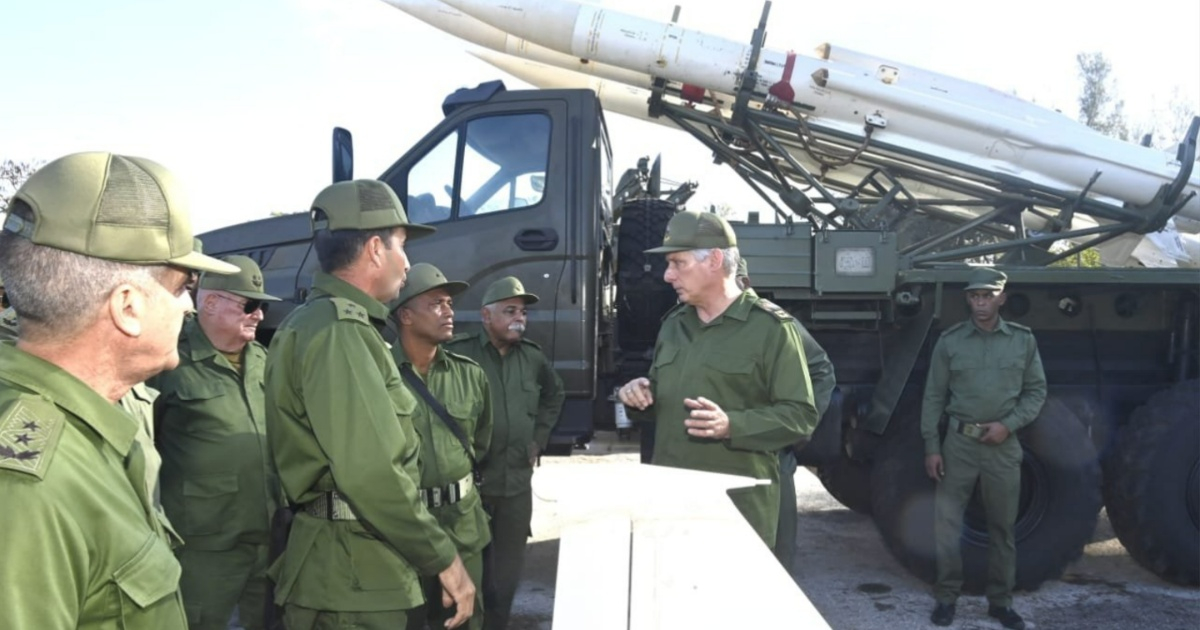
Amid strained relations with the Trump Administration, Cuban leader Miguel Díaz-Canel observed military drills this Saturday.
Díaz-Canel made appearances at the Gran Unidad de Tanques de la Gloria Combativa “Rescate de Sanguily” and later at an anti-aircraft defense unit, where he rallied the troops using the regime's customary propaganda slogans.
"The best way to deter aggression is for imperialism to consider the cost of attacking our country. This is closely tied to how prepared we are for such military responses," he asserted, according to a report from the Cuban Presidency.
Accompanying the leader were the top military brass of the regime: the Army Corps General and Minister of the Revolutionary Armed Forces (FAR), Álvaro López Miera; Army Corps General Roberto Legrá Sotolongo, First Deputy Minister and Chief of the General Staff of the FAR; and Army Corps General and Deputy Minister of the FAR, Joaquín Quintas Solá.
The president emphasized the significance of the drills, stating, "This is crucial in the current context, given the hegemonic offensive being developed by the United States government."
He further highlighted the high levels "of readiness, cohesion among you, and the cooperation between different components of the territorial defense system."
"By participating in these preparations for the defense of the homeland, unity is achieved. History has shown that when we unite, we always triumph," he added.
Following the capture of Nicolás Maduro on January 3, the Trump administration is reportedly working actively to instigate political change in Cuba before the year's end, according to an extensive investigation by The Wall Street Journal.
U.S. officials cited by the newspaper claim Washington sees a "historic window of opportunity" to pressure the Cuban government towards collapse amid unprecedented economic decline and increasing regional isolation.
Although there is no declared military plan or official timeline, the White House's strategy focuses on intensifying economic, diplomatic, and symbolic pressures on the Cuban regime while seeking internal interlocutors willing to negotiate a potential transition.
In parallel with public pressure measures, the U.S. government has heightened discreet contacts with the Cuban exile community and civic leaders in cities like Miami and Washington.
The goal? To identify potential figures within the Cuban state apparatus who "see what's coming" and are willing to negotiate a peaceful exit.
According to the Wall Street Journal, multiple private meetings have been held to gather information on Cuban officials or military personnel "ready to recognize the historical moment" and break away from the leadership.
Understanding the Current U.S.-Cuba Tensions
What was the purpose of Díaz-Canel's visit to the military exercises?
Díaz-Canel's visit aimed to demonstrate military readiness and deter potential aggression, emphasizing the importance of preparedness amid U.S. tensions.
How is the U.S. administration attempting to influence Cuba politically?
The U.S. administration is intensifying economic, diplomatic, and symbolic pressures and engaging with Cuban exiles and civic leaders to encourage internal negotiations for a political shift.
What is the expected outcome of the U.S. strategy towards Cuba?
The strategy aims to collapse the Cuban regime through increased pressure and to facilitate a negotiated transition by identifying cooperative figures within Cuba.