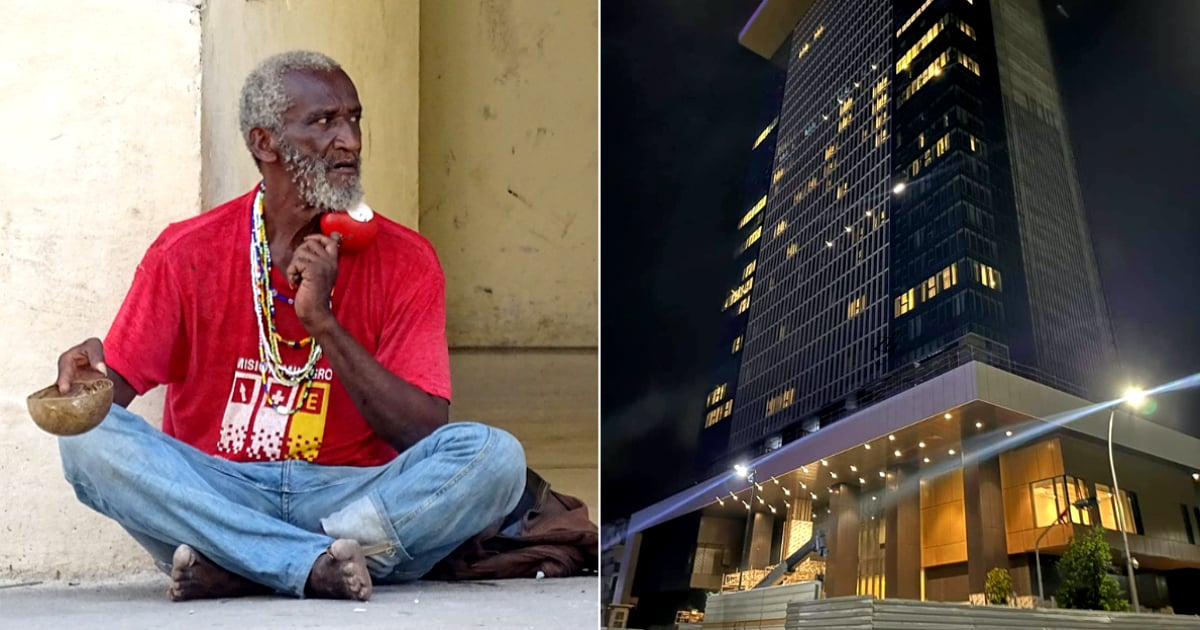
The tallest hotel in Havana, the controversial Torre K, stands illuminated amidst widespread power outages, symbolizing the stark contrast between the official narrative of a "blockade" and the reality in a country where sacrifice seems reserved solely for the general population.
Located in the heart of Vedado, this skyscraper was constructed during the COVID-19 pandemic and worsening economic crisis. It is notable not only for its height but also for its constant energy consumption in a city where entire neighborhoods, including Vedado itself, endure dark nights, hospitals lack supplies, and families are forced to cook with wood due to shortages of electricity and gas.
While millions of Cubans endure daily blackouts, the hotel gleams as a beacon of abundance, exclusive to tourists and the elite connected to the regime. This sentiment was echoed by citizen Orestes Reyno Amer in a Facebook post.
"Where is the blockade when tons of steel, cement, bulletproof glass, modern electrical systems, state-of-the-art elevators, central air conditioning, and high-powered lights were imported? Who financed it? Who approved spending millions on luxury while the country falls apart?" questioned Reyno, addressing the construction of the contentious skyscraper.
In his view, this opulence reveals that "there is no blockade for the regime’s businesses, no blockade for hotels, no blockade for the military or the ruling class. The 'blockade' only exists to justify the people's hunger."
The disparity is even more glaring against the national backdrop. Cuba is grappling with one of its worst economic crises in decades, characterized by a sustained decline in production, soaring inflation, prolonged blackouts, and a visible deterioration of basic infrastructure.
Despite this dire situation, the government has prioritized multi-million-dollar investments in the tourism sector, even as visitor numbers have not fully rebounded.
Recently, President Miguel Díaz-Canel acknowledged significant failures in agricultural production, food procurement, and market circulation, while urging a "change in mindset" to cut down on imports.
However, the hotel, aglow amidst the power cuts, reinforces the perception that austerity and scarcity are not equitably distributed.
Beyond the semantic debate between "embargo" and "blockade," the illuminated skyscraper serves as an uncomfortable testament against the official rhetoric.
"Cuba trades with dozens of countries, imports food from the United States, receives remittances, tourism, loans, and international aid. If there were truly a total blockade, this hotel could never have been built. But it was built. And not for Cubans, but for foreigners and the power elite," emphasized Reyno.
He believes that "this building is living proof that Cuba's problem is internal, not external. It's not Washington; it's Havana. It's not the embargo; it's corruption, waste, and utter disregard for the people. While Cubans are asked for 'resistance,' 'sacrifice,' and 'homeland,' the regime lives in light, air conditioning, and luxury."
For many Cubans, the building doesn't signify development or modernity, but rather a snapshot of imbalance.
To many, the focus on hotels is just another indication of the lack of strategy and vision in Cuba's political and economic model, which has lost the ability to retain its people and sustain the country from within.
The Cuban government continues to allocate enormous resources to hotel construction amid an internal economic crisis, with underutilized tourist infrastructures and no clear short-term recovery prospects.
The "tourism first" logic has led to the systematic deterioration of the rest of the productive apparatus, yet the government remains anchored to a strategy that yields no results, despite economists’ warnings about the need to settle debts, decentralize payment systems, and align supply with real demand.
Experts and citizens have criticized this approach, arguing that it does not meet the real demand or the country's urgent needs, deepening a devastating contrast: majestic hotels rise while overflowing trash piles up on Havana's corners, and more citizens face lives marked by poverty.
Understanding Cuba's Economic Disparities
Why is the Torre K in Havana a controversial symbol?
The Torre K is controversial because it remains fully illuminated and operational amidst widespread power outages affecting ordinary Cubans, highlighting the disparity between the regime's priorities and the hardships faced by the general population.
How does the Cuban government justify its investment in tourism?
The Cuban government prioritizes tourism investments as a strategy for economic recovery, despite the ongoing economic crisis and criticism that this focus neglects the urgent needs of the country's infrastructure and population.
What are the criticisms of Cuba's economic model?
Critics argue that Cuba's economic model lacks strategy and vision, focusing too heavily on tourism and failing to address broader economic needs, leading to a visible imbalance and deterioration of the country's overall infrastructure.