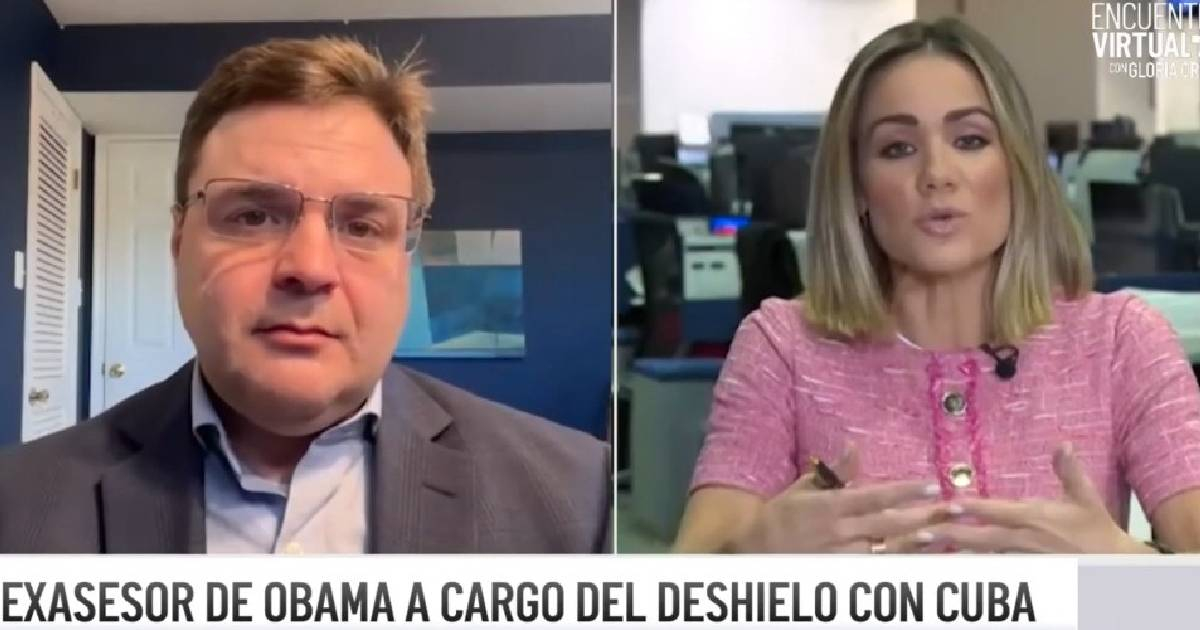
Over a decade after the thaw between the U.S. and Cuba, Ricardo Zúñiga, former advisor to President Barack Obama from 2009 to 2017, stated on Saturday that Cuba lacks the internal divisions seen in Venezuela that might allow for a negotiated exit from the regime.
During an interview with journalist Gloria Ordaz for Telemundo 51's Virtual Encounter, Zúñiga emphasized that the current situation in Cuba makes any internally negotiated transition difficult.
“There is no equivalent figure like Delcy Rodríguez,” said Zúñiga, who was directly involved in the secret negotiations of the 2014 thaw with Cuba. This comment refers to the role played by the Venezuelan leader and interim president following Nicolás Maduro’s capture on January 3.
Zúñiga elaborated that unlike Venezuela, Cuba maintains a "hard core" that firmly controls the security forces and state apparatus, without visible fissures that could be utilized in a political negotiation process.
This cohesion, he noted, was a key factor that thwarted the goals of the rapprochement initiated by Obama, intended as a long-term process aimed at improving citizens' lives and healing a Cold War-era wound.
The former official acknowledged that neither Havana nor the Trump administration took consistent steps to genuinely alleviate the Cuban people's situation.
A decade later, the outcome is a single-party dictatorship with a collapsed economy, increased political repression, and the largest migration wave in recent history, with over 1.5 million Cubans living abroad.
These statements come at a time when President Donald Trump has confirmed discreet communications with Cuba, while outlets like The Wall Street Journal recently reported that Washington is exploring a political resolution before the year ends.
Zúñiga, however, stressed that the Cuban scenario does not allow for the straightforward application of the Venezuelan model.
This analysis contrasts with recent views that identify Deputy Prime Minister Oscar Pérez-Oliva Fraga as a potential transitional interlocutor, given his close ties to the Castro family's military core (as a great-nephew of Fidel and Raúl Castro) and his technocratic profile.
For Zúñiga, the real lack of power fragmentation limits such prospects, reinforcing the notion that any change in Cuba will rely less on individual figures and more on a deeper systemic collapse.
Ten years after the thaw, the former negotiator concluded, the relationship between Washington and Havana is once again at a critical juncture, but with fewer illusions about internal reforms and a regime still committed to endurance over transformation.
Cuban Regime and Political Transition
What are the main obstacles to a negotiated transition in Cuba?
The main obstacles include the cohesive control of the security forces and state apparatus by a "hard core," and the absence of internal divisions that could be leveraged for negotiation, unlike in Venezuela.
How did the U.S.-Cuba thaw under Obama impact the current situation?
The thaw, intended to improve citizens' lives and mend historical wounds, was hindered by the regime's cohesive power structure and lack of sustained efforts from both Havana and the Trump administration to genuinely improve conditions.