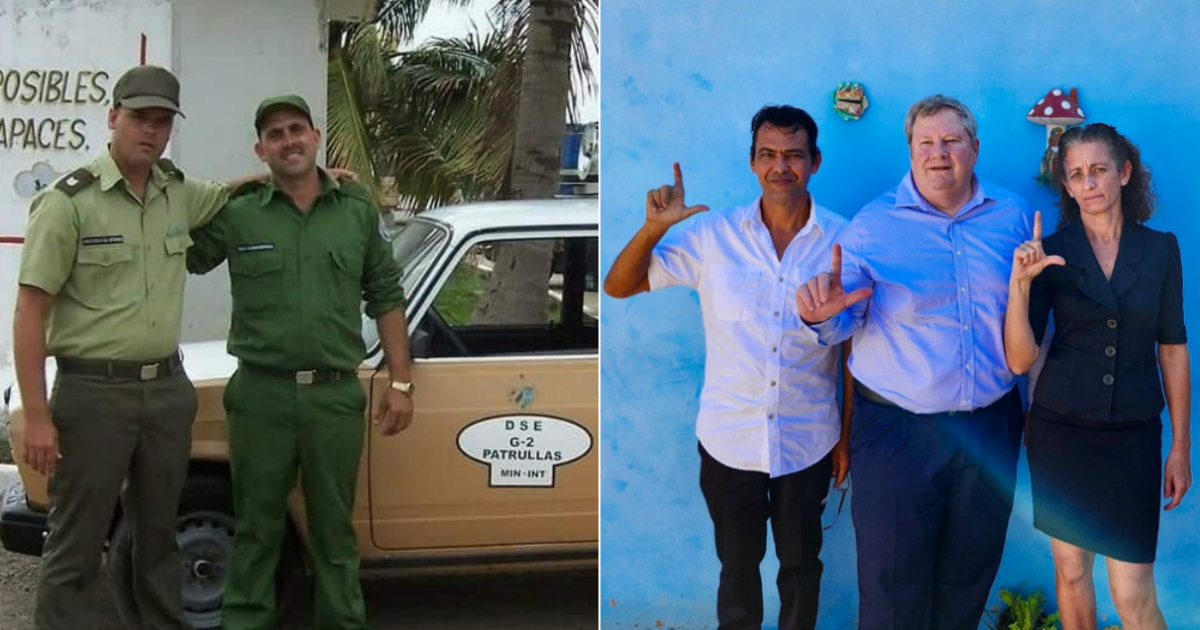
Cuban State Security has announced its intention to prevent any further interactions between Mike Hammer, the Chargé d'Affaires of the U.S. Embassy in Cuba, and representatives of Cuban civil society. This declaration comes after Dagoberto Valdés Hernández, director of the Center for Coexistence Studies (CEC), was interrogated, according to the center's reports.
The CEC released a statement indicating that the officers who detained and questioned Valdés in Pinar del Río made it clear that they "would not allow the American diplomat to make contact with individuals and use them for his objectives amid the current situation in Cuba."
The Cuban regime has labeled Valdés's recent meeting with Hammer as "collaboration with a foreign power that threatens to invade the island." This meeting, described by the CEC as humanitarian, focused on the distribution of aid donated by the United States through the Catholic Church.
Valdés was brought to the provincial headquarters of State Security, where he underwent an interrogation lasting over two hours. Several officers, including Major Ernesto, who is responsible for "overseeing" the Center for Coexistence Studies, and the head of the Legal Department, were involved.
During the interrogation, agents read excerpts from a column published by Valdés, in which he urged Cubans to prepare for a peaceful change. The officials accused him of "terrorism" and sharing enemy ideas, warning that they "will not allow the same as happened in Venezuela."
The CEC reported that the police operation also involved the detention of collaborator Yoandy Izquierdo Toledo, who was likewise interrogated. Both were later released, though Valdés refused to sign the warning document imposed by authorities.
This incident is part of an increasing wave of harassment against Catholic activists and religious figures, such as priests Alberto Reyes Pías and Castor José Álvarez Devesa, who were summoned by State Security this week for their criticisms of the political system.
The warning against engaging in dialogue with foreign diplomats underscores the regime’s strategy: to shut down channels of exchange and criminalize international cooperation with independent actors on the island.
The Dynamics Between Hammer and Cuban State Security
Mike Hammer, serving as the Chargé d'Affaires of the U.S. Embassy in Cuba, has become a notably visible and simultaneously challenging diplomatic figure for the Cuban regime. His approach—characterized by venturing out of the embassy, traveling through provinces, and engaging with sectors not controlled by the state—breaks with the traditional passive stance of the diplomatic corps in Havana.
Hammer's agenda prioritizes human rights, freedom of expression, and support for civil society, which the regime perceives as interference. Recently, he has been seen meeting with independent journalists, activists, families of political prisoners, and religious leaders, signaling that Washington acknowledges the Cuban people as legitimate interlocutors, rather than the Communist Party apparatus.
The Cuban state's response has been swift: constant surveillance by State Security, discrediting campaigns in official media, and orchestrated demonstrations by government-backed groups during his visits. Documented instances of harassment in public places like Varadero and Matanzas have been framed by the regime as "spontaneous popular reactions."
Simultaneously, Hammer maintains an active agenda in the United States, meeting with Secretary of State Marco Rubio, Cuban exile figures, and senior officials from the Southern Command (SOUTHCOM) to coordinate pressure and monitoring actions concerning the island's situation.
During his recent trip to Washington, Hammer and Rubio discussed the need to intensify sanctions and focus on the release of political prisoners and ending repression. His stance, in line with the current Trump administration policy, argues that "change in Cuba will come from the Cubans," and that the U.S. will not negotiate legitimacy with a regime accused of systematically violating fundamental rights.
Insights on U.S.-Cuba Relations and Civil Society
What is the role of Mike Hammer in Cuba?
Mike Hammer serves as the Chargé d'Affaires at the U.S. Embassy in Cuba. He is known for engaging with Cuban civil society, focusing on issues like human rights and freedom of expression.
Why is the Cuban regime opposed to Hammer's activities?
The Cuban regime views Hammer's interactions with civil society as interference and a threat to its control, interpreting his actions as collaboration with a foreign power.
How has the Cuban government responded to Hammer's actions?
The government has increased surveillance on Hammer, launched discrediting campaigns, and organized demonstrations to disrupt his activities.