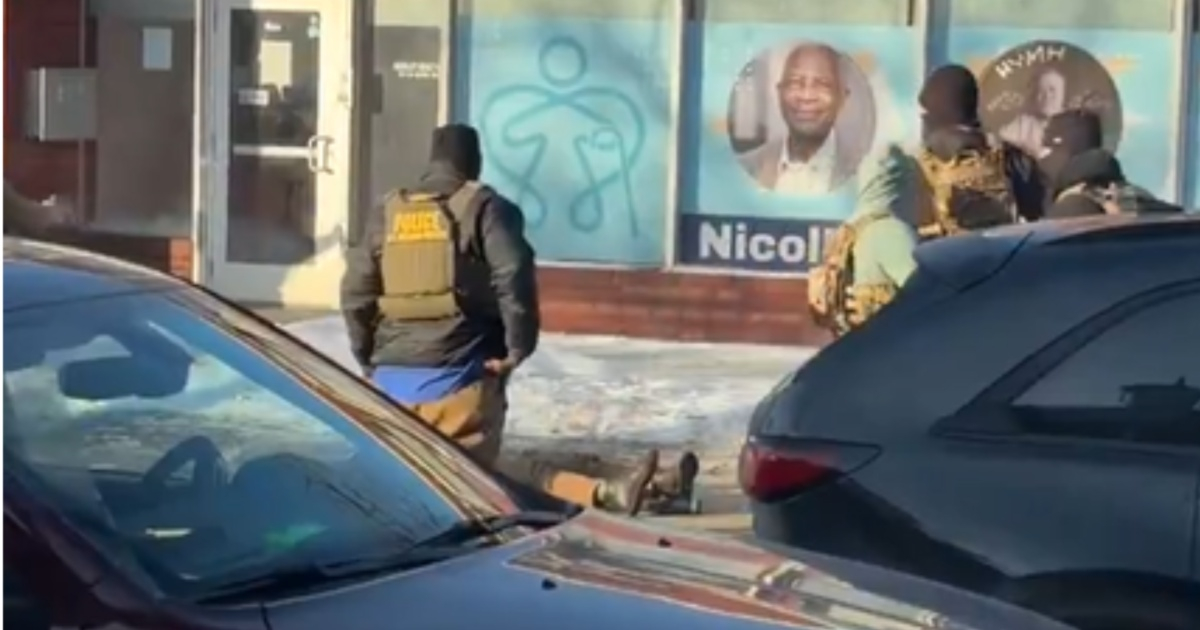
In Minneapolis, Minnesota, federal agents from the Department of Homeland Security (DHS) fatally shot a man on Saturday morning. Federal authorities have linked the incident to an immigration enforcement operation.
This tragic event marks the third shooting involving federal agents in the city since the death of Renee Good on January 7, according to local reports.
A video circulated on social media captures the scene from a distance. It shows several federal agents struggling with a man, attempting to restrain him on the sidewalk while at least one officer strikes him with an object. An initial gunshot can be heard, followed by several others.
In a statement, the DHS detailed that at 9:05 a.m. Central Time, Border Patrol agents were carrying out an operation targeting an "illegal immigrant sought for violent assault."
During this operation, an individual allegedly approached the officers wielding a 9mm semiautomatic pistol. The agents attempted to disarm him, according to DHS.
The officer who fired the shot claimed to have feared for his life, as stated by the DHS. They argued that the man "resisted violently," leading the officer to fire in self-defense.
Despite receiving medical attention at the scene, the man was pronounced dead there, as per the statement.
The shooting occurred near 28th Street West and Nicollet Avenue.
Furious protesters gathered at the scene, demanding the arrest of the federal agents involved. In response, law enforcement deployed tear gas and flashbang grenades to disperse the crowd.
The report also indicated the use of chemical irritants to manage the protestors.
Authorities noted that the deceased had two magazines and no identification on him. Approximately 200 individuals, described as "agitators," later arrived, obstructing and confronting law enforcement officers, prompting crowd control measures.
This incident unfolds amid heightened tensions over immigration operations in Minnesota. The earlier death of Renee Good, a 37-year-old woman shot by an ICE agent in Minneapolis on January 7, had already stirred unrest.
Furthermore, local and state media have reported another shooting in north Minneapolis on January 14, where a man was shot by a federal agent, sparking further protests.
Minnesota Governor Tim Walz condemned the incident on Saturday as abhorrent.
"I just spoke with the White House following another horrific shooting by federal agents this morning. Minnesota has had enough. This is appalling. The President must end this operation. Withdraw the thousands of violent and untrained agents from Minnesota. Immediately," he declared.
Following the fatal shooting of Renee Good, the Trump administration ordered approximately 1,500 active-duty troops to be on standby for potential deployment to Minnesota.
Tensions Escalate with Potential Military Involvement
Two battalions from the 11th Airborne Division, based in Alaska, were placed on alert for possible intervention in Minnesota, although their specific roles in the state remain unclear.
The military could be tasked with crowd control or supporting law enforcement during protests.
Meanwhile, Minneapolis Mayor Jacob Frey criticized the notion of deploying active-duty soldiers to Minnesota to aid in immigration crackdowns as absurd and unconstitutional.
Frey urged protesters to remain peaceful, hoping to prevent the President from feeling compelled to deploy the U.S. military.
Understanding the Impact of Federal Operations in Minnesota
What sparked the recent protests in Minnesota?
The protests were ignited by a series of shootings involving federal agents in Minneapolis, including the recent fatal shooting of a man during an immigration operation.
How has Governor Tim Walz responded to the shootings?
Governor Tim Walz has condemned the shootings, labeling them as repugnant and calling for the withdrawal of federal agents from Minnesota.
What role might the military play in Minnesota?
The military could potentially assist in crowd control or support law enforcement during the ongoing protests.