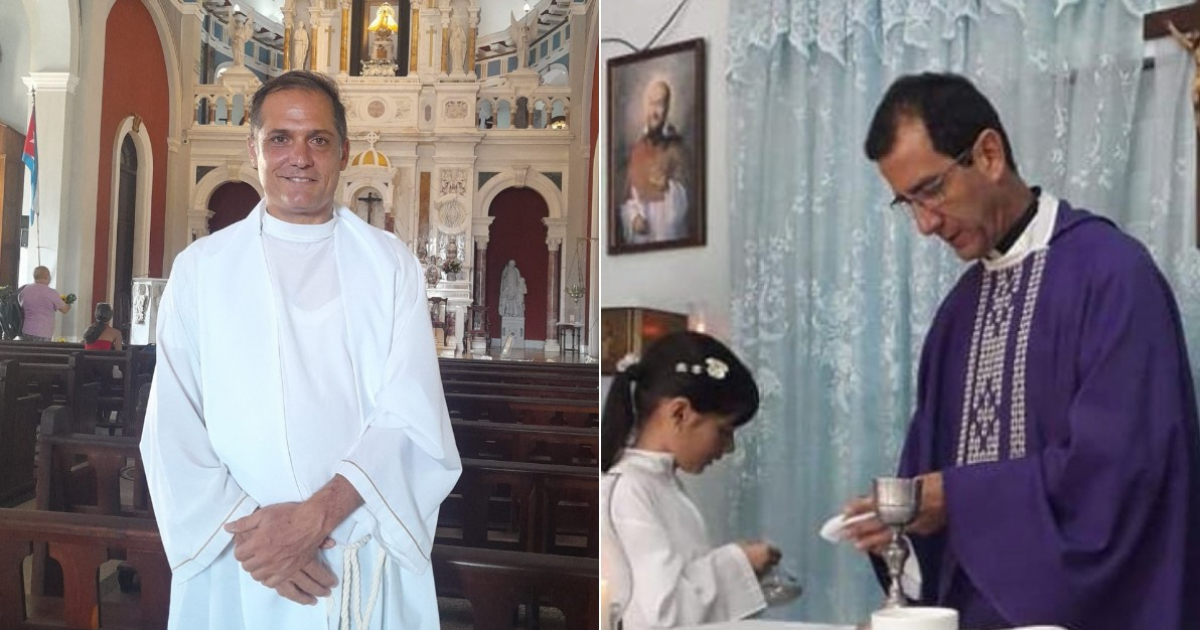
State Security in Cuba has once again targeted outspoken voices within the country's Catholic Church.
Priests Alberto Reyes Pías and Castor José Álvarez Devesa were summoned in Camagüey and subjected to a warning for their public criticisms of the political system. The summons was not conducted to foster dialogue or provide explanations but to intimidate.
Father Alberto Reyes detailed the incident in a Facebook post.
"Father Castor and I are fine. The purpose of the summons was to issue us a warning for our public stance on the system, which, according to them, could be considered punishable offenses under the law," he stated.
The priest expressed gratitude for the support received and emphasized his commitment to his civic and spiritual duties.
"Thank you all for your support and prayers. We will continue striving for the greater good of our homeland, for everyone in our homeland," he added.
This official warning highlights an increasingly evident practice: the regime's use of its repressive apparatus to silence religious leaders who go beyond liturgical duties and speak about the people's real suffering.
Instead of heeding these voices, the authorities threaten them with legal repercussions.
The summonses were issued without initially providing a reason. Journalist Eugenia Gutiérrez shared on social media that both priests had been called by State Security "without a declared motive."
Soon after, writer Osvaldo Gallardo González clarified that they would be questioned separately, with Father Castor already being interrogated while Father Alberto was scheduled for later.
Continuing Repression Against Religious Figures
This incident is not isolated. It is part of a systematic pattern of pressure against clergy advocating for human rights, freedom of expression, and citizen dignity.
The implicit message is unmistakable: anyone criticizing the system from the pulpit or social media risks facing repercussions.
Father Castor José Álvarez Devesa, known locally as Father Castor, has long been a thorn in the regime's side. During the July 11, 2021 protests, he was detained and beaten by police while trying to protect a 14-year-old boy from being assaulted by an officer.
Since then, his name has become synonymous with a priest who goes beyond prayer, acting decisively when witnessing injustice.
Antonio Rodiles, leader of the independent organization Estado de Sats, described his work as follows: "He is convinced that ignoring the people's suffering contradicts the Church's mission."
Castor has called for free elections, respect for freedoms, and a profound change in the country's governance. In 2018, he even traveled to the Vatican with other priests to deliver a letter demanding democratic freedoms for Cuba.
Symbolic Protests and Public Denunciations
Meanwhile, Father Alberto Reyes Pías, a parish priest in Esmeralda, Camagüey, has also maintained a steadfast position against the regime.
In May 2024, he announced his intention to ring his church bells 30 times each night during power outages as a symbolic protest against the energy crisis affecting the population.
Through his Facebook column, "I've Been Thinking," Reyes regularly condemns the misery, neglect, and lack of real solutions from the government.
He does not engage in partisan politics but speaks of ethics, dignity, and justice. In the Cuban context, this becomes a subversive act against the regime.
The summoning of these priests demonstrates that the government tolerates no criticism, not even from religious spaces. Repression does not distinguish between activists, journalists, or clergy: anyone who coherently articulates a complaint is seen as an enemy.
Rather than addressing the people's grievances—blackouts, hunger, lack of medicine, meager salaries—the regime resorts to warnings, records, and threats.
By doing so, it attempts to subdue even the Church, one of the few institutions still holding some moral authority among the populace.
The fact that two respected priests were summoned by State Security for "crimes" related to public opinions underscores the regime's level of intolerance.
Actions are not punished; words are. Justice is not sought; silence is.
The pressure on the Church not only undermines religious freedom but also attacks one of the few spaces where the country's pain can be spoken of openly. In Cuba, speaking the truth remains a perilous act.
Understanding the Threats to Cuban Clergy
Why were the Cuban priests summoned by State Security?
The priests were summoned for their public criticisms of the Cuban political system, which the authorities claimed could be considered punishable offenses under the law.
What actions have the priests taken against the regime?
The priests have publicly criticized the regime, called for free elections and respect for freedoms, and engaged in symbolic protests, such as ringing church bells during power outages.
What is the regime's response to criticism from religious leaders?
The regime uses its repressive apparatus to silence religious leaders through warnings, threats, and legal repercussions, rather than addressing the underlying grievances of the population.