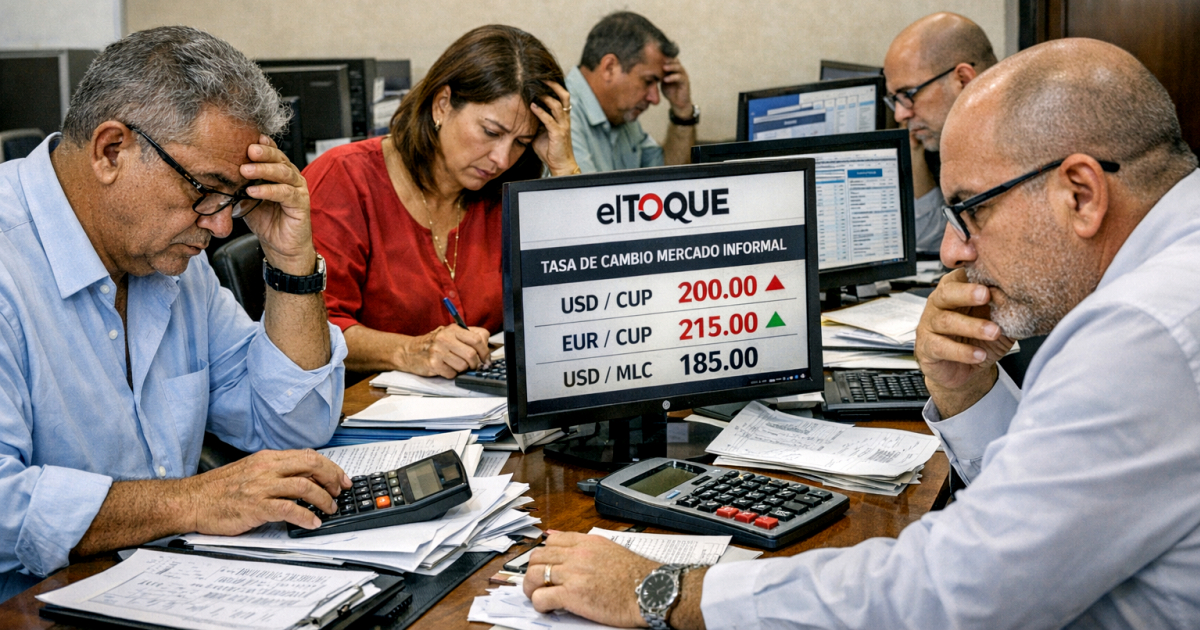
The Central Bank of Cuba (BCC) took action again this Saturday, adjusting its official exchange rate, thereby deepening the devaluation of the Cuban peso and signaling a shift in the pace of economic adjustments.
As per the latest figures available for January 24, 2026, the U.S. dollar (USD) has climbed to 435 Cuban pesos (CUP), marking an increase of three pesos. Meanwhile, the euro (EUR) has surged to 512.67 CUP, continuing an upward trend that has intensified compared to previous weeks.
This adjustment is not an isolated incident. Since mid-December, when the Cuban regime introduced a new "exchange segments" scheme and pledged a floating rate aligned with market supply and demand, the BCC has been gradually tweaking its figures.
However, recent developments reveal a deeper issue: the monetary authority is reacting to pressures from the informal market, rather than leading the way, as would be expected.
Initially, during the early weeks of this new system, the Central Bank kept the official rate largely unchanged, with minimal daily fluctuations of one or two pesos, while the street rate for the dollar climbed from 440 to nearly 500 CUP.
This inaction resulted in a record-breaking gap, exceeding 70 pesos per dollar, the largest since the introduction of the new exchange framework.
In recent days, the BCC has been attempting to regain ground. First, by raising the official dollar exchange rate by seven pesos, followed by more aggressive increases in the euro, and now with a sustained acceleration that places the official dollar rate at 435 CUP.
Nevertheless, the disparity with the informal market remains significant: the dollar is sold on the street for around 490 CUP, and the euro trades at approximately 530 CUP, leaving a gap of 55 pesos for the dollar and nearly 18 for the euro.
Economists consulted by CiberCuba agree that this pattern highlights the practical failure of the "floating rate" policy.
"We are not witnessing a genuine float but a belated chase of the informal market," explains an independent analyst. "The BCC adjusts only after the market has moved far ahead, without support in reserves or liquidity."
The broader economic and political context exacerbates the situation. The ongoing energy crisis, persistent inflation, and increasing international pressure on the Cuban regime further undermine confidence in the peso, driving citizens and economic actors to seek refuge in stronger currencies.
Thus, even though the Central Bank is accelerating the official devaluation and implicitly acknowledging its rate was outdated, the message that emerges is different: the true benchmark remains the informal market, and the government's exchange policy continues to lag behind an uncontrollable reality.
Understanding Cuba's Exchange Rate Challenges
Why is the Cuban peso being devalued?
The Cuban peso is being devalued due to the Central Bank's adjustments to align with informal market pressures and the lack of genuine floating rate implementation.
What is the impact of the informal market on Cuba's official exchange rate?
The informal market significantly influences Cuba's official exchange rate, as the Central Bank's adjustments often lag behind, resulting in a substantial disparity between official and street rates.
How does the economic context affect the Cuban peso?
The economic context, including energy crises, inflation, and international pressure, weakens confidence in the peso, prompting a shift towards stronger currencies like the dollar and euro.