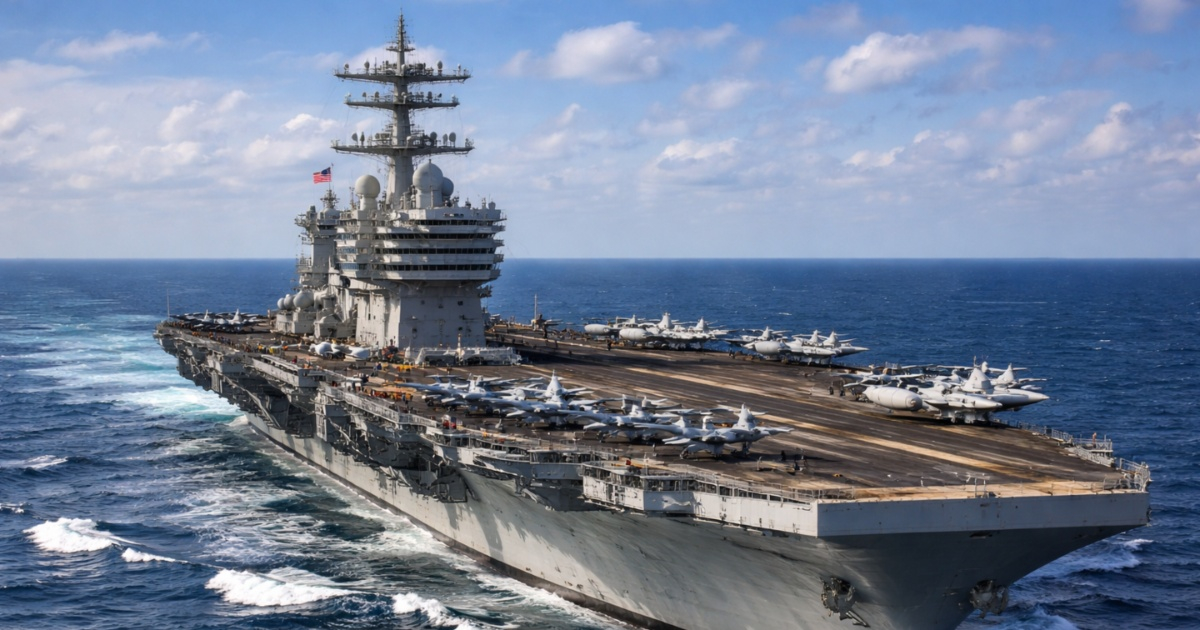
Recently, social media and some news outlets have been abuzz with claims that the U.S. aircraft carrier USS George H. W. Bush is positioned approximately 60 nautical miles north of Varadero, based on maritime tracking platforms like MarineTraffic.
There has yet to be any official confirmation from either the U.S. government or the Cuban authorities regarding the carrier's precise location, mission, or the duration of its deployment, thus urging caution in how the matter is handled.
If the ship is indeed situated around 60 nautical miles (roughly 111 kilometers) off Cuba's northern coast, it would not be within Cuban territorial waters.
In such a scenario, the carrier would be beyond Cuba's 12 nautical mile territorial sea limit and outside its contiguous zone, which extends up to 24 nautical miles. However, it could potentially be within Cuba's Exclusive Economic Zone (EEZ), which stretches out to 200 nautical miles.
Understanding Maritime Boundaries: More Than Just "Cuban Waters"
The term "Cuban waters" is often used to mean "near Cuba," but from a legal standpoint, the distinctions are important:
1) Territorial Sea (up to 12 nautical miles): This is where Cuba exercises sovereignty. If the carrier were within this range, it would be in Cuban territorial waters—a significant and sensitive issue. Sixty nautical miles far exceeds this limit.
2) Contiguous Zone (up to 24 nautical miles): This area does not grant full sovereignty. Here, Cuba can enforce laws related to customs, immigration, or sanitation. Again, 60 nautical miles is beyond this zone.
3) Exclusive Economic Zone (up to 200 nautical miles): While Cuba has rights primarily over resources like fishing or energy exploitation, it does not equate to territorial waters. At 60 nautical miles, the carrier would likely be in the EEZ, but this does not mean it's in "territorial waters."
4) High Seas (beyond the EEZ): Commonly referred to as "international waters." Anything beyond 200 nautical miles from Cuba would be considered high seas. At 60 nautical miles, the carrier is not in international waters.
The viral report has gained traction amid regional tensions and heightened interest in military maneuvers in the Caribbean.
Nonetheless, the presence of U.S. warships in the area does not inherently suggest hostile intent, and any talk of conflict without official data would be purely speculative.
Key Questions about the USS George H. W. Bush's Location
Is the USS George H. W. Bush currently in Cuban territorial waters?
No, if it is located 60 nautical miles from Cuba, it is beyond the 12 nautical mile territorial sea limit.
What does it mean if the carrier is in Cuba's Exclusive Economic Zone?
Being in the Exclusive Economic Zone means Cuba has rights over resources, but it does not have complete control over navigation, allowing other states certain maritime freedoms.
Could the presence of the carrier indicate a military threat?
Not necessarily. U.S. warships in the region do not automatically imply hostile actions, and speculation about conflict is unfounded without official information.