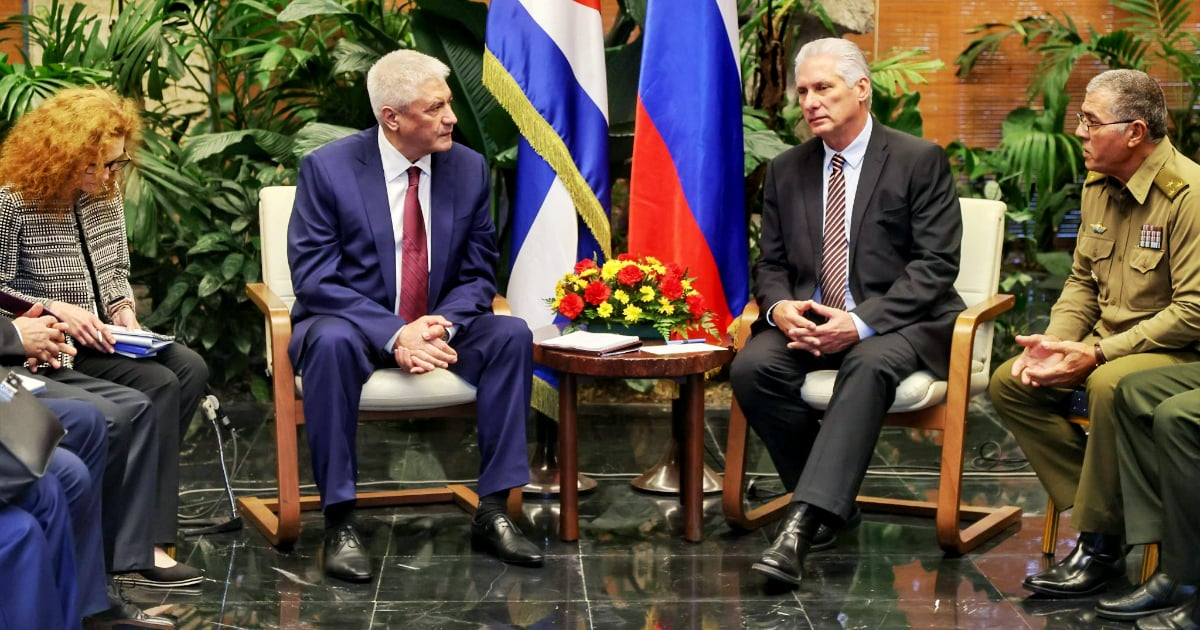
Recent interactions between the Havana regime and representatives from Russia and China have raised alarms in Washington, where these developments are seen as a potential threat to national security.
According to Martí Noticias, U.S. government sources have voiced their concern over the Cuban regime's engagements with Russia's Interior Minister, Vladimir Kolokoltsev, and China's ambassador to Havana, Hua Xin.
The U.S. Department of State emphasized that these activities are of significant interest to U.S. national security. It highlighted the importance of having Cuba led by a competent democratic government that refuses to host military and intelligence services from adversarial nations.
The Department of State has reiterated its commitment to continue monitoring Cuba's relationships with rival powers. Recent contacts with Moscow and Beijing indicate that Havana is attempting to reshape its strategic alliances in response to the new regional dynamics instituted by the Trump Administration.
The Russian Visit and Its Regional Implications
This week, Russia's Interior Minister commenced an official visit to Cuba, marking his second trip in just over two years. His agenda included bilateral meetings with his Cuban counterpart, Lázaro Alberto Álvarez Casas, General Raúl Castro, and the Cuban leader, Miguel Díaz-Canel.
This visit is the first of a high-ranking Russian delegation since the U.S. military deployment in the Caribbean and the operation that resulted in the capture of Venezuelan dictator Nicolás Maduro, during which 32 Cuban soldiers were killed.
Díaz-Canel described the meeting with Kolokoltsev as "significantly important," as he seeks to strengthen ties with Moscow amid escalating tensions with the United States.
International observers view this visit as Havana's effort to secure military and political backing in the face of increasing international isolation and domestic unrest.
China's Support and Emergency Aid
Simultaneously, Chinese Ambassador Hua Xin met with Díaz-Canel at the Palace of the Revolution. According to official reports, the meeting focused on bilateral cooperation and the "acceleration of the Community of Shared Future between both countries."
This meeting took place just days after Chinese President Xi Jinping approved a new round of assistance to the island, valued at $80 million, along with a donation of 60,000 tons of rice.
The funds, as reported by the Cuban Presidency, will be allocated to purchasing electrical equipment and addressing "urgent needs" amid the collapse of the national energy system and a severe social crisis.
However, this aid arrives amidst increasing pressure from the Trump administration, which has warned the Cuban regime that there will be "no more oil or money" from Venezuela following Maduro's downfall.
Questions on Cuba's International Alliances
Why is the United States concerned about Cuba's ties with Russia and China?
The United States views Cuba's strengthening ties with Russia and China as a potential threat to national security, fearing it could lead to the hosting of adversarial military and intelligence services.
What recent actions have Russia and China taken in support of Cuba?
Russia's Interior Minister visited Cuba for high-level meetings, while China provided financial aid and a significant donation of rice, indicating continued support for the Cuban regime.