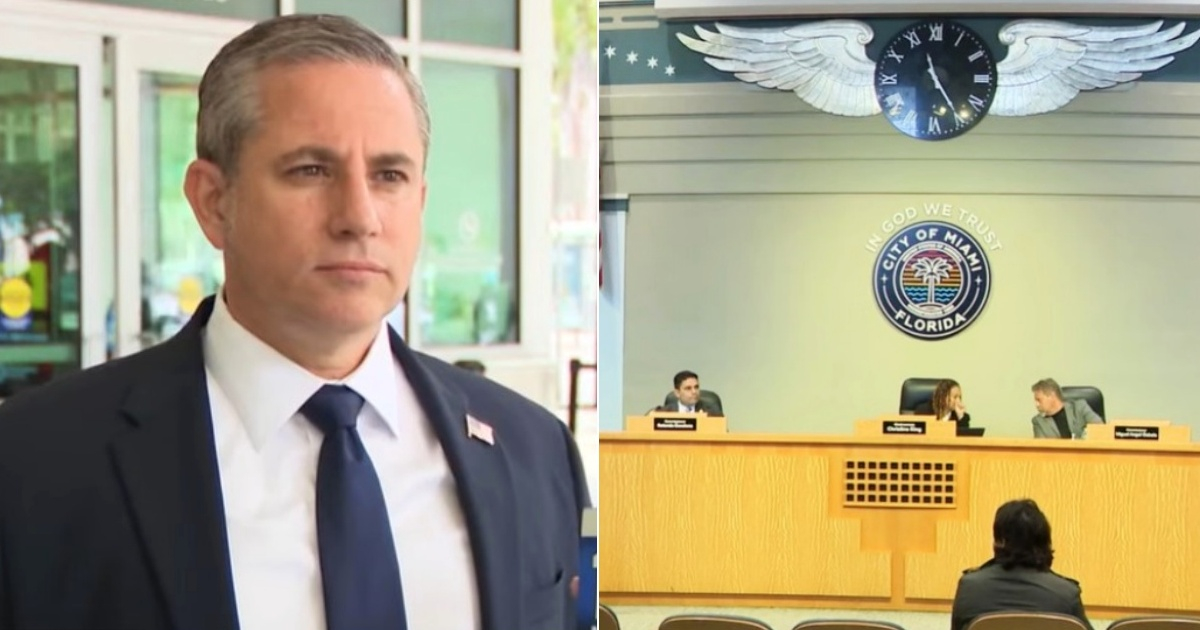
The Miami City Commission has unanimously endorsed the formation of a specialized task force to scrutinize and oversee business licenses of companies with potential financial, administrative, or operational connections to the Cuban regime.
This initiative, set to be implemented within the next ten days, aims to ensure adherence to federal sanctions and prevent the economic support of Havana's government from U.S. soil.
District 4 Commissioner Ralph Rosado emphasized the significance of this move, stating, "Today's vote clearly demonstrates that the City of Miami is serious about enforcing federal sanctions laws and will not turn a blind eye."
Collaboration and Enforcement
Unlike similar efforts in Hialeah—where Álex Otaola plays a pivotal role—the Miami task force will comprise municipal employees and officials from the Miami-Dade County Tax Collector's Office.
Although the approval does not imply immediate actions against local businesses, it establishes a systematic framework for verification. The proposal includes two key resolutions: requesting the Department of Justice to review all businesses registered in the city and authorizing the Tax Collector to audit companies possibly linked to Cuban-controlled entities.
District 3 Commissioner Rolando Escalona elaborated, "We've passed two things: a resolution asking the Department of Justice to review all the businesses in Miami to ensure compliance with regulations regarding trade with Cuba."
Legal Repercussions and Federal Coordination
Should illegal operations be identified, the task force may escalate findings to federal authorities or directly recommend the suspension or revocation of municipal business licenses. Coordination with higher agencies could lead to criminal proceedings if embargo laws or financing of sanctioned entities are violated.
"Our parents and grandparents did not flee a dictatorship to finance that same dictatorship from another country," one commissioner remarked, appealing to the historical and moral coherence of the exiled community.
Wider Implications and Local Reaction
This measure is part of a growing trend in South Florida, where local authorities, backed by federal legislation, are adopting mechanisms to halt any economic ties with the Cuban regime. Amid increasing travel, remittances, and commercial operations, municipal governments are opting for stricter verification and compliance systems.
While the task force's actions will depend on initial audit findings, the political message has been sent: in Miami, business with the Cuban dictatorship is not tolerated.
According to Local 10, Dariel Fernández, Miami-Dade Tax Collector, assured that his office is actively pursuing companies doing business with the Cuban government, highlighting collaboration with the State Department.
Fernández stated, "We are working together with the State Department," and added, "We can review or revoke any local business tax in Miami-Dade."
However, not everyone in the business community welcomes these measures. Yfraín Villazón of Café Travel, a Miami-Dade travel agency catering to Cuba, expressed disbelief. His colleague Leonel Vicent noted that authorities should focus on large corporations, citing airlines like American Airlines that continue flights to Cuba as examples of perceived policy inconsistency.
In response to criticism, Fernández firmly stated, "We don't care if you're Democrat, Independent, or Republican. This is not a political game. I don't need this position to play games."
Ultimately, the establishment of the Miami task force reinforces a trend towards heightened scrutiny of economic activities that might benefit the Cuban government. With legal tools and institutional support, the measure sends a clear message: in Miami, there will be zero tolerance for collaboration with a dictatorship, even under the guise of legitimate business.
FAQs on Miami's Business Licensing Review for Cuban Ties
What is the purpose of Miami's new task force?
The task force aims to investigate and monitor business licenses of companies with potential links to the Cuban regime, ensuring compliance with federal sanctions.
How will the task force affect local businesses?
While no immediate actions are planned, the task force will create a framework for systematic verification, potentially leading to reviews and audits of businesses with suspected ties to the Cuban government.
How does this initiative align with federal and other local actions?
The initiative is part of a broader trend in South Florida and aligns with federal legislation to prevent economic support of the Cuban regime, coordinating with other local jurisdictions like Hialeah and Miami-Dade County.