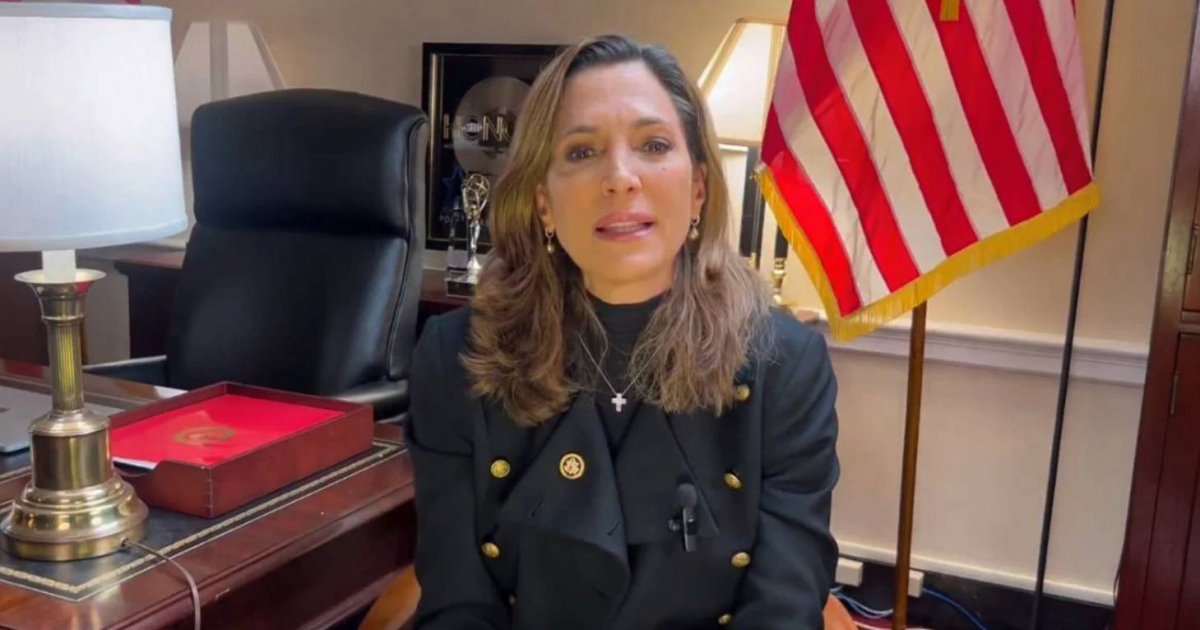
Republican Congresswoman Maria Elvira Salazar expressed her approval of the Trump administration's plan to instigate political change in Cuba, declaring that liberty is "finally approaching" the island.
"The Cuban dictatorship is at the core of repression and chaos in our hemisphere and is finally being held accountable," Salazar stated on her official X account after The Wall Street Journal published an investigation about the White House's approach towards Havana.
Salazar, a Florida legislator and daughter of Cuban exiles, emphasized that for over six decades, this "brutal regime" has oppressed its own people, exported tyranny, and supported other dictators.
In her statement, she added, "I will always stand with the Cuban people, never with their oppressors. Appeasement has failed. Silence has failed. Cuban freedom is on the horizon. The regime's days are numbered."
The Wall Street Journal report stated that U.S. officials confirmed President Trump's administration is actively working to encourage a political transition on the island before the year's end.
According to the report, Washington perceives a "historic window of opportunity" to undermine Miguel Díaz-Canel's regime amid unprecedented economic turmoil and Havana's diplomatic isolation.
The White House strategy includes a mix of economic, diplomatic, and symbolic pressures, along with discreet engagements with the Cuban exile community and government insiders who might agree to negotiate a peaceful exit.
The article suggests that Cuba's economic deterioration is so severe that the U.S. considers the regime to be "on the brink of collapse."
Compounding the situation is the loss of Venezuelan oil supplies following Nicolás Maduro's capture, which has left Havana without its primary energy support source.
"Cuba seems on the verge of collapse. I don't know how they can sustain themselves, they have no income," Trump remarked in a recent interview aboard Air Force One.
Washington's strategy also aims to replicate aspects of the model used in Venezuela, where the military operation culminating in Maduro's capture benefited from internal informant support and led to a transition headed by Delcy Rodríguez.
An American official quoted by the Journal described Cuban leaders as "incompetent Marxists who've ruined their country," urging them to "make a deal before it's too late."
Proposed measures include new economic sanctions, migration restrictions on officials linked to medical missions, and diplomatic pressure on countries accepting these programs, which the U.S. views as state-enforced labor.
Secretary of State Marco Rubio has reiterated Washington's strategic aim to ensure Cuba has a "democratic government free from foreign military influence."
Experts consulted by the Journal cautioned that despite Washington's optimism, the Cuban situation might be more challenging than Venezuela's.
"The Cuban regime is a much tougher nut to crack," noted Ricardo Zúñiga, a former Obama administration official, referencing the loyalty of the repressive apparatus and the absence of organized opposition on the island.
For Trump and his allies in Florida, the fall of the Cuban regime would be a historic achievement and a significant political legacy.
"This is the moment. If we don't act now, we might not have another chance for decades," a White House official told The Wall Street Journal.
Understanding the U.S. Plan for Cuba's Political Transition
What is the main focus of the U.S. plan for Cuba?
The U.S. plan primarily focuses on instigating a political transition in Cuba through economic, diplomatic, and symbolic pressures while engaging discreetly with the Cuban exile community and potential negotiators within the island.
Why does the U.S. see this as a historic opportunity?
The U.S. considers this a historic opportunity to weaken the Cuban regime due to the current economic crisis in Cuba and the diplomatic isolation of Havana, which together create a unique chance for change.
How does the economic situation in Cuba affect the U.S. strategy?
The severe economic deterioration in Cuba, exacerbated by the loss of Venezuelan oil supplies, positions the regime as vulnerable, which the U.S. perceives as an opportunity to press for political transition.