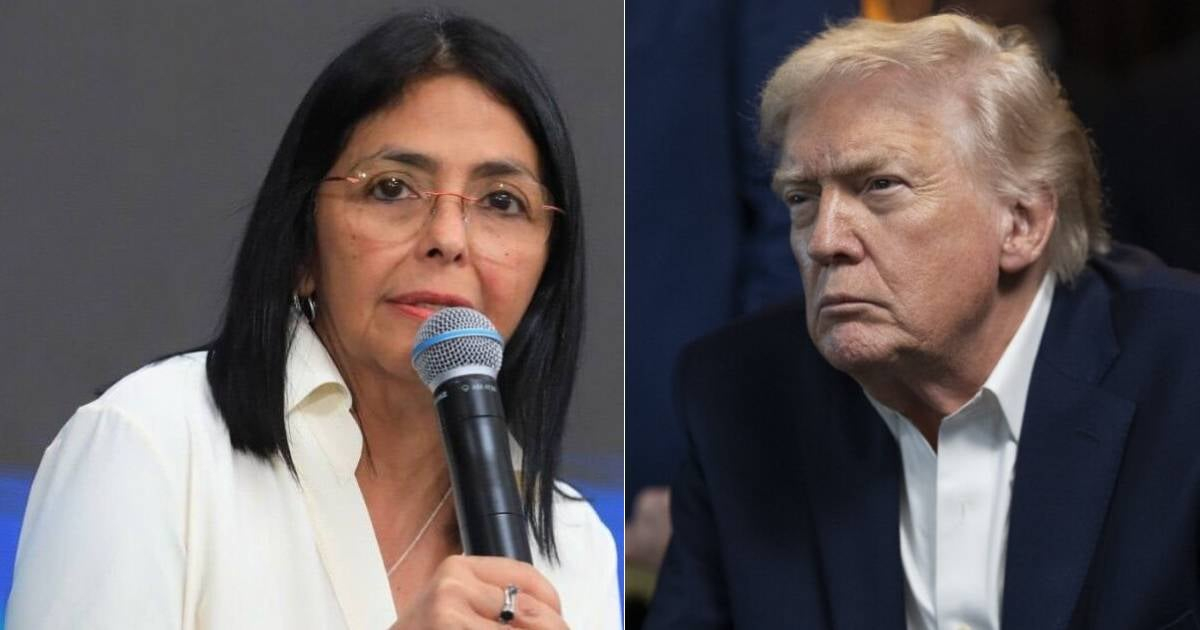
In the months leading up to the military operation that resulted in the capture of Venezuelan dictator Nicolás Maduro and his wife Cilia Flores, Delcy Rodríguez and her brother Jorge engaged in clandestine communications with officials from the United States and Qatar.
A recent investigation by The Guardian uncovers that the Rodríguez siblings promised cooperation with the Trump administration once the leader of the Chavista regime was removed from power.
According to sources referenced by the British newspaper, Delcy Rodríguez, at the time Venezuela's Vice President, and Jorge Rodríguez, the President of the National Assembly, assured U.S. and Qatari officials through intermediaries that they would favor Maduro's departure.
These discussions originated in the autumn of the previous year and extended beyond a November phone call between Trump and Maduro, during which the U.S. president demanded Maduro step down.
Despite Maduro's refusal, Delcy Rodríguez signaled to Washington her readiness to act in the post-Maduro scenario. "Delcy was communicating that Maduro needed to leave," one source noted. Another individual familiar with the exchanges mentioned Rodríguez's willingness to "work with whatever came next."
Initially skeptical, Secretary of State Marco Rubio began to view Delcy Rodríguez's commitments as the optimal path to avoid chaos in Venezuela following Maduro's removal. The Rodríguez siblings' pledge to cooperate before the U.S. military intervention had not been previously reported.
In October, the Miami Herald, as cited by The Guardian, disclosed that Delcy had through Qatar proposed leading a transitional government if Maduro agreed to step down, though this initiative did not succeed.
Reuters reported on Sunday that Interior Minister Diosdado Cabello, a powerful figure in Chavismo, also engaged in discussions with U.S. representatives months before the operation leading to Maduro's capture.
A photograph from January 8 in Caracas depicts Cabello presiding over a ceremony honoring Venezuelan and Cuban soldiers who perished during the U.S. operation.
Sources indicate that while Delcy and her brother pledged cooperation following the president's fall, they did not agree to actively participate in his overthrow, emphasizing that it was not a coup orchestrated by them.
Hours after the operation, Trump seemed to confirm these contacts. In a statement to the New York Post, the president said, "We've talked to her many times, and she understands the situation."
The Venezuelan government did not respond to emailed inquiries, and the White House declined to comment on the conversation details.
The report from The Guardian further reveals that, in addition to secret talks, there were official meetings between Trump officials and the Maduro government representatives.
Maduro himself met with Ric Grenell, a close advisor to the president, just ten days after Trump's inauguration to discuss the release of American prisoners, who were subsequently freed.
Individuals familiar with these discussions stated that while diplomatic channels remained open, Trump and his advisors maintained exchanges with the Rodríguez siblings to coordinate issues such as fortnightly deportation flights of Venezuelans from the U.S., the fate of Venezuelan prisoners in El Salvador, and the potential liberation of imprisoned opposition figures.
According to the same sources, Delcy Rodríguez maintained close personal ties with members of Qatar's royal family, a country acting as a mediator and enjoying favorable relations with Washington.
The small emirate donated a $400 million luxury jet to President Trump, an unprecedented gesture that bolstered trust between the parties and facilitated rapprochement with Rodríguez, according to two informants.
In the months leading up to Maduro's downfall, Delcy Rodríguez once again proposed the establishment of a transitional government led by herself—a plan that failed but convinced several U.S. officials that she was not a doctrinaire leader.
Sources describe her as a skilled and charismatic figure, capable of forming personal connections with foreign diplomats. Her eccentricities reportedly include a taste for champagne, a private table tennis coach, and a habit of challenging dignitaries to friendly matches.
By October, even the toughest U.S. officials on Maduro were open to collaborating with Rodríguez. One reason was her promise to cooperate with American oil companies. "Delcy is the most committed to working with U.S. oil," an ally of hers stated.
Mauricio Claver-Carone, a former special envoy for Trump to Latin America and close to Secretary Rubio, was one of her main supporters, although he declined to comment.
A January 15 photograph in Caracas shows Delcy Rodríguez alongside a portrait of Hugo Chávez, now serving as interim president. Her role, according to sources cited by The Guardian, was crucial in maintaining the country's institutional stability after Maduro's capture.
"The most important thing was to prevent Venezuela from becoming a failed state," stated one of the involved officials.
Sources assert that it was toward the end of autumn when the Rodríguez siblings began negotiating with the U.S. behind Maduro's back. The November phone call between Trump and the then-president marked a turning point: a week later, it was apparent that Maduro had no intention of relinquishing power.
For Delcy Rodríguez, the operation was a balancing act. While she agreed to collaborate with Washington, she avoided directly betraying Maduro. "She was afraid of him," a knowledgeable official remarked.
When U.S. attack helicopters stormed Caracas in early January, Delcy Rodríguez was not present in the capital. While some rumors placed her in Moscow, two sources claimed she was taking refuge on Margarita Island.
The Guardian's report concludes that the Trump administration's priority was to ensure stability following the Chavista regime's collapse and prevent a civil war. Within this context, Delcy Rodríguez emerged as the pragmatic option to maintain internal order during the transition to a new government.
Key Insights into Delcy Rodríguez's Role in Venezuela's Transition
What was Delcy Rodríguez's role in the transition of power in Venezuela?
Delcy Rodríguez played a crucial role in maintaining institutional stability in Venezuela following Nicolás Maduro's capture. Despite her cooperation with Washington, she avoided directly betraying Maduro, acting as a pragmatic alternative to preserve order during the transitional period.
Did Delcy Rodríguez plan a coup against Nicolás Maduro?
No, Delcy Rodríguez and her brother did not plan a coup against Nicolás Maduro. While they pledged to cooperate with the U.S. after his fall, they did not actively participate in his overthrow.
How did Qatar facilitate Delcy Rodríguez's communications with the U.S.?
Qatar acted as a mediator in the communications between Delcy Rodríguez and U.S. officials. The country's close relations with both parties, along with gestures like donating a luxury jet to President Trump, helped facilitate these exchanges.