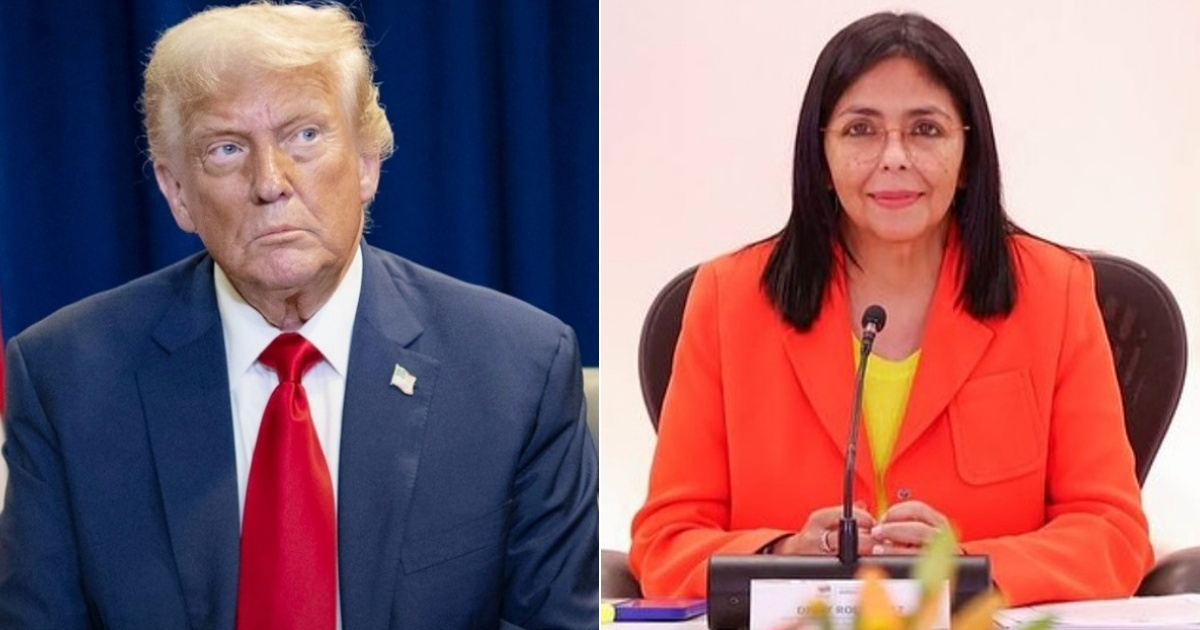
The White House has announced that Delcy Rodríguez, the acting president of Venezuela, is planning to visit Washington in the near future. However, specific details regarding her agenda and the exact timing of the visit remain undisclosed.
This development, reported by a U.S. official to EFE, signifies a major shift in U.S. policy towards Venezuela following the arrest of Nicolás Maduro in a military operation conducted on January 3.
Rodríguez, who previously served as vice president under Maduro, would be the first Venezuelan leader to visit Washington in over a quarter-century if this trip materializes.
If realized, this visit would represent the initial formal engagement between the governments of the two nations since the complete diplomatic break during the chavista period.
"We are working with the United States, unafraid to address our differences," Rodríguez stated from Caracas.
A New Political Landscape Post-Maduro
The potential visit aligns with the new regional dynamics following the capture and extradition of Maduro and his wife to New York, where they face charges of narcoterrorism. Since then, Washington has supported Delcy Rodríguez as a pivotal figure in Venezuela's transition.
According to the White House, Rodríguez's administration is meeting U.S. demands, including ensuring access to Venezuelan oil, facilitating the export of millions of barrels of crude to the United States, and releasing numerous political prisoners.
Donald Trump, now playing a prominent role in Venezuela's political reorganization, publicly praised Rodríguez during a press conference, stating, "I was against Venezuela, but now I love Venezuela." He added, "We have been working very well with Delcy Rodríguez. She has freed many political prisoners."
Trump's change in rhetoric comes after years of open confrontation with the chavista regime. His new strategy appears to favor a "guided transition" aimed at ensuring internal stability, energy security, and a geopolitical realignment under U.S. leadership.
Temporary Exclusion of María Corina Machado
The news of Rodríguez's potential trip to Washington follows a recent meeting at the White House between Trump and opposition leader María Corina Machado, a Nobel Peace Prize laureate. Although Trump has praised Machado, he has currently excluded her from the new governance framework.
"She's an incredible woman who did something extraordinary," Trump said, referring to Machado's symbolic gesture of gifting him her Nobel medal during their meeting. While Trump hasn't ruled out her future involvement—"maybe we could involve her somehow"—he currently believes Machado lacks sufficient support to lead the transition process.
For her part, Machado has sharply questioned the legitimacy of the interim chavista government, stating, "The chavista leader does not represent the Venezuelan people. This government is doing part of the dirty work in this complex phase," while reiterating her hope for an "orderly transition" for the country.
Strategic Engagements: The CIA in Caracas
Rodríguez's possible visit is part of a series of high-level diplomatic contacts. On the same day as Trump's meeting with Machado, the interim Venezuelan president met in Caracas with CIA Director John Ratcliffe. The meeting focused on security and economic cooperation and was seen as a concrete step in establishing a direct channel between Caracas and Washington.
Ratcliffe is currently the highest-ranking U.S. official to visit Venezuela since Maduro's capture. His meeting with Rodríguez reinforces the perception that the U.S. is betting on a transition from within the chavista apparatus, with new interlocutors who can ensure swift results and predictability in the energy sector.
Sanctions, Oil, and Sovereignty: A Delicate Balance
Despite diplomatic progress, Delcy Rodríguez remains a contentious figure. She is still subject to sanctions, including asset freezes in the United States, and her legitimacy is questioned by significant segments of the Venezuelan opposition.
From Caracas, Rodríguez has tried to maintain a sovereignist discourse without completely breaking away from the chavista narrative. "If I have to visit Washington as Venezuela's leader, I will do so standing, walking, not crawling," she recently declared.
Meanwhile, the U.S. government has begun to ease some measures, such as lifting sanctions on certain oil tankers in the Caribbean, signaling a gradual de-escalation. Trump has also predicted a substantial increase in Venezuelan oil revenues "in the coming months," which he claims will be "higher than in the last 20 years."
Key Questions About Delcy Rodríguez's Visit to Washington
Why is Delcy Rodríguez visiting Washington?
Delcy Rodríguez's visit to Washington is part of a diplomatic effort to engage with the United States, address differences, and potentially pave the way for improved relations and cooperation between the two nations.
What significance does this visit hold for U.S.-Venezuela relations?
The visit marks a significant shift in U.S.-Venezuela relations, as it could represent the first formal engagement between the countries' governments since diplomatic ties were severed during the chavista era.
How is the U.S. administration supporting Delcy Rodríguez?
The U.S. administration is supporting Delcy Rodríguez by recognizing her as a key figure in Venezuela's transition and by requiring her administration to meet conditions such as granting U.S. access to Venezuelan oil and releasing political prisoners.