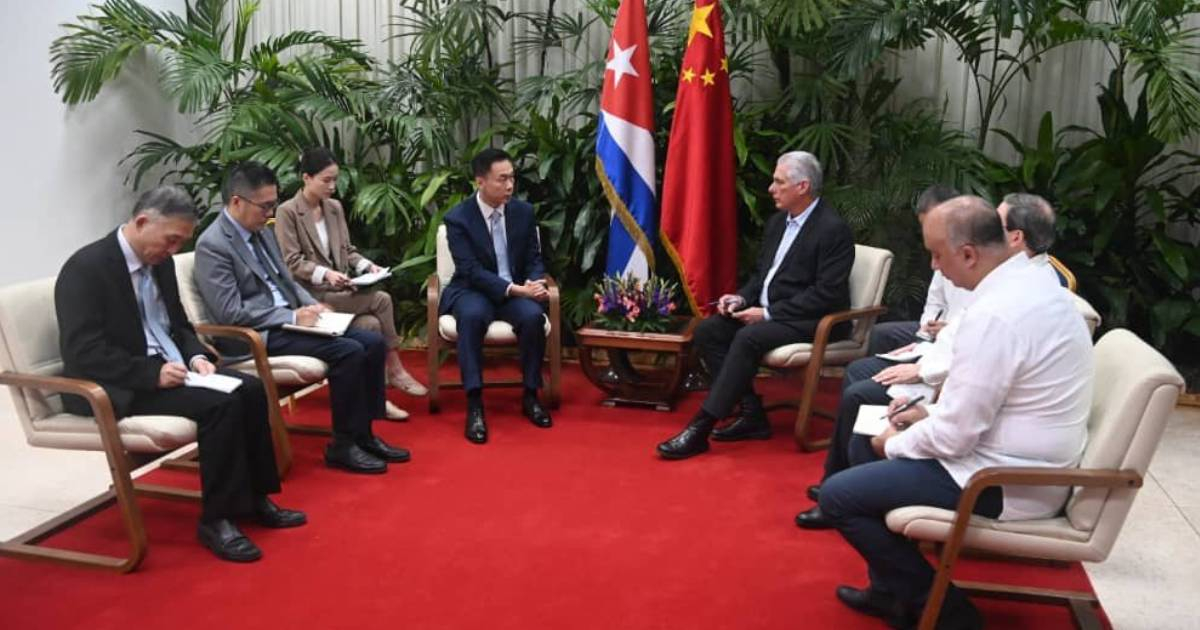
In a significant move, Chinese President Xi Jinping has sanctioned a fresh wave of support for Cuba, encompassing an emergency financial package worth $80 million alongside a donation of 60,000 tons of rice, as communicated by the Presidency of Cuba.
This information was formally conveyed to Cuban leader Miguel Díaz-Canel during a meeting at the Palace of the Revolution with China's ambassador in Havana, Hua Xin.
According to official reports, the funds are earmarked for purchasing electrical equipment and addressing other "urgent needs" within the nation, which is grappling with a collapsing national power grid and a severe social crisis impacting millions of families.
The Chinese diplomat confirmed that he had received direct orders from his government to relay this decision to Cuban authorities following a series of high-level exchanges between officials from both nations.
During these discussions, they acknowledged the dire economic situation in Cuba and the deterioration of the electrical system, issues the official narrative continues to blame on the U.S. embargo.
Beyond these announcements, the aid arrives at a particularly critical juncture for the Cuban populace. Rice, a staple in the daily diet of Cubans, has become increasingly scarce and, when available, is often priced beyond the reach of many.
The delivery of 60,000 tons in an "emergency mode," as emphasized in the official note, directly targets a food crisis that can no longer be hidden.
Díaz-Canel expressed gratitude to Beijing for their support and emphasized the strong bilateral relations, highlighting ongoing projects with Chinese backing, including those related to solar energy, digital transformation, and high-definition television.
Nevertheless, ordinary Cubans wonder how much of this assistance will genuinely translate into tangible relief for their daily lives, which are characterized by shortages of electricity, food, and hope.
The Chinese aid comes amidst an exceptionally challenging international climate for Havana. Recently, U.S. President Donald Trump has intensified his rhetoric against the Cuban regime.
Following the capture of Nicolás Maduro and the collapse of Chavismo as an economic pillar for Cuba, Trump warned that "there will be no more oil or money" from Venezuela and urged Cuban authorities to "make a deal before it's too late."
Soon after, the President was even more explicit, stating that Cuba "hangs by a thread." In a television interview, he described the nation as "in great trouble" and suggested that the regime is nearing a breaking point, primarily due to the loss of external support that had long sustained the system.
While acknowledging that such predictions of collapse have been made before, he offered a statement resonating strongly both within and outside the island: "I think they're pretty close."
Without Venezuelan oil, Cuba has been forced to seek fuel in distant markets, even in Africa, while blackouts stretch up to 20 hours a day in some provinces. Hospitals operating partially, families cooking with charcoal, and nighttime protests met with repression paint a picture reminiscent of the worst moments of the Special Period.
Cuba's Economic Challenges and International Relations
What support is China providing to Cuba?
China is providing Cuba with an emergency financial package worth $80 million and a donation of 60,000 tons of rice to help address the country's urgent needs.
Why is rice so important for Cuba?
Rice is a staple in the daily diet of Cubans, and its scarcity has made it increasingly difficult for many to afford, highlighting the severity of the food crisis in the country.
How has the U.S. responded to Cuba's current situation?
U.S. President Donald Trump has increased his criticism of the Cuban regime, warning of the loss of Venezuelan support and suggesting that Cuba is nearing a breaking point.