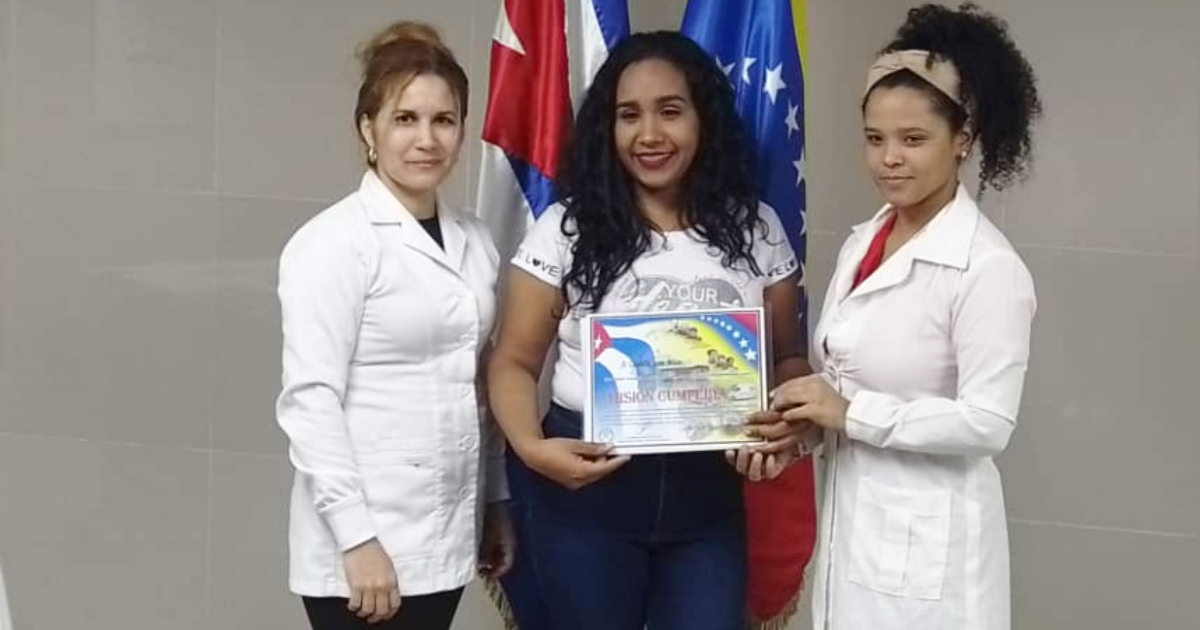
A recent announcement from the Cuban Medical Brigade in Venezuela, triumphantly celebrating the return of a group of collaborators to the island, suggests the beginning of a larger move that Havana is trying to frame as "planned." However, this occurs at a particularly challenging time for the Cuban-Chavista alliance.
Following the capture of Nicolás Maduro on January 3, the Ministry of Public Health (MINSAP) has confirmed the return of some healthcare personnel stationed in Venezuela, attributing it to the "resumption of flights" after U.S. airspace closures due to attacks.
Unanswered Questions and Official Silence
Despite the announcement, specific numbers were not provided, and it remains unclear how many professionals will stay in Venezuela. Is this a standard rotation or a strategic withdrawal? Could Havana be quietly evacuating its personnel in response to the new political landscape?
Questions multiply alongside official silence and mounting pressure from Washington. The U.S. has urged interim President Delcy Rodríguez to remove Cuban personnel associated with both security and medical services as part of a broader strategy to diminish foreign influence within the state's framework.
The End of a Lucrative Era?
For two decades, the Comprehensive Cooperation Agreement between Cuba and Venezuela, signed by Fidel Castro and Hugo Chávez, allowed the Cuban regime to receive billions in oil and currency in exchange for sending tens of thousands of healthcare professionals.
However, Maduro's capture, the shifting power dynamics in Caracas, and Rodríguez's outreach to the United States threaten to dismantle this mechanism, which has been a significant source of revenue for the Cuban state.
Reality Behind the Heroic Rhetoric
While MINSAP speaks of "duty fulfilled" and "mission accomplished," accounts from cooperatives gathered by Diario de Cuba and other independent media reveal a starkly different reality: fear, confinement, activated evacuation protocols, and orders for silence.
Havana aims to project an image of calm, but its heroic narrative no longer conceals the fragility of its position. If medical cooperation is reduced or canceled, Cuba stands to lose one of its most lucrative economic pillars amid extreme shortages and internal social discontent.
Beyond the images of white coats and flags, the return of doctors from Venezuela might signal the beginning of the end of an era: one where "proletarian internationalism" became a business, and Chavista oil sustained the island's economy.
Key Questions about Cuba's Medical Repatriation
Why is Cuba repatriating medical personnel from Venezuela?
Cuba is withdrawing medical personnel following the capture of Nicolás Maduro and in response to U.S. pressure on the interim Venezuelan government to reduce foreign influence.
What has been the role of the Cuba-Venezuela cooperation agreement?
The agreement, signed by Fidel Castro and Hugo Chávez, provided Cuba with billions in oil and currency in exchange for sending thousands of healthcare professionals to Venezuela.
What are the implications of reduced medical cooperation for Cuba?
A reduction or cancellation of medical cooperation would deprive Cuba of a crucial economic pillar during a time of extreme shortages and internal unrest.