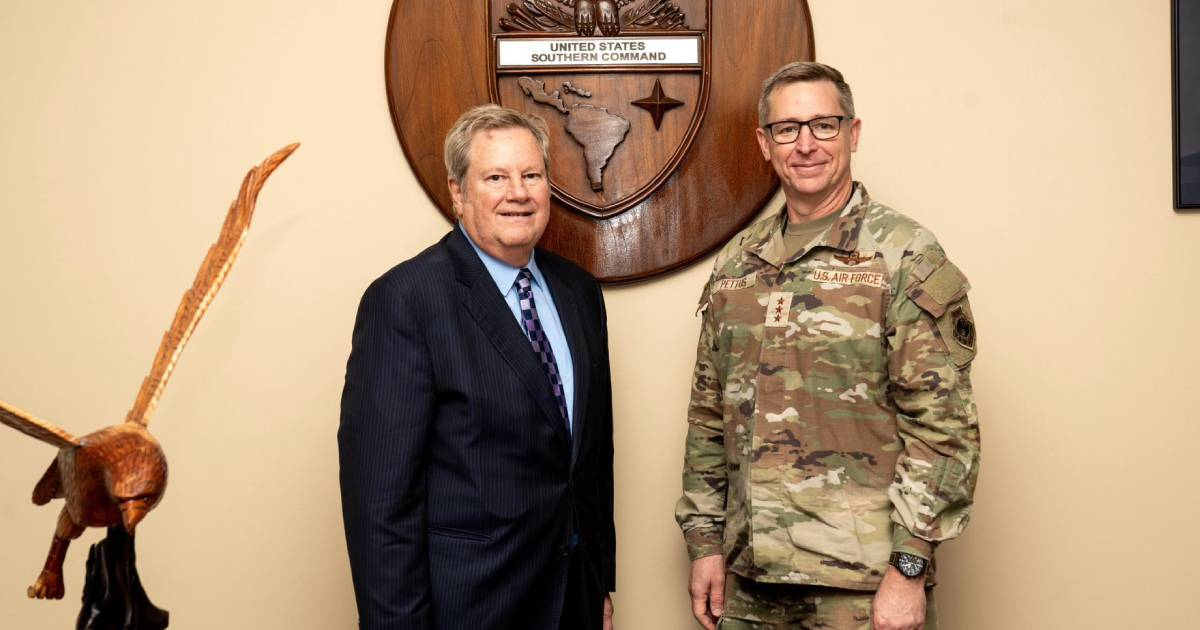
Mike Hammer, the head of the United States diplomatic mission in Cuba, recently met with the Southern Command at a time marked by heightened regional tensions, an increased U.S. military presence in the Caribbean, and a severe crisis on the island that continues to drive thousands of Cubans to emigrate.
The meeting took place with Lieutenant General Evan L. Pettus, who has recently taken over leadership of the United States Southern Command. The discussions centered around the situation in Cuba and the Caribbean, according to a statement from the U.S. Embassy in Havana shared on social media.
An image released shows Hammer with the high-ranking military official at the SOUTHCOM headquarters in Doral, Florida, a location that holds significant political and strategic symbolism.
Although the embassy provided limited details, the timing of the meeting is crucial. This is not the first encounter between Hammer and the Southern Command since he assumed his role in Havana, but it is the first under a new leadership following Admiral Alvin Holsey’s retirement after more than 37 years of service. Holsey was known for his openly critical stance against the Cuban regime.
In previous meetings, Hammer engaged with Holsey on hemispheric security, human rights, and democracy, with a focus on the impact of Cuba's crisis on regional stability.
Holsey had described Cuba as a "corrosive" influence in Latin America, citing its connections with powers like Russia, China, and Iran, as well as its role in irregular migration and insecurity in the hemisphere.
The leadership change in the Southern Command brings a new dimension to these interactions. Evan L. Pettus took command in December amid a significant U.S. military deployment in the Caribbean and operations against alleged drug trafficking routes, an offensive that has stirred concern in the region due to its scope and proximity to countries like Venezuela.
During his inauguration, Pettus stated that his leadership will focus on strengthening cooperation with regional allies and addressing complex security challenges. Under his command, the Southern Command oversees an increase in troops and military operations in an increasingly tense geopolitical context, with Cuba once again becoming a focal point in Washington's analyses.
For many Cubans, both on the island and abroad, such meetings do not go unnoticed. Amidst power outages, shortages, repression, and unprecedented migration, the fact that Cuba's situation is being discussed at the highest levels of the U.S. military apparatus reinforces the perception that the country remains a critical point on the regional agenda.
Understanding the U.S. Military's Focus on Cuba
Why is the U.S. Southern Command interested in Cuba?
The U.S. Southern Command is interested in Cuba due to its strategic influence in Latin America, its ties with countries like Russia, China, and Iran, and its impact on regional issues such as migration and security.
How has the leadership change in the Southern Command affected U.S.-Cuba relations?
The leadership change brings a new perspective and potentially shifts the focus on cooperation with regional allies and addressing security challenges, but it continues to keep a close watch on Cuba's influence in the Caribbean.