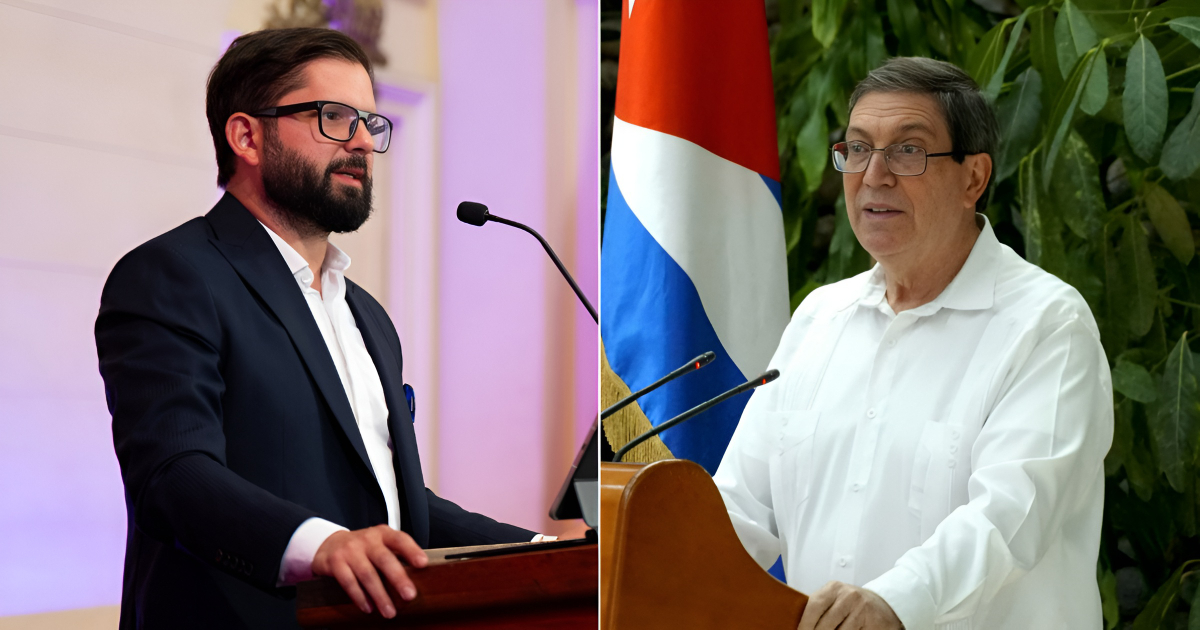
The Cuban Foreign Minister, Bruno Rodríguez Parrilla, recently accused Chile's socialist President Gabriel Boric of engaging in "political opportunism" after Boric labeled Cuba as a dictatorship and attributed the island's severe crisis directly to its leadership.
In a statement shared on the social media platform X (formerly known as Twitter), Rodríguez Parrilla refrained from naming names, yet his implications were unmistakable: "While Latin America and the Caribbean face aggression and threats from the United States, some regional leaders choose to criticize Cuba. In his case, attacking our country is neither an act of coherence nor bravery, but rather political opportunism."
Cautious of the repercussions of his remarks, the Cuban foreign minister subtly added that this leader "squandered his time" and implied that "his mistakes and inconsistencies handed his country over to the neofascist far-right," referencing the recent victory of a conservative bloc in Chile following Boric's tenure.
These comments come shortly after Boric, during an interview with the Spanish newspaper El País, reiterated his critical stance towards Havana's regime.
"Cuba lacks democracy; it is a one-party regime with no freedom of expression," the Chilean president noted, emphasizing that "the primary responsibility lies with those governing Cuba, beyond the impacts of the U.S. embargo."
Boric further described the island's situation as a "deep and painful" crisis characterized by scarcity, migration, and a lack of fundamental freedoms.
A History of Criticism from Boric towards the Cuban Regime
Boric's statements are not an isolated incident. Even before assuming power, the Chilean leader maintained a firm position against authoritarian leftist governments.
Following the July 11, 2021 protests in Cuba, he expressed support on social media: "My solidarity with those demanding freedom and democracy in Cuba."
During his presidential campaign, he distanced himself from orthodox leftism by stating, "I have no problem saying that Cuba and Nicaragua are dictatorships," and as president, he declared that his government would condemn any human rights violations "regardless of the political color of the responsible regime."
His stance drew criticism from more radical sectors of Chilean progressivism, particularly the Communist Party, but was praised by broad democratic sectors in Latin America for his ideological consistency and defense of human rights without double standards.
Chile's Socialist Tradition of Critique
Havana's aggressive response contrasts with the evolution of Chile's left since the return to democracy.
Socialist presidents like Ricardo Lagos and Michelle Bachelet also maintained a cautious distance from the Cuban regime, prioritizing human rights over ideological solidarity.
During his term, Lagos avoided aligning with Havana in international forums, while Bachelet, as the UN High Commissioner for Human Rights, faced criticism from the regime for including Cuba in her reports on fundamental freedoms.
Boric himself represents a new generation of Latin American leftists who seek to differentiate from the historical authoritarianism of Castroism and Chavism, advocating for a modern, pluralistic social democracy committed to transparency and civil liberties.
End of Propaganda
The Cuban foreign minister's message, laden with slogans and standard accusations against "imperialism," highlights the regime's struggle to accept criticism even from former allies.
The tactic of discrediting every dissident or external critic no longer yields the same results in a region increasingly aware of human rights violations on the island.
While official propaganda tries to portray any critique as treachery, Boric's stance—though uncomfortable for the old Latin American left—shows that a section of the regional progressivism has decided to break the silence in the face of the Cuban regime's totalitarian imprint.
Key Questions on Cuban and Chilean Political Dynamics
Why did Bruno Rodríguez accuse Gabriel Boric of political opportunism?
Bruno Rodríguez accused Gabriel Boric of political opportunism because Boric criticized Cuba as a dictatorship and attributed the island's crisis to its leadership, which Rodríguez viewed as an opportunistic move rather than a coherent or brave stance.
What has been Gabriel Boric's stance on authoritarian regimes?
Gabriel Boric has maintained a firm stance against authoritarian leftist regimes, openly criticizing Cuba and Nicaragua and supporting human rights and democracy, regardless of political ideology.