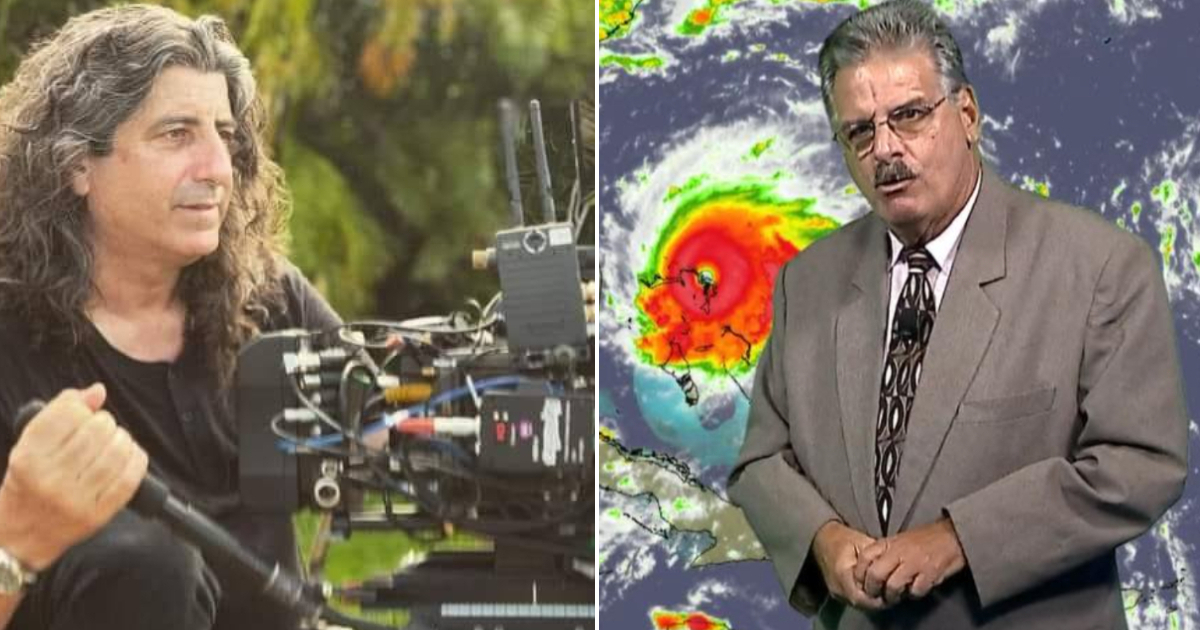
Exiled Cuban filmmaker Lilo Vilaplana has shed light on how weather forecasts on state television have been used as tools of political and psychological control. He recalls the repeated phrase, “dangerous swells for small vessels,” which has been a staple in Cuba's news programming for years.
In a Facebook post titled “The Exile,” Vilaplana pointed out that this weather warning served as an intimidating message aimed at those considering escaping the island by sea. According to him, it wasn't merely a cautionary notice but a politically charged signal.
Having spent years working in Cuban television before moving to the United States, Vilaplana explained that the phrase was often reiterated even when extreme conditions were absent. The clear intent was to instill fear, discourage escape, and reinforce the belief that leaving the country was tantamount to a death sentence.
“The climate became a tool of control, presented as a neutral and technical fact,” Vilaplana emphasized. He highlighted that meteorologists, announcers, and executives were complicit in the daily dissemination of this implicit message—‘don’t leave’—wrapped in maps, figures, and scientific language. Without overt threats, the State used the guise of responsible reporting to exert psychological intimidation.
Weather Warnings and War Rhetoric: A Tool for Control
Vilaplana drew a parallel between this mechanism and the current official narrative about the supposed “State of War” in Cuba. “The same pattern is repeated today when the regime declares the country in a State of War without any real combat. It’s not about describing an objective situation but about fabricating a constant threat to justify obedience, militarization, and sacrifice,” he wrote.
His remarks arrive shortly after the National Defense Council approved “plans and measures for transitioning to a State of War,” a decision presented by state media as part of “Defense Day.” The official note did not detail the specific measures or their impact on civilians.
This warlike rhetoric has intensified following the capture of Nicolás Maduro in Caracas on January 3rd, escalating the rhetoric of “resistance” and symbolic military preparations on the island, while the population grapples with blackouts, shortages, and an unprecedented economic crisis.
Legal Implications and Public Debate
Vilaplana’s reflection coincides with a debate sparked by historian and activist Alina Bárbara López, who publicly questioned whether the government had suspended constitutional guarantees following the National Defense Council's announcement. “When the state of war is declared, are constitutional guarantees suspended?” she asked on Facebook, amid systematic repression of peaceful protests.
Legal experts consulted by López warned that the implementation of war plans could effectively lead to severe rights restrictions, even without a formal declaration. López clarified, “since they haven’t done so, I assume not, and I go out without worries,” referencing her monthly civic action in Matanzas.
In this context, Vilaplana’s words take on a symbolic dimension: the manipulation of technical language—whether meteorological or military—as a tool for psychological and social control. “Today, it’s an abstract and invisible war. In both cases, the power uses supposedly technical language to impose fear and remind citizens there is no escape, not even symbolically, from State control,” the filmmaker concluded.
Understanding Cuba's Political Climate
What was the purpose of the repetitive weather warnings in Cuba?
The repetitive weather warnings served as a tool for political and psychological control, aiming to intimidate those considering leaving the island by sea, and reinforcing the idea that escape equated to certain death.
How does the Cuban regime use language as a means of control?
The regime manipulates technical language in weather and military reports to create a sense of constant threat, justifying obedience and control without overt threats, thereby instilling fear and maintaining power over the populace.