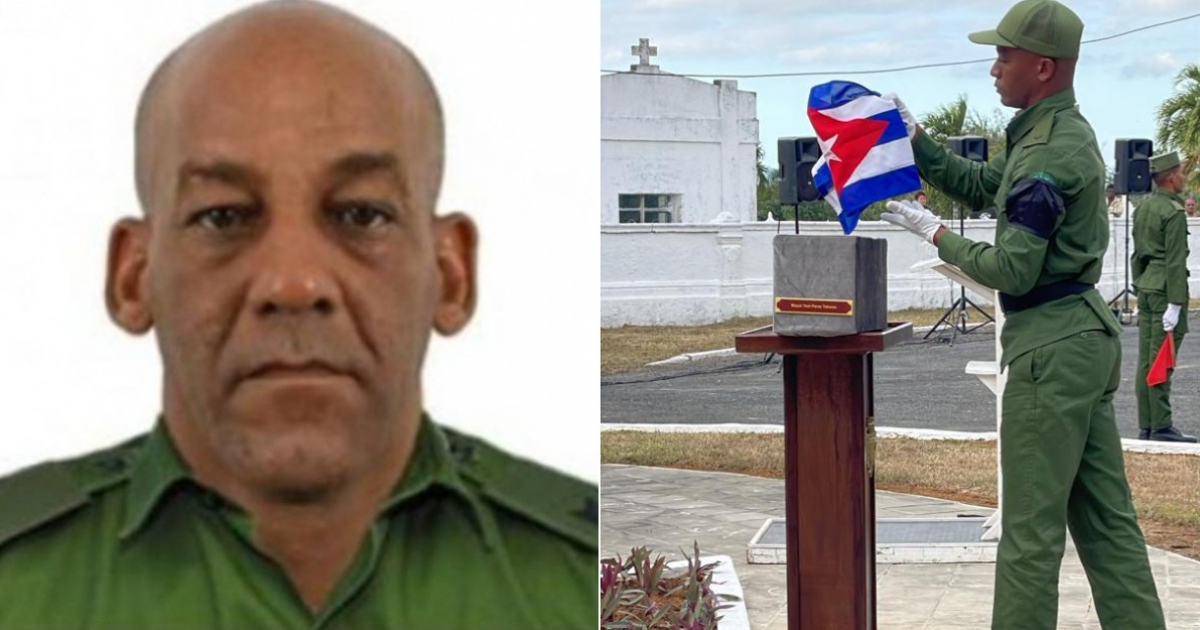
The recent death of Cuban military officer Yoel Pérez Tabares in Caracas highlights a stark contradiction between the official narrative and his actual deeds. While the government portrays him as a hero, in reality, Pérez was involved in the repression of independent journalists and critics of the regime in Cuba.
Before the remains of the 32 Cuban military personnel arrived on the island, their families shared memories and insights about their lives with Juventud Rebelde.
Yoel Pérez Delgado, his father, takes solace in the belief that his son died "defending, fulfilling his duties as he should have." Pérez Tabares, aged 48 and holding the rank of captain in the MININT, had only been in Venezuela for less than two months.
His family understood the high responsibility of his work: the elder Pérez was to wait for his son to contact him and never take the initiative. Pérez Delgado admits to having many unresolved questions about the circumstances of his son's death, only knowing that they "held out" during the incident. As a father, he praises his son's preparedness: "I knew that if anything happened, they wouldn't easily bypass him; they would have to go through him."
Meanwhile, his wife recalled his service in the provincial instruction branch of the MININT, asserting that he chose his career out of passion, not obligation. "He excelled in his tasks. Although I wasn't privy to his work, his achievements were evident in the recognition he received," she mentioned.
Despite the familial admiration, Pérez Tabares' history in Cuba reflects a significant role in political repression. A victim of State Security recounted an incident in October 2020 when he was summoned, interrogated, and threatened by the now-deceased captain, who accused him of posting an anti-revolutionary sign.
The victim disclosed that he remained under State Security surveillance for six months and was again detained on July 11, 2021, during the anti-government protests. He asserted that these repressive actions were orchestrated by Yoel Pérez Tabares, who summoned, interrogated, and threatened him with imprisonment, maintaining constant surveillance over him and his family.
Regime agents even visited his workplace to discredit him, nearly costing him his job. "Those were times of anguish for my family," he recounted to journalist Mario J. Pentón.
The posthumous homage, rich in patriotic rhetoric, attempts to cast the deaths of these military personnel as a heroic saga. However, the mission was neither patriotic nor humanitarian in nature; it aimed to ensure the survival of an allied authoritarian regime.
Among the 32 officers, including Pérez Tabares, their deployment was to safeguard the regime of Nicolás Maduro, not to protect Cuba. The U.S. operation that led to their deaths confirmed what Havana had long denied: Cuban officers were directly involved in securing the Chavista leadership.
The personal tragedies faced by the families starkly contrast with the regime's propagandistic narrative, which seeks to turn these deaths into heroic acts to bolster its confrontational stance against the United States.
While families mourn the loss of sons, fathers, and husbands, the events lay bare the instrumentalization of the Cuban military to support a foreign dictatorship amid a domestic backdrop of shortages, power outages, and growing social dissatisfaction.
Understanding the Role of Cuban Military in Venezuela
What was Yoel Pérez Tabares' role in Venezuela?
Yoel Pérez Tabares was deployed as part of a military contingent to protect the regime of Nicolás Maduro in Venezuela.
How did the Cuban government portray Yoel Pérez Tabares?
The Cuban government portrayed Yoel Pérez Tabares as a hero, focusing on his military service and dedication.
What actions of repression was Yoel Pérez Tabares involved in?
Yoel Pérez Tabares was involved in political repression, including summoning, interrogating, and threatening individuals critical of the Cuban regime.