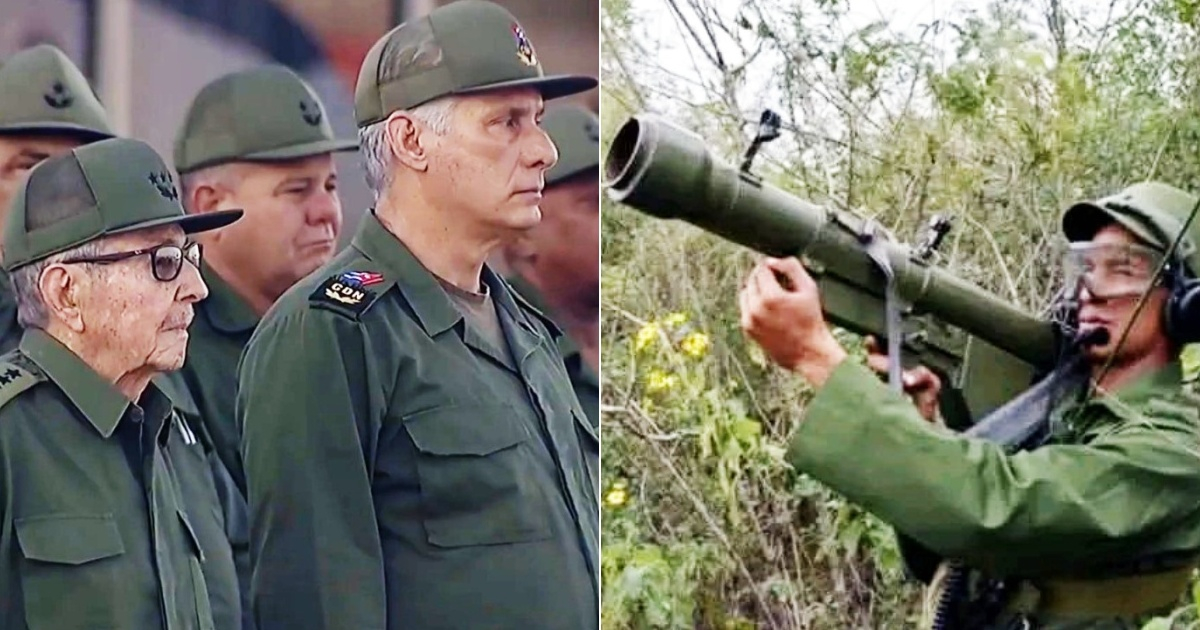
The Cuban National Defense Council, convening this past Saturday, has approved the "plans and measures for transitioning to a State of War" as part of its so-called "strategic concept of the War of the Entire People."
This information was released by state-run media outlets Cubadebate and Granma, framing the announcement as part of Defense Day activities.
According to the concise official statement: "In alignment with the activities planned for Defense Day, aimed at enhancing and refining the preparedness and cohesion of leadership bodies and personnel, the National Defense Council gathered this Saturday to evaluate and approve the plans and measures for transitioning to a State of War, within the framework of the strategic concept of the War of the Entire People."
As usual in state propaganda, the language used is more theatrical than informative.
The statement fails to specify any concrete measures that were approved, what real implications this supposed "preparation" will have, or what level of civilian mobilization is expected.
Nevertheless, the communiqué concluded by noting that "Army General Raúl Castro Ruz was kept informed of the activity's progress, which he described as a good and efficient meeting."
The continued prominence given to Raúl Castro—officially retired from power for years—once again underscores the symbolic weight the regime assigns to his figure, overshadowing the designated president Miguel Díaz-Canel, who is completely absent from the note, not even mentioned as Head of the National Defense Council.
In a nation where access to food, electricity, medicine, and basic services is increasingly precarious, and where mass migration is reaching historic levels, the announcement of this "transition to a State of War" seems, at best, an absurd provocation, and at worst, a veiled threat against the population itself.
Cubans Express Outrage and Mockery on Social Media
The public reaction was swift. Social media, one of the few platforms where Cubans can express themselves without state filters, erupted with indignation, sarcasm, and skepticism. To many, the announcement appears to be a propagandistic distraction amid the deep national crisis:
-"Deploy the troops to plant sweet potatoes."
-"War of the entire people... without consulting the people."
-"Invest in improving quality of life for the population, because the Americans will just let this fall apart on its own. Focus on what's truly important."
-"In peacetime, there's no electricity, water, gas, food, or medicine. Imagine with a naval blockade. What combat morale do they expect, and what are people supposed to defend, the round leaders?"
-"Cuba doesn't need trenches or military parades. It needs food, electricity, medicine, decent salaries, and freedom."
-"Isn't Canel the head of the National Defense Council? Because it seems like Raúl is still in charge."
-"State of war? We've been in that since 1959, but against hunger and misery."
-"The war they need to fight is the production of food, not this farce."
-"Let them go to the front. I'd like to see the top officials on the front lines, not hiding in an air-conditioned office."
-"I have so much to say about all this, and even though it doesn't apply in this country, I'll use my freedom of expression because I feel like it."
-"Count me and my family out for any stupid little war."
Military Display: Outdated Weapons and Tired Rhetoric
On that same Saturday, alongside the Council's announcement, the Ministry of the Revolutionary Armed Forces (Minfar) released videos of military exercises from the official accounts of the Western, Central, and Eastern Armies.
The footage showed trenches, AK-47 rifle fire, drones, rocket launches, and controlled explosions, all set against epic music and waving flags.
What was intended to be a demonstration of power and unity was met with widespread mockery: "Drills to intimidate the people"; "Completely outdated systems. Who are they planning to confront with that?"; "A joke compared to modern military technology."
Other users made it clear they feel there's nothing worth defending under current conditions:
"The country is in shambles, people are leaving by the thousands, and now they want to play soldiers"; "We have no electricity, no food, no medicine. What nation are we supposed to defend like this?" "With this 'war of the entire people,' they want to force people to mobilize without openly saying so. They don't have support, they know it, and that's why they resort to veiled threats," were other opinions shared.
The Context: Military Propaganda Amid Fear of Collapse
The regime's militaristic shift is not new, but it has intensified since the capture of Nicolás Maduro in Caracas by U.S. forces on January 3rd.
Since then, the rhetoric of "resistance" has escalated. Every Saturday, a symbolic "defense preparation" action is held, while the country remains mired in its worst crisis in decades.
Some analysts suggest that this bellicose language aims to stir patriotic emotions, but more importantly, to reinforce internal control, create a sense of threat, and silence the social unrest spreading even within the official bases.
"They live like modern pharaohs while the people are like ancient-era slaves"; "We're no longer living like human beings, sometimes I wonder if we're even living"; "In the meetings, only the bellies of those who gather grow"; "What defense are they talking about if they're just defending privileges?" The real battlefield is in the kitchens, not in military grounds.
The contrast between the regime's war rhetoric and the everyday life of Cubans couldn't be more grotesque:
-"I'm without food and haven't bathed. I have nothing to cook with. That's the real war without cuts, an eight-hour blackout."
-"Children used as political propaganda instead of receiving a free and critical education."
-"Where's the promised glass of milk from Raúl Castro?"
-"This whole war is against the people, not against any external enemy."
-"For this, they have gasoline and food, for the military."
-"God, reach out and lift my beautiful island from this nonsense. Many good people there don't deserve such punishment."
Conclusion: A War the People Do Not Recognize
The approval of the "transition to a State of War" by the National Defense Council has not been received as an act of unity or national defense.
On the contrary, it has sparked rejection, mockery, and distrust from citizens tired of prioritizing parades and meetings over basic needs.
Instead of unity, it has caused division. Instead of trust, fear. Instead of hope, further disillusionment.
As one popular comment sums up among the many that flooded social media:
"The people are at war, yes. But not against the Yankees, rather against the hunger, blackouts, and misery that you yourselves have caused."
Understanding Cuba's Political and Social Climate
What is the "War of the Entire People" concept?
The "War of the Entire People" is a strategic concept employed by the Cuban government to suggest that the entire population is involved in the defense of the nation against external threats. However, it is often criticized as a rhetorical device rather than a practical strategy.
Why is Raúl Castro still prominent in Cuban politics?
Despite his official retirement, Raúl Castro remains a significant figure in Cuban politics due to his symbolic importance and historical role within the regime. His presence often overshadows current leaders like Miguel Díaz-Canel.
How do Cubans generally react to government announcements?
Many Cubans express skepticism and mockery towards government announcements, especially those that seem disconnected from the everyday struggles they face, such as shortages of food, medicine, and basic services.