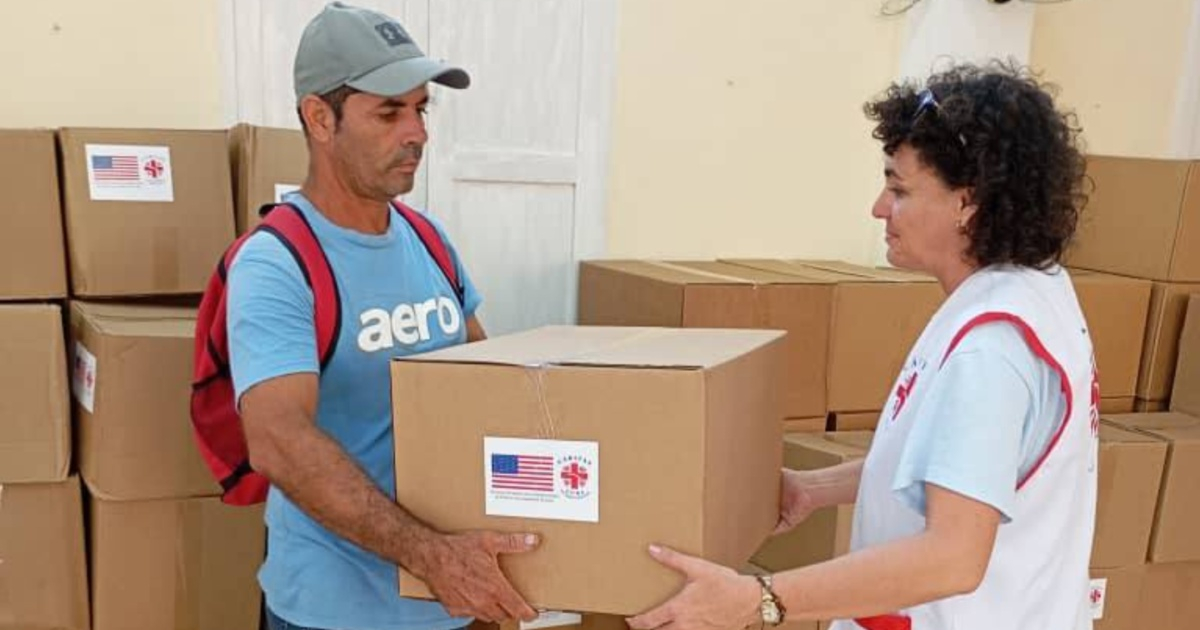
The United States Embassy in Cuba expressed satisfaction as humanitarian aid for those affected by Hurricane Melissa begins reaching the most vulnerable. The embassy stated that if the distribution continues smoothly, "more will follow."
This announcement was made on platform X amid the initiation and expansion of distributing food and hygiene kits in eastern Cuban communities, an effort coordinated by the Catholic Church and Caritas Cuba.
Caritas Cuba reported that distribution efforts kicked off at the Parish of San Pedro Apóstol in the municipality of Cacocum. With assistance from volunteers and local community members, food and hygiene kits are being delivered to families impacted by the cyclone.
These packages are specifically targeted at individuals who lost their homes, belongings, and regular access to essential resources due to Melissa's impact in October.
This delivery is part of a larger operation involving several shipments from the United States, aiming to support approximately 6,000 families across the dioceses of Bayamo-Manzanillo, Holguín-Las Tunas, Santiago de Cuba, and Guantánamo-Baracoa, according to Caritas' own information.
In this context, a second plane carrying humanitarian aid landed at Antonio Maceo International Airport in Santiago de Cuba, bringing 528 kits of non-perishable food and 660 hygiene kits.
This shipment accompanied an earlier consignment that had already arrived at Holguín airport with similar quantities.
The report highlights that the U.S. government announced a total of three shipments for the disaster victims: two by air and one by sea.
According to a State Department communiqué referenced in the text, these deliveries are part of a $3 million disaster relief package, expected to assist up to 24,000 people in the hardest-hit provinces: Santiago de Cuba, Holguín, Granma, and Guantánamo.
Besides basic subsistence items like rice, beans, oil, and sugar, the shipments include supplies for water purification and storage, as well as essential household goods such as pots, cooking utensils, sheets, blankets, and solar flashlights for dealing with power outages.
Caritas emphasized that the aid represents a gesture of charity and solidarity, underscoring the importance of local volunteers in ensuring that help reaches families "directly."
In stark contrast, the Cuban government criticized the aid, accusing Washington of exploiting the disaster for "political manipulation" purposes and claiming there was no official coordination between the two governments. Havana insists that all humanitarian contributions must be routed through state channels.
Nevertheless, the aid is being received and distributed across eastern communities still grappling with the aftermath of the hurricane.
Key Questions About Humanitarian Aid to Cuba
What is included in the humanitarian aid sent to Cuba?
The aid includes food items like rice, beans, oil, and sugar, and supplies for water purification, as well as essential household items such as pots, cooking utensils, sheets, blankets, and solar flashlights.
Which organizations are involved in distributing the aid in Cuba?
The distribution is coordinated by the Catholic Church and Caritas Cuba, with support from local volunteers and community members.
How has the Cuban government responded to the aid?
The Cuban government has criticized the aid, accusing the United States of political manipulation and insisting that all humanitarian efforts should be channeled through state avenues.