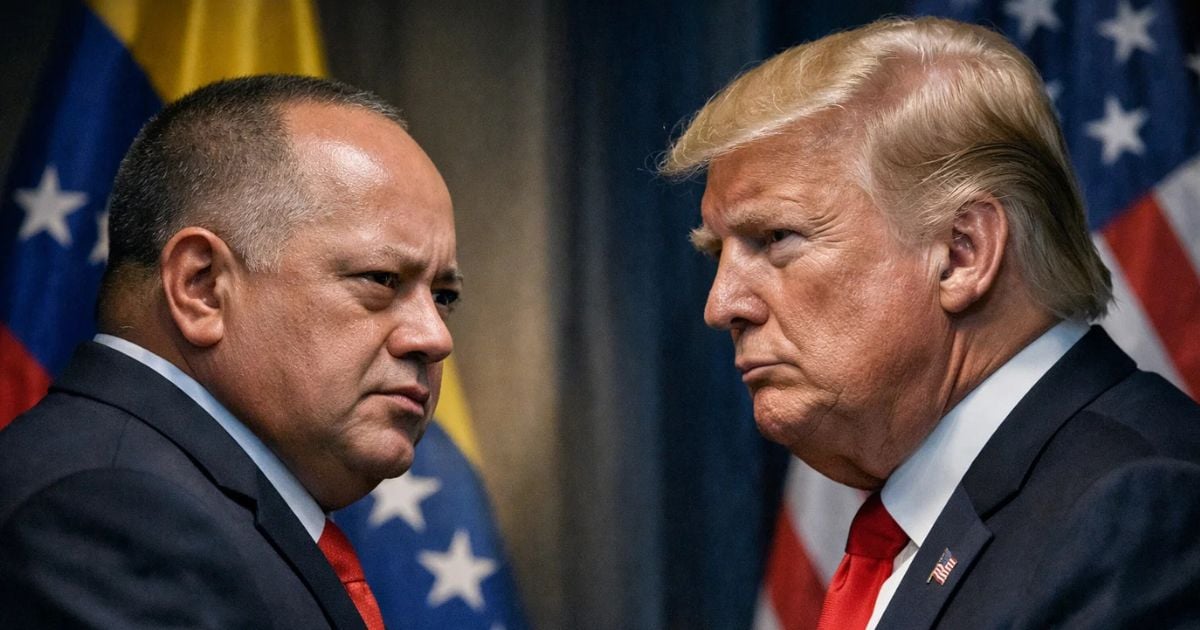
Trump Administration officials engaged in discussions with Diosdado Cabello, Venezuela's Interior Minister and the second-in-command of the Chavista regime, months prior to the U.S. operation that led to the capture of Nicolás Maduro.
Both parties have continued their dialogue, as reported by Reuters on Saturday, citing sources familiar with the matter.
The communications reportedly began in the early days of the Trump Administration and intensified in the weeks leading up to the January 3 operation.
In these exchanges, U.S. officials reportedly demanded that Cabello refrain from using security services or party militants to target opposition groups, according to four consulted sources.
This request extended to intelligence forces, police, and pro-government militias known as colectivos, which remain active despite the U.S. raid.
Although his name appears in the same narcotics indictment the U.S. used to justify Maduro's capture, Cabello was not arrested during the operation and continues to hold a significant position within the regime.
The discussions also reportedly covered U.S. sanctions imposed on him, although it's unclear whether he has adhered to the warnings.
The Venezuelan minister has been in contact with the U.S. administration both directly and through intermediaries, according to anonymous sources discussing sensitive internal communications.
These communications have been crucial for the Trump administration's efforts to maintain stability in Venezuela, according to the sources.
Cabello, 62, is a key enforcer of repression in Venezuela.
As a former military officer, he wields influence over military and civilian counterintelligence agencies, oversees domestic espionage operations, and maintains close ties with pro-government armed civilian groups.
Had he chosen to deploy the forces under his control, it could have sparked chaos jeopardizing the political control of interim President Delcy Rodríguez, whom Washington views as a pivotal figure in its strategy for post-Maduro Venezuela.
The Trump Administration has thus far opted for an alliance with Delcy Rodríguez, Venezuela's interim president, to prevent chaos similar to the aftermath of the Iraq invasion following Saddam Hussein's fall in 2003.
Donald Trump himself engaged in a lengthy phone conversation with Rodríguez this week, praising her for complying with his team's demands.
The president argued that his administration seeks a "controlled, stable, and effective" transition in Venezuela and has been open about his willingness to negotiate with her instead of opposition leader María Corina Machado.
Until now, Cabello's name had not surfaced publicly in this process.
The talks with Washington had not been reported and highlight the ex-military official's significance as a stabilizing force during an unspecified transitional period, during which the U.S. aims to secure access to the country's oil resources.
Key Insights on U.S. and Venezuela Relations
What role did Diosdado Cabello play in the U.S. operation to capture Maduro?
Diosdado Cabello was involved in discussions with the U.S., where officials demanded he not use security forces against the opposition. His cooperation was seen as crucial to maintaining stability during the operation.
How did the Trump Administration view Delcy Rodríguez's role in Venezuela?
The Trump Administration regarded Delcy Rodríguez as a key figure in ensuring a stable transition in Venezuela, preferring to negotiate with her rather than opposition leaders.
Why were the communications between the U.S. and Cabello significant?
The communications were important for maintaining stability in Venezuela and ensuring that Cabello did not use his influence to disrupt the political climate during the U.S.-led operation.