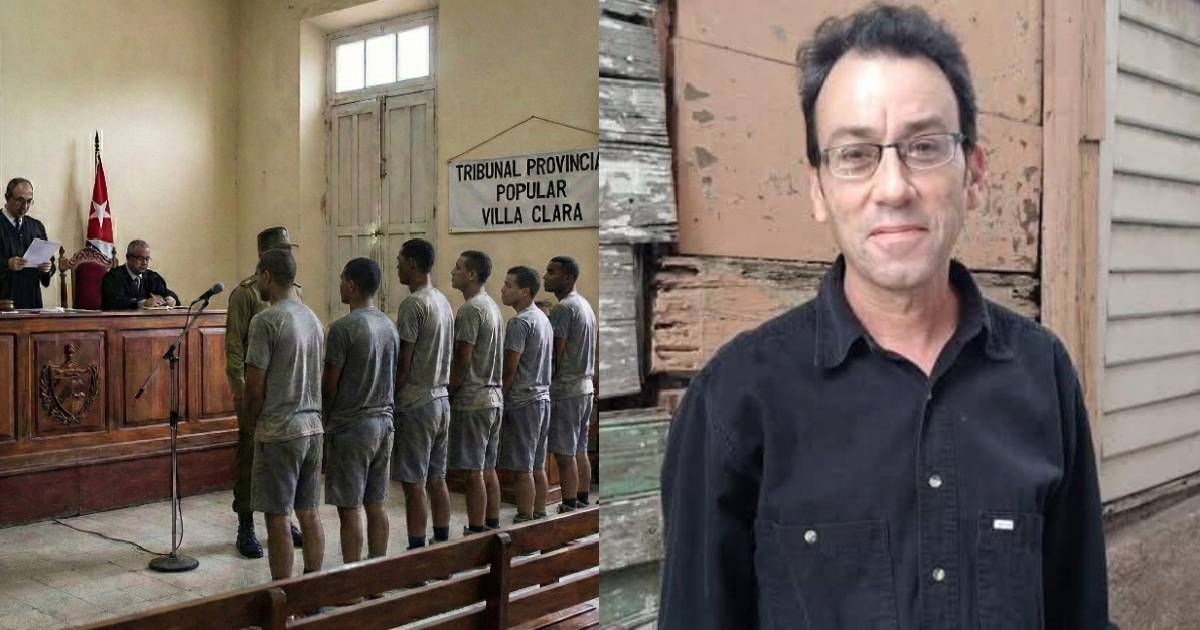
In a striking example of its authoritarian grip, a Cuban court has handed down sentences of up to eight years in prison to six individuals who voiced their demands for electricity during a power outage in Encrucijada, Villa Clara Province. Human rights organizations are decrying these actions as oppressive and a blatant violation of fundamental freedoms.
The Villa Clara Provincial People’s Court, specifically its State Security Offenses Chamber, convicted these six individuals of “public disorder” for their participation in a peaceful protest during a blackout on November 7, 2024, in Encrucijada.
The penalties, as highlighted by the Cuban Observatory for Human Rights (OCDH), include prison terms of up to eight years, alongside restrictions on freedom and correctional labor.
According to the 2026 ruling No.4 related to Case No.82/2025, José Gabriel Barrenechea Chávez received a six-year prison sentence; Yandri Torres Quintana was penalized with eight years; Rafael Javier Camacho Herrera received seven years; and Rodel Bárbaro Rodríguez Espinosa was sentenced to five years.
Meanwhile, Yuniesky Lorences Domínguez was subjected to three years of correctional labor without confinement, and Marcos Daniel Díaz Rodríguez was given five years of restricted freedom.
The OCDH accessed the ruling, which describes how the accused gathered in front of the municipal headquarters of the Communist Party of Cuba (PCC) and the Government, shouting slogans like “we want power” and banging pots, actions labeled by the judges as creating “noise and commotion” and hindering traffic and official duties.
The ruling, signed by judges Aimee Caraballé Corrales, Justo Gustavo Faife Hernández, and María Teresa Domínguez Rodríguez, downplays the peaceful nature of the protest and criminalizes the citizens' demands, such as preventing a PCC official from providing explanations during the outage.
In Barrenechea’s case, the court resorted to stigmatizing descriptions commonly used against activists, despite acknowledging his lack of a prior criminal record.
The OCDH condemned these sentences as a direct breach of the rights to freedom of expression and peaceful assembly, as enshrined in the Universal Declaration of Human Rights and the International Covenant on Civil and Political Rights, to which Cuba is a signatory.
From the organization’s perspective, protesting the lack of electricity is not a crime but a legitimate demand in response to the country’s prolonged energy crisis.
Barrenechea’s case has sparked particular outrage due to the treatment he received while incarcerated. Detained since November 2024, the opposition intellectual was denied the opportunity to say goodbye to his mother, Zoila Esther Chávez Pérez, who passed away in May 2025 at 84 from metastatic cancer.
Despite repeated requests for compassionate leave, prison authorities refused visitation rights, even though he was her sole caregiver.
From La Pendiente prison in Santa Clara, Barrenechea penned a letter published by independent outlet 14ymedio, expressing his pain over the loss and acknowledging his “crime” of joining neighbors to demand electricity.
Following her passing, he was only allowed a brief, monitored visit to the wake, without the chance for a proper farewell, before being returned to his cell.
The OCDH highlights that this case is part of a broader context of increasing repression. Their VIII Report on Social Rights indicates that in 2025, blackouts became the primary concern among Cubans, surpassing even the food crisis.
That year, the organization documented at least 3,179 instances of repressive actions against civilians, including new prison sentences for exercising fundamental human rights.
Key Questions on Cuban Protests and Sentences
What sparked the protests in Encrucijada, Cuba?
The protests were sparked by a power outage on November 7, 2024, in the municipality of Encrucijada, prompting citizens to demand electricity.
How has the Cuban government responded to these protests?
The Cuban government responded by sentencing the protestors to prison terms of up to eight years for public disorder, viewed as oppressive by human rights organizations.
What are the broader implications of these sentences?
These sentences reflect a trend of increasing repression in Cuba, with human rights organizations noting a rise in actions against civilians exercising fundamental rights.