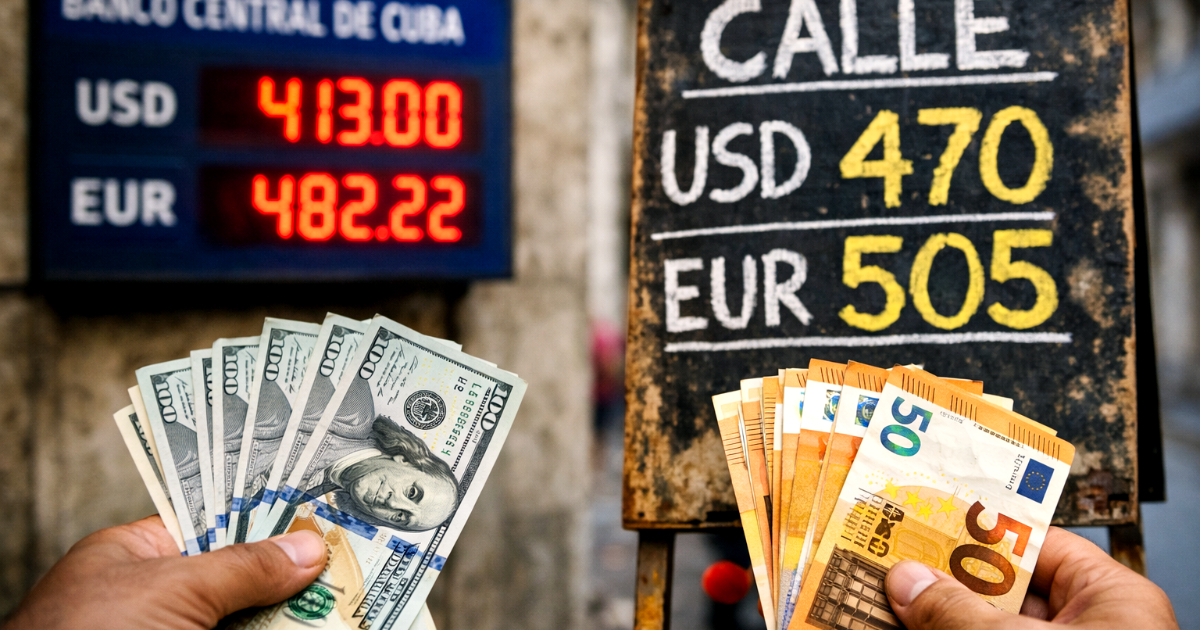
The value of the U.S. dollar (USD) surged to 470 Cuban pesos (CUP) in the informal market on Tuesday, while the euro (EUR) climbed to 505 CUP, as reported by the independent monitor elTOQUE.
These figures highlight a persistent trend that the Cuban government has yet to reverse: the national currency continues its depreciation, with the gap between the Central Bank of Cuba (BCC)'s official rate and the real market widening significantly.
Currently, the BCC maintains an official rate of 413 CUP per dollar and 482.22 CUP per euro, resulting in discrepancies of 57 pesos and 23 pesos, respectively, when compared to the informal exchange rates.
Stagnant "Floating" Rate
Just last month, this difference was a mere 30 pesos per dollar. However, it has ballooned by nearly 90% in under a month, revealing that the so-called "floating rate" introduced in December is anything but buoyant: it's sinking.
The Cuban regime unveiled its new exchange system as a step toward economic modernization. The model—comprised of state, mixed, and "floating" segments—was intended to gradually align the peso's value with supply and demand. Yet, the BCC's daily adjustments are minimal, often just one or two pesos, rendering them disconnected from actual market dynamics.
As the state institution "tweaks" its rate in official reports, Cubans engage in street transactions at rates 15% to 20% higher. There's a lack of transparency, liquidity, and access to dollars or euros at government-stated prices.
A Policy Lacking Backing and Control
This disconnect results in an official rate that is merely symbolic, offering no practical economic impact or public trust. The policy isn't faltering due to ill intent, but rather flawed design. The BCC is attempting to regulate a market it neither controls nor supplies.
Without a steady stream of foreign currency, solid international reserves, and faith in the national currency, no floating system can succeed. The alleged "floating" depends on state intervention rather than market-driven forces.
According to independent economists, the current framework isn't a reform—it's a bureaucratic rehash of centralized control. The Cuban peso remains overvalued in state sectors (1x24 for essential operations) and artificially maintained in official rates (1x413 for the public).
Meanwhile, the informal market remains the only reliable indicator of money's true value.
Two Rates, Two Realities
The coexistence of two rates—one official, one informal—mirrors a deeper divide: the disconnect between the state-run economy and everyday life. The government operates through statistics and controls, whereas the citizens navigate improvisation and survival. The Central Bank can declare a "rate for the day's operations," but in practice, such operations are non-existent.
As the BCC pretends the peso floats, the informal market reveals the uncomfortable truth: the CUP's value isn't determined by official declarations but by what Cubans are willing to pay for a dollar. This disparity—57 pesos today—represents not just a monetary gap but the chasm between authority and reality.
Understanding Cuba's Currency Challenges
Why is the Cuban peso losing value?
The Cuban peso is depreciating due to economic mismanagement, lack of trust in the currency, and a widening gap between the official and informal exchange rates.
What is the informal market rate for USD in Cuba?
As of the latest report, the informal market rate for USD in Cuba has reached 470 CUP.
How does the Central Bank of Cuba's official rate compare to the informal market?
The Central Bank of Cuba's official rate is significantly lower than the informal market, with a 57 peso difference per USD.