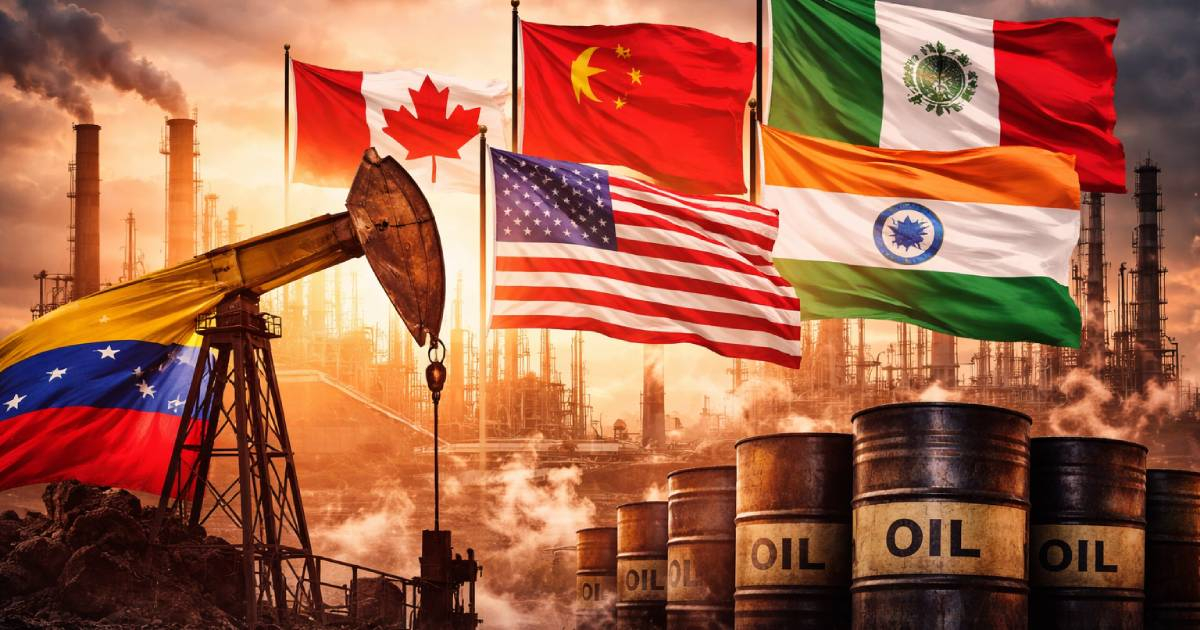
The downfall of Nicolás Maduro marks not only a significant political shift in Venezuela but also disrupts the global energy balance, reshaping interests, routes, and alliances in a market where oil remains a potent tool of power.
With the world's largest proven oil reserves, the future of Venezuelan oil has become a strategic asset coveted by the United States, Canada, China, India, and indirectly, Mexico.
According to an analysis by Valora Analitik, while Washington has expressed a clear interest in spearheading the reconstruction of Venezuela's oil sector, with potential investments reaching up to $100 billion, other players are not sitting idle.
For instance, Canada sees this situation as an opportunity to redirect its heavy oil to Asian markets, particularly China and India, in anticipation of Venezuelan oil eventually returning to the U.S. market.
Timing and Infrastructure Challenges
The timeline is crucial. Reviving Venezuela's ravaged oil infrastructure will neither be swift nor cheap. Experts cited by the report suggest it will take years and massive investments, providing a window for producers like Canada to strengthen their foothold in Asian markets.
The recent expansion of the Trans Mountain pipeline, facilitating the export of hundreds of thousands of barrels daily to the Pacific coast, is a step in this direction.
Asian Markets' Strategic Moves
Meanwhile, Asia watches the developments with both caution and ambition. India, which ceased importing Venezuelan crude in 2025, has expressed willingness to resume purchases should alternatives beyond U.S. companies arise.
For New Delhi, Venezuelan oil offers a path to diversify supplies and secure heavy crude compatible with its refineries amidst increasing global energy competition.
Mexico's Vulnerability and the U.S. Strategy
Mexico emerges as one of the more vulnerable players in this reconfiguration. Should the U.S. decrease its Mexican oil imports to accommodate Venezuelan oil, Pemex would need to accelerate market diversification.
Although long-term contracts somewhat cushion the impact, the risk of losing ground in the strategic Gulf of Mexico market looms large, especially if Venezuela restores its export capacity.
Behind these energy maneuvers lies hardline politics. President Donald Trump has not only supported a controlled engagement with Venezuela's oil sector but also placed the country's oil revenues under the U.S. Treasury's protection, shielding them from embargoes and lawsuits.
This strategy aims to stabilize Venezuela, alleviate migration pressures, and sever ties with actors deemed hostile by Washington.
Cuba's Energy Crisis
The ramifications are profound for Cuba. For years, Havana relied heavily on Venezuelan oil. Now, with Maduro out and Trump declaring "no more oil or money for Cuba," the island finds itself sidelined from a new energy order.
As other nations vie for barrels and markets, Cuba faces power outages, shortages, and deepening isolation.
The global oil map is shifting rapidly. Venezuela reemerges at the center, not as the reliable supplier of the past, but as a strategic territory in contention.
In this game of interests, alliances, and power, oil continues to prove it is more than just energy: it is politics, influence, and for many regional countries, a matter of survival.
Key Questions on the Global Oil Landscape
What are the main challenges in rebuilding Venezuela's oil infrastructure?
Reconstructing Venezuela's oil infrastructure is expected to be a long and costly process, requiring years and massive financial investment due to its current devastated state.
How does the shift in the global oil market affect Mexico?
Mexico faces potential vulnerabilities as the U.S. might reduce Mexican oil imports in favor of Venezuelan oil, pressuring Pemex to expedite market diversification to maintain its strategic position.