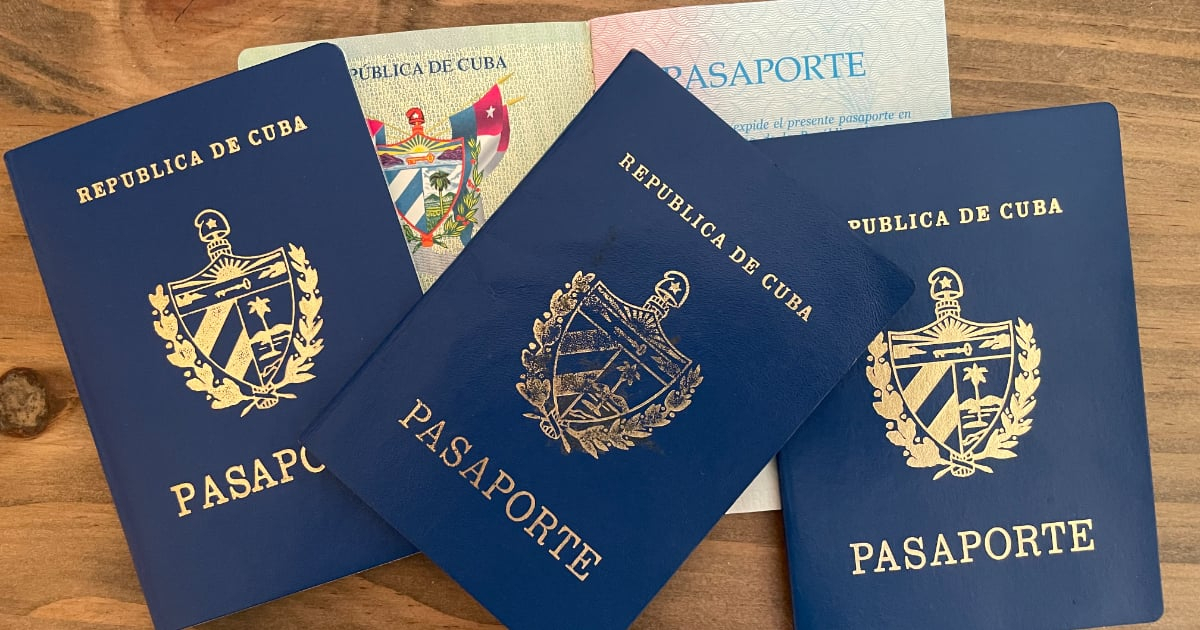
In recent hours, the Cuban authorities have addressed rumors circulating on social media about an alleged increase in passport fees for Cubans living abroad. The government clarified that these claims are inaccurate as the fees remain unchanged.
Technically, this denial holds true since there have been no adjustments to the charges. The Ministry of Justice has kept the prices the same since 2022, with the cost of obtaining a passport for Cubans abroad at 5,625 Cuban pesos, equal to 234 US dollars. Additionally, the renewal of the document remains at 2,000 Cuban pesos, which equates to 83 dollars.
Ana Teresita González, the Director General of Consular Affairs and Assistance to Cubans Living Abroad, confirmed on the social media platform X that "no modifications have been approved for the current fees." Indeed, the amounts for obtaining and renewing the passport have been consistent since 2022.
However, the Ministry of Justice's Resolution 486/2025, published in the Official Gazette, signals a significant shift in approach. For the first time, the legal text acknowledges that the updated fee structure is intended to "generate income in foreign currency," a rationale not explicitly stated in the previous regulation, Resolution 171/2022.
In practice, Cubans residing abroad have already been paying for these services in foreign currencies through consulates, so the measure doesn’t introduce a new financial burden for migrants. The change lies in the state's narrative, which no longer treats the passport solely as an administrative process but openly incorporates it into a revenue-generating strategy.
The truly novel aspect of Resolution 486/2025 is found in its foundational statements. In one of the "WHEREAS" clauses, the Ministry of Justice openly acknowledges the economic objective behind the fee adjustments:
"Based on the experience gained from applying the previously cited Resolution and studies conducted to generate income in foreign currency and to provide flexible options for charging the fees for legal services for obtaining and legalizing documents with effects both inside and outside the national territory..."
This acknowledgment was absent in Resolution 171/2022, which justified changes solely for administrative reasons and service reorganization.
Cuban consulates regularly publish the costs for these procedures in foreign currencies. For instance, in Mexico, passport renewals are charged in Mexican pesos, whereas in Bolivia, payment is required in cash and in US dollars, with specific conditions on accepted bills.
The resolution also consolidates payment in US dollars or other freely convertible currencies and strengthens the role of specialized law firms and consular offices as channels for managing these payments outside the country.
All of this unfolds amid a severe economic crisis, a scarcity of foreign currency, and increasing reliance on income from emigration. Consequently, while the government denies a non-existent fee hike, the official document reveals a deeper truth, positioning the Cuban passport as a paid service and emigrants as central to the state's financial strategy.
Understanding Cuba's Passport Fee Structure and Foreign Currency Requirement
Why did the Cuban government address rumors about increased passport fees?
The Cuban government addressed these rumors to clarify that passport fees for Cubans living abroad have not increased and remain the same since 2022.
What is the significance of Resolution 486/2025 regarding passport fees?
Resolution 486/2025 marks a shift by explicitly stating the objective of generating foreign currency income through the updated fee structure, which was not addressed in previous regulations.
How does the payment process for Cuban passports work for expatriates?
Cubans living abroad typically pay for passport services in foreign currencies at consulates, which has been a standard practice even before the new resolution was introduced.