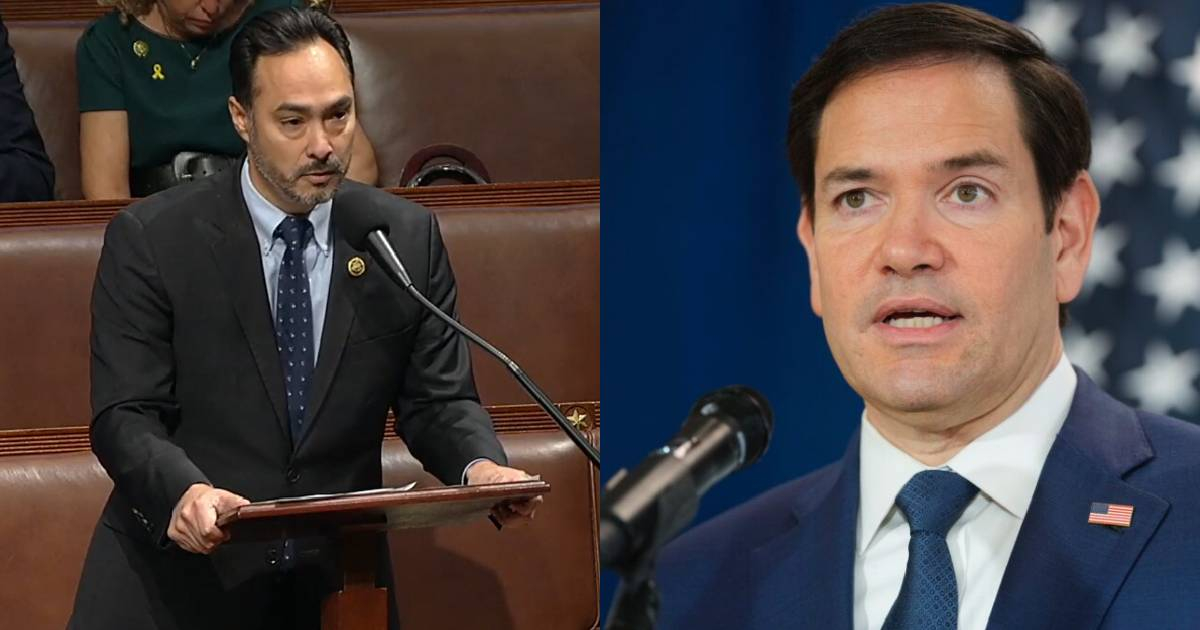
A coalition of 75 Democratic lawmakers has issued a stark warning to U.S. Secretary of State Marco Rubio regarding the potential political, economic, and diplomatic consequences of military action in Mexico. This follows President Donald Trump's threats to initiate ground operations against drug cartels.
The lawmakers' concerns were articulated in a letter to Rubio, expressing their "strong opposition" to any unilateral military action on Mexican soil, as reported by the news agency EFE.
This development came after Trump's interview with Fox News, where he declared his intention to conduct ground operations against the cartels, accusing them of "running Mexico."
The letter, spearheaded by Representatives Joaquín Castro, Gregory W. Meeks, and Greg Stanton, acknowledges President Claudia Sheinbaum's renewed efforts to combat organized crime. The lawmakers argue that military intervention would violate Mexico's sovereignty and undermine the current bilateral cooperation.
They stated, "Any unilateral military action would tarnish the new era of cooperation initiated by President Claudia Sheinbaum."
The legislators also highlighted the potential for "far-reaching" economic impacts on the United States. They noted that American direct investment in Mexico surpassed $14.5 billion in 2025, with over five million U.S. jobs reliant on bilateral trade, suggesting that military escalation could adversely affect American businesses and workers.
Moreover, they cautioned that bombing efforts could destabilize decades of joint initiatives to combat drug supply chains, including state-strengthening and anti-corruption programs.
The letter praised Sheinbaum's administration for enhancing intelligence against organized crime, reducing homicide rates, and achieving the largest fentanyl seizure in the nation's history.
Responding on Friday, the Mexican leader characterized Trump's remarks as typical of his communication style but pledged to seek direct contact with the State Department and, if necessary, with Trump himself to bolster bilateral coordination. "Mexico is a sovereign nation," she reiterated.
Trump's threats arise amid escalating regional tensions, highlighted by the recent U.S. military operation in Venezuela to capture Nicolás Maduro, whom Washington accuses of narcoterrorism.
This action has sparked fears that the White House might employ similar tactics in other countries under the guise of combating drug trafficking.
In his interview, Trump claimed his administration had blocked 97% of drugs entering via sea and declared that the next step would be to target cartels on land. Although he did not specify the extent or locations of potential operations, his rhetoric alarmed diplomats in Mexico and stirred concerns in the U.S. Congress.
Potential Consequences of U.S. Military Intervention in Mexico
What are the potential economic impacts of a U.S. military intervention in Mexico?
A military intervention could disrupt American direct investment in Mexico, which exceeded $14.5 billion in 2025. It could also negatively affect over five million U.S. jobs tied to bilateral trade.
How might military action affect U.S.-Mexico cooperation?
Military action could violate Mexico's sovereignty and damage the current era of bilateral cooperation, undermining joint initiatives to combat organized crime and drug trafficking.
What has President Claudia Sheinbaum achieved in the fight against crime?
Under Sheinbaum's leadership, there has been an increase in intelligence operations against organized crime, a reduction in homicide rates, and the largest seizure of fentanyl in Mexico's history.