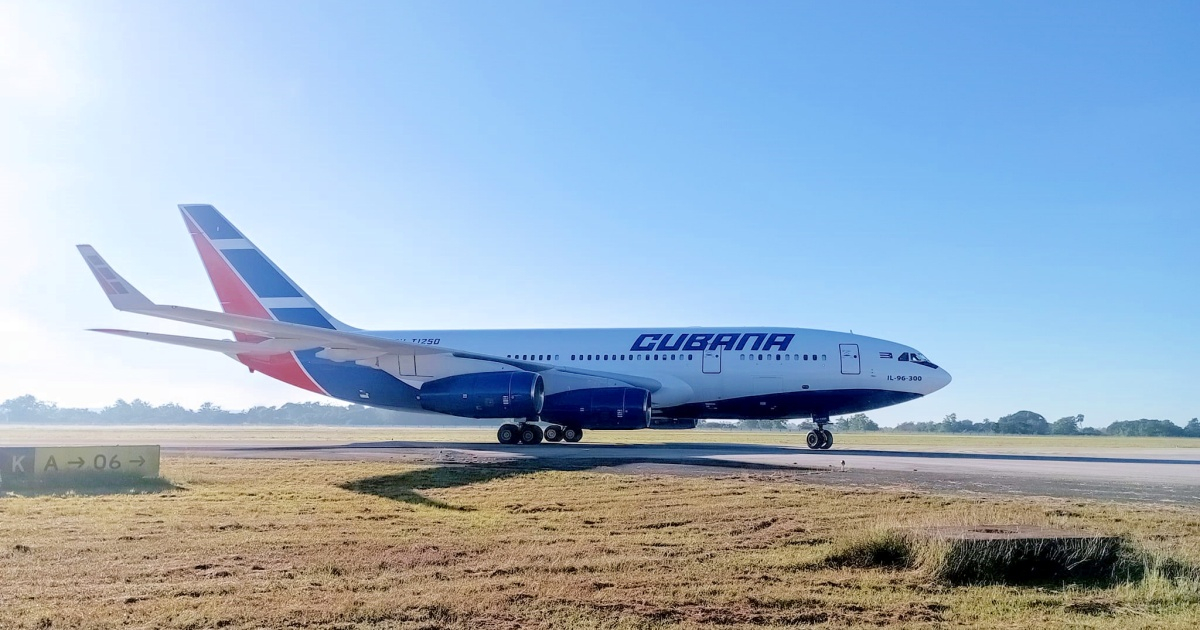
A Cubana de Aviación aircraft, bearing registration CU-T1250, had to return to Cuban soil after an unsuccessful attempt to land in Venezuela on Thursday morning.
This event is considered unusual in the realm of international air traffic, drawing considerable attention on monitoring platforms and social media in the recent hours.
Heightened Regional Tension and Air Restrictions
This incident unfolds amidst a climate of heightened tension in the region, characterized by airspace restrictions, military maneuvers, and security warnings impacting both civilian and state aircraft.
According to data from the digital monitor FlightRadar24, the Ilyushin Il-96-300, a Russian-made aircraft used for both commercial flights and the transport of Miguel Díaz-Canel, performed several 360-degree turns near Venezuelan airspace before abandoning its landing attempt and heading back to Cuba.
An Unconventional Flight
The plane took off from an unspecified airport in Havana and later landed in either Holguín or Santiago de Cuba, according to the records reviewed.
This operation did not resemble a regular commercial flight: it lacked the usual public data and identification numbers typically assigned to such routes, suggesting a special or classified mission.
Possible Connection to Venezuelan Crisis
Earlier this week, the digital outlet 14yMedio reported that the same aircraft was prepared for a mission to repatriate the remains of 32 Cubans who died in Venezuela, in the context of the recent U.S. military offensive that ended with the capture of Nicolás Maduro and Cilia Flores.
According to accounts cited in the independent press, the plane was expected to depart with "military personnel who were supposed to stay there," as per the testimony of an airport employee who requested anonymity.
This type of operation, humanitarian and diplomatic in nature, would have taken place with logistics separate from the commercial terminal, using military facilities and with restricted access for both airport staff and civilian observers.
Increased Aerial Activity in the Caribbean
The thwarted landing on Thursday, for which there is no official information regarding its purpose, occurred amid an escalation in aerial activity in the Caribbean.
Regional media outlets such as La Patilla reported that on the same day, a sophisticated U.S. reconnaissance drone, the MQ-4C Triton, hovered for hours over the Venezuelan coast, in the same area where the Cuban plane made its loops before retreating.
This unarmed aircraft, operated by the U.S. Navy, departed from the Naval Air Station in Jacksonville, Florida, and remained over the Caribbean Sea between the air control zones of Curaçao and Venezuela.
Speculations and Unanswered Questions
The simultaneous presence of the drone and the Cuban plane's decision to avoid entering Venezuelan airspace has led to various speculations.
The aircraft involved, registration CU-T1250, recently underwent major repairs in Belarus before rejoining Cubana de Aviación operations.
The Il-96-300 is the largest and longest-range aircraft in the state airline's fleet but also one of the most expensive to operate, in a company facing a severe structural crisis due to lack of parts, route cancellations, and technological obsolescence.
Historically, Cubana has maintained flights to Venezuela as part of the close ties between the two governments. However, the current circumstances—marked by a radical power shift in Caracas, a U.S. military presence in the region, and heightened restrictive measures—cast doubt on the viability of these air links in the near future.
Lack of Official Statements
So far, neither Cubana de Aviación nor Cuban or Venezuelan authorities have issued public statements about this incident.
The reasons for the plane's return have not been clarified, nor has the nature of the mission been officially confirmed.
The typical lack of transparency from both governments has fueled conflicting narratives about the flight's purpose, the reasons for its return, and the operational context in which it was conducted.
Insights into the Cuban Aviation Incident
Why did the Cubana de Aviación plane return to Cuba?
The Cubana de Aviación plane returned to Cuba after failing to land in Venezuela. The exact reasons for this decision remain unclear, as neither the airline nor the authorities have provided official explanations.
What was the intended mission of the aircraft?
The aircraft was reportedly on a mission related to the repatriation of 32 Cuban bodies from Venezuela, amidst a backdrop of political and military tensions in the region.
How does this incident fit into the broader regional context?
This incident occurs amid rising tensions in the Caribbean, including U.S. military activities and airspace restrictions, which have impacted aviation operations in the region.