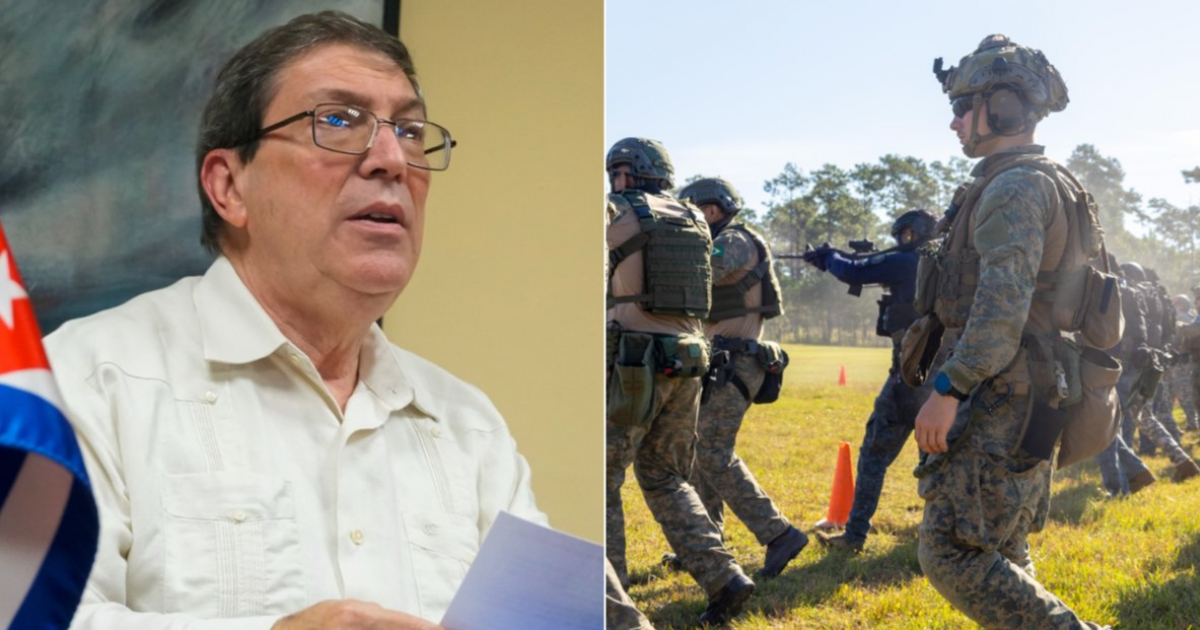
Cuban Foreign Minister Bruno Rodríguez Parrilla once again targeted the United States in a message on his X account, as tensions between Havana and Washington escalate due to recent U.S. actions regarding Venezuela.
Rodríguez Parrilla accused the U.S. of fostering an "international order rooted in military power and force," reminiscent of what he called "the darkest days of warfare-fueled plunder."
He argued that such a policy entails violating international law principles established after centuries of conflict and chaos.
The Cuban diplomat claimed that the United States endangers "the lives of countless low-income American youths by enlisting them into the armed forces and deploying them to fight across the globe."
He also criticized the perceived wasteful spending of billions on military conflicts, which he claimed contradicts the electoral promises made by the U.S. administration.
The Cuban Narrative Against U.S. Policies
Rodríguez Parrilla's remarks reflect the Cuban government's long-standing portrayal of the United States as a global aggressor, manipulating vulnerable youths for its geopolitical gains.
However, many Cubans met his message with skepticism and criticism on social media, arguing it ignores the island's internal issues and the daily struggles faced by its youth and citizens.
Responses and Escalation
The Cuban leader's post referenced a tweet by U.S. Defense Secretary Pete Hegseth, who defended America's firm stance following recent Venezuelan oil tanker seizures.
"The United States continues to enforce the blockade on all dark fleet vessels illegally transporting Venezuelan oil to fund illicit activities, stealing from the Venezuelan people," Hegseth stated.
He emphasized that only legitimate and legal energy trade, as determined by Washington, would be allowed.
Meanwhile, Cuban Deputy Foreign Minister Carlos Fernández de Cossío supported and intensified Rodríguez's narrative, likening the U.S. to historical enemies and legitimizing any "patriotic" response against it.
"Against Hitler, it was the patriotic response of the peoples and their governments, where it existed, such as in the USSR, that dealt the defeat to Nazi-fascism and saved Europe and the world from the scenario the U.S. now seeks to impose," he wrote.
Context of Tensions
This exchange of accusations comes amid heightened tensions after U.S. President Donald Trump's remarks following the capture of Venezuelan leader Nicolás Maduro in Caracas.
Trump declared that "Cuba is ready to fall," arguing the Cuban regime's economic support has crumbled with the collapse of Venezuelan oil supply, making the island's government "inevitable to fall."
In response, Rodríguez accused Trump of "total ignorance about Cuba" and of echoing "the Cuban-American politicians' agenda of lies."
He labeled the U.S. president's statements as "blasphemy" and asserted that Cubans are prepared to "sacrifice their lives" to defend national sovereignty.
Internal Challenges and Propaganda
Rodríguez's declarations extend beyond rhetoric, reiterating the historical "anti-imperialist resistance" narrative the Cuban regime has employed for decades, while setting a stage for direct confrontation with the U.S., portraying any external pressure as aggression warranting mobilization and sacrifice from the populace.
These accusations occur as Cuba faces one of its most severe economic and social crises in decades, marked by prolonged blackouts, food shortages, and a mass exodus.
In this context, the Cuban government's aggressive discourse relies on external threat narratives to rally support and distract from internal decay and rising demands for change within the country.
For many Cubans, this is part of a propaganda strategy using international conflicts to draw attention away from the deep failures of the domestic political and economic model.
Understanding U.S.-Cuba Relations and Tensions
Why did Bruno Rodríguez criticize the United States?
Bruno Rodríguez criticized the U.S. for allegedly promoting an international order based on military power, risking the lives of low-income American youths, and wasting billions on conflicts, which he claims contradicts U.S. electoral promises.
What sparked the recent tensions between the U.S. and Cuba?
Recent tensions have been exacerbated by the U.S.'s firm stance on Venezuelan oil tanker seizures and President Trump's comments on the potential fall of the Cuban regime following the capture of Nicolás Maduro.